
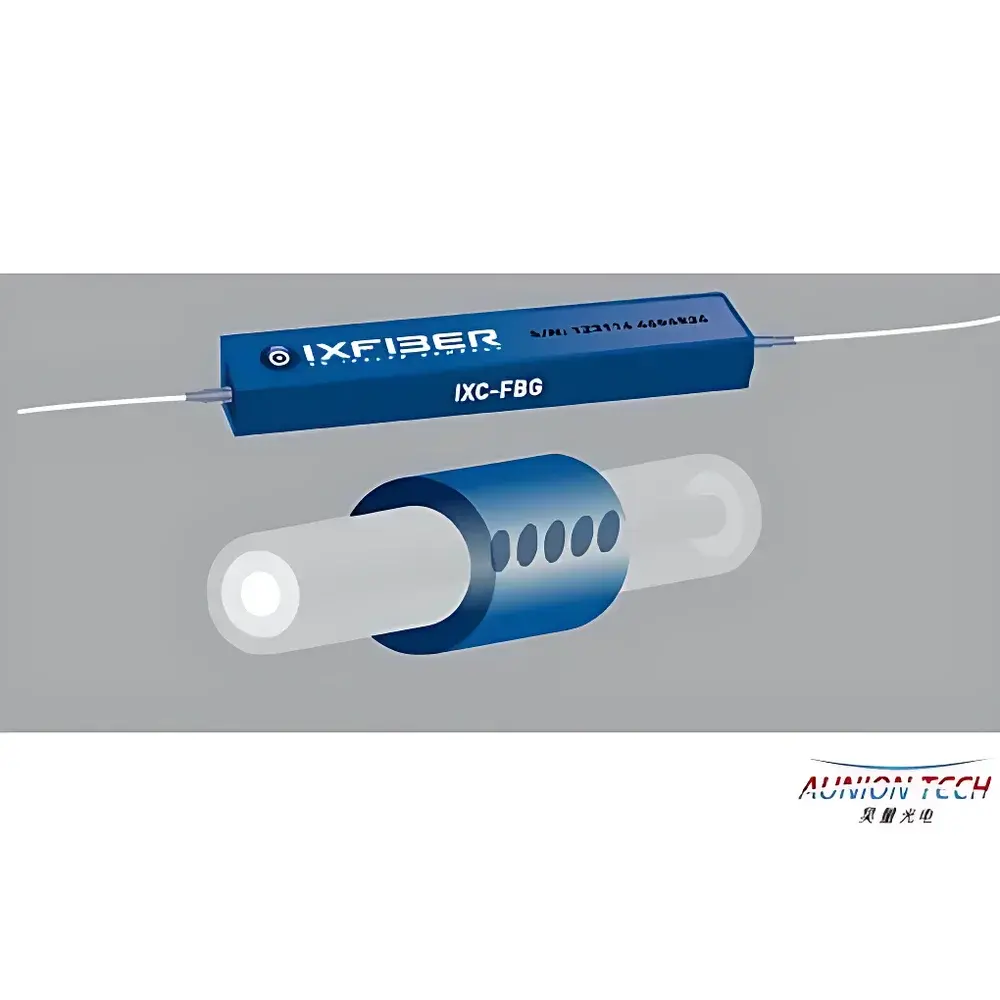
Ixblue Photonics FBG Laser Cavity Mirror for High-Power Fiber Lasers
| Brand | Ixblue Photonics |
|---|---|
| Origin | France |
| Product Type | Fiber Bragg Grating (FBG) Device |
| Wavelength Range | 400–2100 nm |
| Reflectivity | 3%–99.9% |
| 3-dB Bandwidth | 0.1–1.5 nm |
| Fiber Type | Single-Mode or Double-Clad |
| Packaging | Thermally Optimized Passive Mounting |
| Pump-Handling Capability | Integrated Pump-Redirect Coating |
| Coating Compatibility | Up to 400 µm Jacket Diameter |
| Residual Pump Absorption | Engineered for Low Thermal Load |
Overview
The Ixblue Photonics FBG Laser Cavity Mirror is a precision-engineered fiber-optic component designed specifically for use as a high-finesse, wavelength-selective reflector in high-power continuous-wave (CW) and pulsed fiber laser resonators. Based on the principle of periodic refractive index modulation inscribed via UV interferometric exposure into the core of photosensitive silica fiber, the FBG functions as a distributed Bragg reflector—providing narrowband, highly stable reflection at a precisely defined central wavelength (λB). Unlike bulk dielectric mirrors, FBGs offer intrinsic mode-matching with the guided fundamental mode, eliminating spatial misalignment losses and enabling diffraction-limited beam quality retention. This device is not a generic optical filter but a core cavity element engineered for thermal stability, polarization-maintaining compatibility (where applicable), and long-term reliability under multi-hundred-watt optical power loads typical of industrial and scientific ytterbium-, erbium-, and thulium-doped fiber laser systems.
Key Features
- Thermally robust packaging architecture developed by Ixblue Photonics for minimal wavelength drift (<0.5 pm/°C typical) under sustained high-power operation
- Customizable Bragg wavelength across 400–2100 nm, including standard laser lines: 1030 nm, 1053 nm, 1064 nm, 1070/1080 nm (Yb-band); 1550 nm, 1560 nm (Er-band); and 1908 nm, 1940 nm, 1950 nm, 2000 nm, 2050 nm (Tm/Ho-band)
- Reflectivity tunable from 3% to 99.9% with ±0.2% absolute tolerance, optimized for specific cavity Q-factor and output coupling requirements
- 3-dB spectral bandwidth controllable between 0.1 nm and 1.5 nm—enabling narrow-linewidth oscillation or broader gain-narrowing control
- Available on both single-mode (SMF-28, HI1060) and double-clad (DC1000, GTWave) fiber substrates with low NA and high damage threshold
- Integrated pump-guiding coating options for cladding-pumped architectures, allowing efficient residual pump light management without external dichroics
- Fully passive assembly—no epoxy bonding in the grating region; all mechanical interfaces utilize hermetic metal-ceramic housings compliant with MIL-STD-883 thermal cycling protocols
Sample Compatibility & Compliance
This FBG mirror is qualified for integration into Class 4 laser systems operating under IEC 60825-1:2014 and EN 60825-1:2014 safety standards. Its design conforms to ISO 10110-7 for surface quality specifications and meets Telcordia GR-1221-CORE mechanical reliability requirements for fiber-optic components. The thermally optimized package ensures compliance with long-term operational stability mandates under GLP-compliant laser development environments. While not an end-product medical device, it supports laser sources used in FDA-cleared applications—including dermatology, material processing, and spectroscopic sensing—where traceable optical performance and batch-controlled manufacturing are required. All devices undergo 100% spectral verification using NIST-traceable optical spectrum analyzers (OSAs) and high-resolution tunable lasers calibrated per ISO/IEC 17025-accredited procedures.
Software & Data Management
Each FBG device is supplied with a unique serial-numbered test report containing full spectral characterization: λB, peak reflectivity, side-lobe suppression ratio (>15 dB), 3-dB and 10-dB bandwidths, group delay ripple (<0.5 ps), and temperature-induced wavelength shift over −5°C to +70°C. Raw OSA data files (.s1p, .csv) are provided upon request for integration into automated laser modeling workflows (e.g., RP Fiber Power, MATLAB-based cavity simulations). Ixblue Photonics maintains full traceability records—including inscription parameters, annealing history, and environmental stress screening logs—for ≥10 years, supporting audit readiness for ISO 9001:2015 and AS9100D quality system certifications.
Applications
- High-power Yb-doped fiber laser cavities (1–2 kW CW, MOPA and oscillator configurations)
- Narrow-linewidth seed sources for coherent beam combining and frequency conversion
- Resonant pumping schemes in Er/Yb co-doped and Tm-doped fiber amplifiers
- Stabilized frequency references in metrology-grade fiber oscillators
- Industrial marking, cutting, and welding systems requiring >10,000-hour mean time between failures (MTBF)
- Scientific ultrafast amplifier front-ends where dispersion compensation and spectral filtering are integrated into the cavity
FAQ
What is the maximum average power this FBG can withstand in continuous-wave operation?
Standard versions are rated for up to 500 W in free-space coupled, collimated configurations; custom heat-sink-integrated packages support >1 kW with active cooling. Power handling depends on fiber type, coating integrity, and mounting interface thermal resistance.
Can the FBG be spliced directly to active gain fiber without degradation?
Yes—devices are delivered with cleaved and angle-polished ends compatible with fusion splicing using commercial arc fusion splicers. Post-splice insertion loss is typically <0.05 dB when aligned to SMF-28 or matching double-clad fibers.
Do you provide phase-mask or apodization profiles for specialized spectral shaping?
Yes—custom apodization (e.g., Gaussian, raised-cosine), chirped, or sampled FBG designs are available under NDA, supporting complex cavity dynamics such as multi-wavelength lasing or dispersion-managed pulse formation.
Is there a version qualified for space or aviation environments?
Ixblue Photonics offers radiation-hardened variants meeting ECSS-Q-ST-60-13C and MIL-PRF-29504/51 specifications, including extended vibration testing (5–2000 Hz, 14.7 g RMS) and outgassing compliance per ASTM E595.
How is wavelength calibration performed and traceable?
All units are measured against a stabilized HeNe laser reference (632.8 nm) and a calibrated wavemeter (Bristol 621A, ±0.0001 nm accuracy), with uncertainty budgets documented per GUM (JCGM 100:2008) and reported in the certificate of conformance.




