
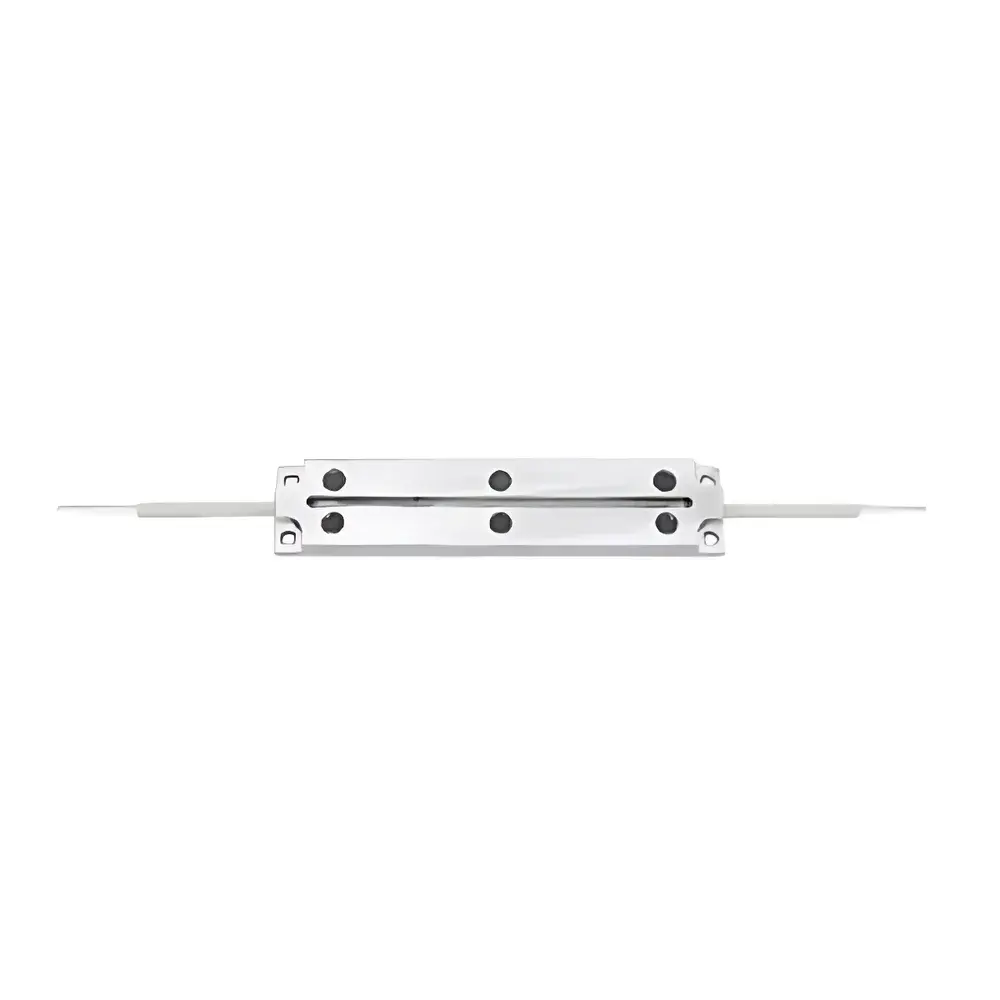
Ixblue Rad Hard FBG (Radiation-Hardened Fiber Bragg Grating)
| Brand | Ixblue / Ixblue Photonics |
|---|---|
| Origin | France |
| Manufacturer Type | Authorized Distributor |
| Product Category | Imported Optical Component |
| Model | Radiation-Hardened Fiber Bragg Grating (Rad Hard FBG) |
| Component Type | Passive Optical Element |
| Radiation Tolerance | Up to 10 MGy (γ), 63 MeV protons, ~5×10¹⁹ n/cm² neutrons |
| Operating Temperature | Up to 350 °C |
| Spectral Stability | <1 pm wavelength shift under combined radiation & thermal stress |
| Radiation-Induced Attenuation (RIA) | ≤150 dB/km after 10 MGy γ-dose |
Overview
The Ixblue Rad Hard FBG (Radiation-Hardened Fiber Bragg Grating) is a passively athermalized, ultra-stable optical component engineered for precision wavelength-selective functions and distributed or quasi-distributed sensing in extreme ionizing radiation environments. Unlike standard FBGs fabricated on telecom-grade silica fiber, the Rad Hard FBG is inscribed directly into proprietary Ixblue low-radiation-induced-attenuation (low-RIA) photosensitive fiber—specifically doped and processed to suppress defect formation under prolonged exposure to mixed-field radiation (X-rays, γ-rays, fast neutrons, and high-energy protons). Its operation relies on the fundamental principle of Bragg resonance: a periodic modulation of the core’s refractive index reflects a narrowband wavelength (λB = 2neffΛ), where Λ is the grating period and neff the effective mode index. In radiation-hardened configurations, λB stability is preserved via co-engineering of both fiber composition and UV inscription parameters—ensuring minimal radiation-induced wavelength drift (<1 pm) and spectral broadening even after cumulative doses exceeding 10 MGy (γ) and elevated temperatures up to 350 °C.
Key Features
- Proprietary Ixblue radiation-tolerant photosensitive fiber with RIA ≤150 dB/km after 10 MGy γ-irradiation
- Fabricated using phase-mask or point-by-point femtosecond laser inscription to ensure reproducible grating uniformity and side-lobe suppression
- Thermally stabilized design minimizing thermo-optic and radiation-induced thermo-mechanical drift
- Validated performance under multi-parameter stress: simultaneous high-dose irradiation (γ, protons, neutrons) and sustained high temperature (up to 350 °C)
- High reflectivity (>90%) and low insertion loss (<0.5 dB) across C- and L-bands (1520–1620 nm), configurable per application requirement
- Hermetically packaged variants available for long-term vacuum compatibility (e.g., space qualification per ECSS-Q-ST-70-08C)
Sample Compatibility & Compliance
The Rad Hard FBG is compatible with standard single-mode fiber pigtails (SMF-28e+, HI1060, or radiation-hardened alternatives) and integrates seamlessly into existing fiber-optic interrogation systems (e.g., tunable-laser-based or interferometric demodulators). It meets stringent environmental compliance benchmarks required for nuclear, aerospace, and high-energy physics applications: qualification testing aligns with ASTM E1249 (standard practice for radiation effects testing of optical fibers), ISO/IEC 61290-1-3 (optical amplifier test methods), and ESA/SCC Basic Specification No. 22900 (radiation hardness assurance for space optics). For nuclear instrumentation, it supports IEC 60584-2 (thermocouple reference tables) traceability when used in calibrated temperature-sensing configurations. All devices undergo full lot-level radiation exposure screening and post-irradiation spectral characterization per MIL-STD-883H Method 1019.8.
Software & Data Management
While the Rad Hard FBG itself is a passive optical element, its integration into measurement systems benefits from standardized data handling protocols. When deployed with Ixblue’s FOG-based or third-party FBG interrogation units (e.g., Micron Optics sm130, HBM FiberSensing FS22), raw wavelength shift data is acquired at sampling rates up to 10 kHz and logged in IEEE 1451.4-compliant TEDS format. Full audit trails—including calibration history, radiation exposure logs, and thermal cycling records—are maintained in accordance with GLP and GMP principles. Optional firmware updates support 21 CFR Part 11-compliant electronic signatures and role-based access control for regulated nuclear or medical physics installations.
Applications
- Real-time temperature and strain monitoring inside tokamak vacuum vessels and blanket modules (ITER-relevant deployment)
- Wavelength-stabilized pump lasers and cavity mirrors in radiation-exposed accelerator beamlines
- Distributed thermal profiling in nuclear reactor cores and spent fuel pool monitoring systems
- Structural health monitoring of satellite optical benches and deployable solar array hinges exposed to proton fluence >63 MeV
- Reference gratings for radiometric calibration of spaceborne spectrometers (e.g., Earth observation missions requiring sub-picometer spectral stability over 15-year lifetimes)
- Embedded sensing in high-radiation zones of particle detectors (ATLAS, CMS upgrades) where EMI immunity and galvanic isolation are mandatory
FAQ
What radiation dose levels are validated for long-term operation?
The Rad Hard FBG is qualified for continuous operation at total ionizing doses up to 10 MGy (γ), 63 MeV proton fluences up to 1×10¹⁵ p/cm², and neutron fluences up to 5×10¹⁹ n/cm² (E > 0.1 MeV), with spectral degradation monitored per IEC 62729.
Can these FBGs be multiplexed in series on a single fiber?
Yes—standard WDM multiplexing with channel spacing ≥1.6 nm is supported; custom apodized designs enable dense arrays (>20 gratings/fiber) with crosstalk <−40 dB.
Is temperature compensation integrated into the grating structure?
No intrinsic compensation is built in; however, dual-grating configurations (one Rad Hard FBG + one radiation-insensitive reference) are routinely implemented for drift-corrected measurements.
Are mechanical packaging options available for harsh vibration environments?
Yes—hermetic metal-ceramic housings (MIL-STD-810G shock/vibe qualified) and polyimide-coated bare-fiber variants are offered per customer mechanical interface requirements.
Does Ixblue provide calibration certificates traceable to national standards?
Each device ships with a NIST-traceable calibration report covering initial Bragg wavelength, bandwidth, reflectivity, and post-irradiation verification data at specified dose points.




