
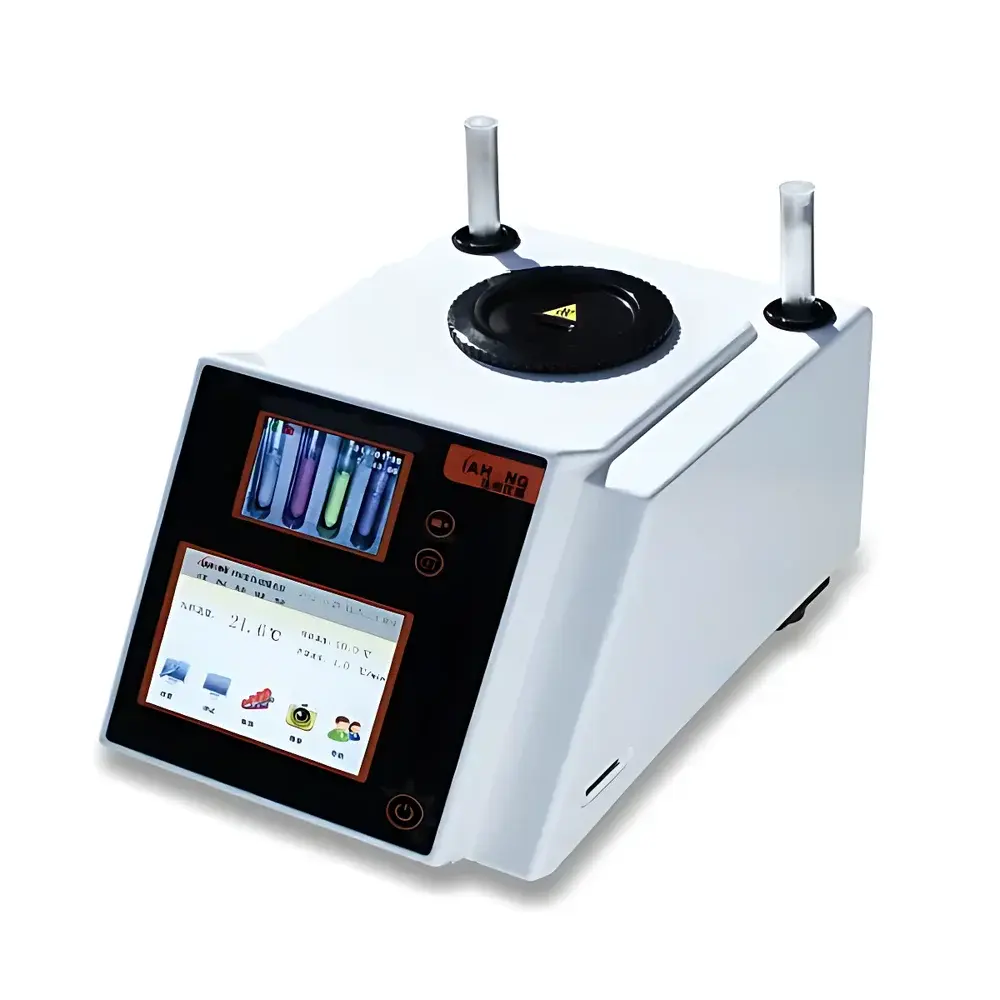
J30 Video Melting Point Apparatus
| Origin | Shanghai, China |
|---|---|
| Manufacturer Type | Authorized Distributor |
| Origin Category | Domestic (PRC) |
| Model | J30 |
| Price | USD 1,650 (FOB Shanghai) |
| Temperature Range | Ambient to 350 °C |
| Heating Rate | 0.1–20 °C/min (200-step continuous adjustment) |
| Temperature Repeatability | ±0.1 °C at 0.1 °C/min |
| Temperature Accuracy | ±0.3 °C (<250 °C), ±0.5 °C (≥250 °C) |
| Capillary Dimensions | OD 1.4 mm, ID 1.0 mm |
| Sample Capacity | 4 positions |
| Temperature Resolution | 0.1 °C |
| Display | 7-inch TFT true-color LCD |
| Data Storage | 200 test records (8 GB internal flash) |
| Video Magnification | 7× |
| Interface | USB 2.0, RS-232, 10/100 Mbps Ethernet |
| Power Supply | 220 V AC, 50 Hz, 120 W |
Overview
The J30 Video Melting Point Apparatus is a precision thermal analysis instrument engineered for accurate, repeatable, and visually verifiable determination of melting points and melting ranges in solid organic compounds. Unlike traditional capillary-based systems relying on subjective visual detection through optical eyepieces, the J30 integrates high-resolution real-time video capture with programmable Peltier-controlled heating. It operates on the principle of controlled thermal ramping while optically monitoring phase transition onset and completion—enabling unambiguous identification of initial softening, meniscus formation, collapse, and full liquefaction. This dual-mode capability (temperature + synchronized video evidence) supports method validation, operator training, and regulatory documentation requirements common in pharmaceutical development, quality control laboratories, and academic research settings where traceability and observational fidelity are critical.
Key Features
- Real-time 7× digital optical magnification with high-definition video recording and playback—eliminates observer bias and enables retrospective analysis of melt progression.
- Simultaneous four-channel independent sample processing with individual capillary positioning—increases throughput without cross-contamination risk.
- Ultra-fine heating rate control (0.1–20 °C/min, adjustable in 0.1 °C/min increments across 200 discrete steps) ensures compliance with pharmacopoeial methods (e.g., USP <741>, EP 2.2.17, JP 2.60).
- Precision temperature regulation using PID-controlled Peltier modules achieves ±0.1 °C repeatability under standardized 0.1 °C/min ramp conditions and maintains accuracy within ±0.3 °C up to 250 °C (±0.5 °C up to 350 °C).
- Integrated 7-inch TFT true-color touchscreen interface with intuitive navigation—supports rapid method setup, real-time parameter monitoring, and on-device result review.
- Robust data management architecture: stores up to 200 complete test records (including timestamped video clips, temperature curves, and operator metadata) on 8 GB embedded flash memory.
- Standard industrial connectivity suite: USB 2.0 host/device, RS-232 serial port, and 10/100 Mbps Ethernet—facilitates integration into LIMS environments and automated report generation.
Sample Compatibility & Compliance
The J30 accepts standard thin-wall glass capillaries (OD 1.4 mm, ID 1.0 mm), compatible with powdered, crystalline, granular, or small solid fragments (≤2 mm). Optional molten-sample adapters support evaluation of viscous melts or low-melting polymers. The system meets core design and performance criteria referenced in ISO 11357-3 (Plastics — Differential Scanning Calorimetry — Part 3: Determination of melting temperature and enthalpy of fusion) and aligns with general principles outlined in ASTM E324 (Standard Test Methods for Melting Point of Organic Solids). While not certified for GMP production environments out-of-the-box, its audit-ready data structure—including time-stamped video logs, user-assigned test IDs, and immutable storage—supports GLP-compliant workflows and FDA 21 CFR Part 11 readiness when deployed with validated networked software extensions.
Software & Data Management
Local operation requires no external PC; all calibration, method definition, acquisition, and review occur natively on the device. Test records include date/time stamp, heating rate, peak onset/offset temperatures, observed melt morphology notes (user-entered), and compressed MP4 video segments (max 60 s per sample). Data export via USB or Ethernet supports CSV-formatted results and bundled video archives for traceable reporting. Firmware updates are delivered via signed binary packages over secure HTTPS channels. No cloud dependency or proprietary runtime environment is required—ensuring long-term operational continuity and IT security compliance in regulated facilities.
Applications
- Pharmaceutical R&D and QC: Identity verification of active pharmaceutical ingredients (APIs), excipient characterization, polymorph screening, and stability-indicating assay development.
- Chemical synthesis labs: Reaction endpoint confirmation, purity assessment (via melting range depression), and batch-to-batch consistency checks for fine chemicals and intermediates.
- Academic teaching: Visual demonstration of eutectic behavior, solid solution formation, and kinetic vs. thermodynamic melting phenomena.
- Food & flavor chemistry: Melting profile analysis of fats, waxes, cocoa butter analogs, and encapsulated aroma compounds.
- Materials science: Thermal transition mapping of organic semiconductors, metal-organic frameworks (MOFs), and supramolecular gels.
FAQ
Is the J30 compliant with pharmacopoeial standards such as USP <741> or EP 2.2.17?
Yes—the instrument’s programmable heating rates, temperature accuracy specifications, and documented repeatability meet the technical requirements for apparatus qualification under these monographs.
Can video recordings be exported and archived externally?
Yes—recordings and associated metadata are exportable via USB drive or network transfer in standard MP4 and CSV formats, supporting long-term archival and electronic record retention policies.
Does the system support multi-user access control or electronic signatures?
Not natively; however, its structured data output and time-stamped audit trail enable integration with third-party LIMS or ELN platforms that provide role-based authentication and 21 CFR Part 11-compliant electronic signature capabilities.
What capillary types are recommended for optimal optical clarity?
Standard wall or thin-wall borosilicate capillaries (1.4 mm OD × 1.0 mm ID) with polished ends yield highest contrast and minimal refraction distortion under 7× magnification.
Is routine calibration traceable to national standards?
Calibration is performed using NIST-traceable reference materials (e.g., pure indium, tin, lead, and bismuth standards); certificate of calibration can be issued upon request with uncertainty budget per ISO/IEC 17025 guidelines.



