
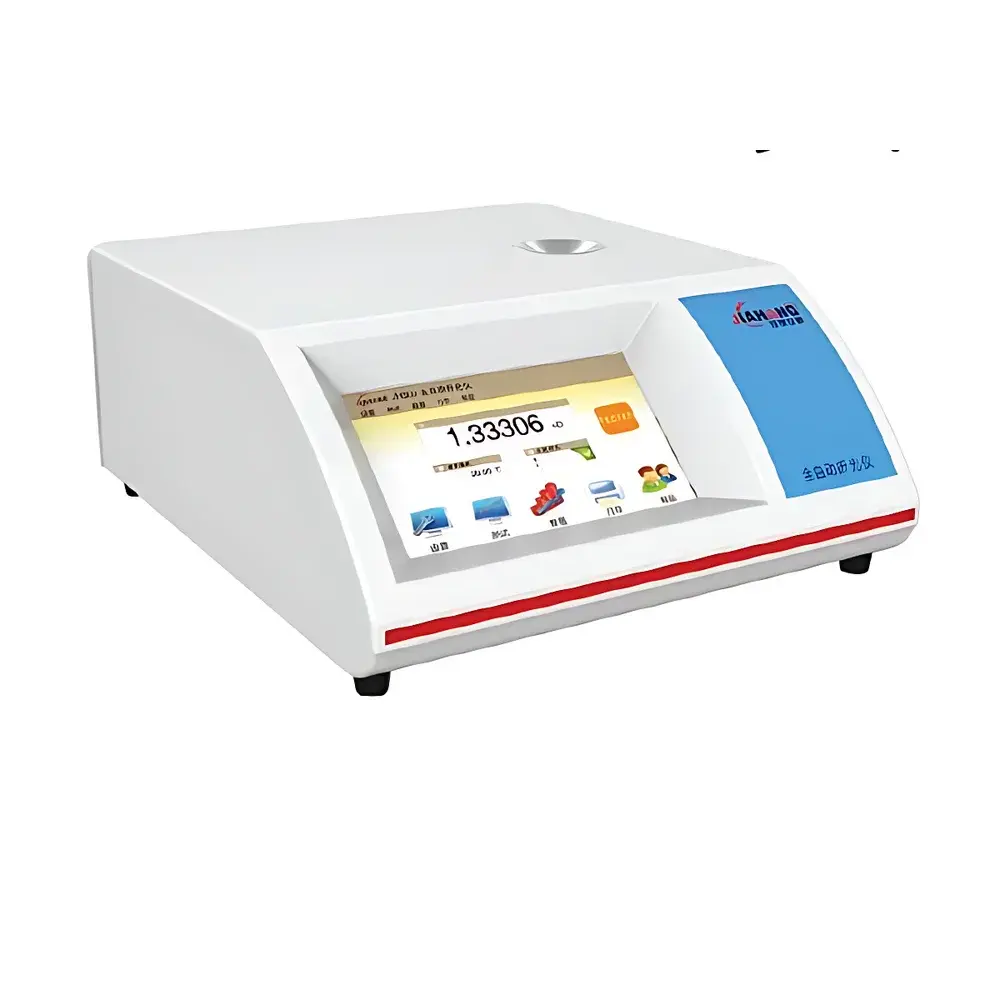
J300 Automated Digital Refractometer
| Origin | Shanghai, China |
|---|---|
| Manufacturer Type | Authorized Distributor |
| Origin Category | Domestic (China) |
| Model | J300 |
| Price Range | USD 2,100–7,000 |
| Instrument Type | Benchtop Refractometer |
| Temperature Control | Peltier-based |
| Digital Display | Yes |
| Refractive Index Range | 1.3000–1.7000 (nD) |
| Refractive Index Accuracy | ±0.0002 |
| Brix Range | 0–100% |
| Brix Accuracy | ±0.1% |
| Temperature Control Range | 5–65 °C |
| Temperature Stability | ±0.03 °C |
| Light Source | LED (589 nm) |
| Prism Material | Sapphire-grade |
| Sample Cell | Stainless Steel |
| Detection Method | Linear CCD Array |
| Display | 7-inch TFT Color Touchscreen |
| Interface | USB + RS-232 |
| Power Supply | 220 V / 50 Hz |
Overview
The J300 Automated Digital Refractometer is a precision benchtop optical instrument engineered for high-reproducibility measurement of refractive index (nD) and mass fraction of aqueous sucrose solutions (Brix %) across diverse industrial and academic laboratories. It operates on the principle of total internal reflection at the prism–sample interface, where a collimated 589 nm LED light beam—matching the sodium D-line wavelength standard—is directed onto a sapphire-grade prism surface. The critical angle of reflection is detected with sub-pixel resolution by a high-sensitivity linear CCD array, enabling real-time digitization of the shadow boundary between light and dark regions in the image plane. This optical geometry, combined with active Peltier temperature stabilization (±0.03 °C), ensures compliance with ISO 21747:2020 (Refractometers — Performance requirements and test methods) and supports traceable, temperature-compensated measurements per ASTM D1218 and USP .
Key Features
- Sapphire-grade prism assembly: Chemically inert, scratch-resistant optical interface rated for repeated exposure to aggressive solvents, viscous oils, and abrasive suspensions without degradation in calibration integrity.
- Dual-zone Peltier thermal control system: Independently regulates both prism block and sample chamber temperature within 5–65 °C range, minimizing thermal gradients and enabling strict adherence to standardized test conditions (e.g., 20 °C or 25 °C per ISO 2859).
- High-resolution linear CCD sensor: 2048-pixel array with 12-bit analog-to-digital conversion delivers stable signal-to-noise ratio (>72 dB) and enables detection limit refinement down to ΔnD = 1×10⁻⁴.
- 7-inch capacitive touchscreen interface: Intuitive TFT display with multi-language support (English, German, French, Spanish, Chinese), onboard method storage (≥100 user-defined protocols), and real-time graphical trend logging.
- Benchtop robustness and regulatory readiness: All-metal housing with IP20-rated enclosure; dual communication ports (USB 2.0 + RS-232) support integration into LIMS environments and audit-trail-capable data export compliant with FDA 21 CFR Part 11 requirements when paired with validated software.
Sample Compatibility & Compliance
The J300 accommodates transparent, translucent, deeply colored, and moderately viscous liquid samples—including crude oil fractions, pharmaceutical syrups, polymer solutions, essential oils, and molasses—without requiring dilution or filtration. Its stainless-steel sample cell (1.5 mL volume) resists corrosion from organic solvents and acidic/basic formulations. Calibration verification follows NIST-traceable standards (e.g., certified sucrose solutions and bromonaphthalene reference fluids). The instrument meets GLP/GMP documentation requirements through timestamped, operator-ID-tagged measurement records and configurable electronic signature workflows. It is routinely deployed in QC labs operating under ISO/IEC 17025 accreditation frameworks and supports validation protocols aligned with ICH Q2(R2) for analytical method verification.
Software & Data Management
Embedded firmware supports direct data export in CSV and PDF formats via USB flash drive or serial connection. Optional PC software (J300Link v3.2) provides advanced features including automated calibration curve generation, statistical process control (SPC) charting, batch report compilation, and secure user role management (admin/operator/auditor tiers). All measurement events—including calibration actions, parameter changes, and manual overrides—are logged with immutable timestamps and digital signatures. Audit trail functionality satisfies FDA 21 CFR Part 11 Subpart B requirements for electronic records and signatures when configured with time-synchronized network authentication.
Applications
- Food & Beverage: Rapid Brix quantification in fruit juices, dairy concentrates, honey, and soft drink syrups; quality control of jam consistency and sugar recovery efficiency in beet/cane processing.
- Pharmaceuticals: Excipient concentration monitoring in oral suspensions and syrup formulations; osmolality estimation via nD-Brix correlation during stability studies.
- Petroleum & Lubricants: Hydrocarbon blend verification, solvent purity assessment, and additive concentration tracking in base oils and greases.
- Chemical Manufacturing: Reaction endpoint detection in esterification processes; concentration monitoring of glycols, ethanol/water mixtures, and caustic soda solutions.
- Academic Research: Teaching optics and physical chemistry principles; supporting graduate-level projects in colloidal science, polymer solution thermodynamics, and biophysical characterization.
FAQ
What refractive index standard does the J300 use for calibration?
The instrument uses the internationally recognized sodium D-line (589.3 nm) as its optical reference wavelength, consistent with ISO 17025-accredited calibration practices and traceable to NIST SRM 1484 (refractive index standards).
Can the J300 measure samples with suspended solids or high turbidity?
It is optimized for homogeneous liquids. Samples with significant particulate load (>0.5 µm particle size or >5% w/v solids) may require centrifugation or filtration prior to analysis to avoid scattering-induced edge detection errors.
Is temperature compensation applied automatically during Brix calculation?
Yes—temperature-dependent Brix conversion employs the ICUMSA polynomial model (1994 revision), with real-time correction applied using the measured prism temperature and built-in density–concentration lookup tables.
Does the J300 support external printer output?
Direct thermal or inkjet printing is supported via RS-232 with ESC/POS or PCL command sets; PDF reports generated on connected PCs can be routed to any Windows-compatible printer.
What maintenance is required for long-term accuracy?
Daily prism cleaning with lint-free wipes and spectroscopic-grade ethanol; annual verification against certified reference materials; biannual inspection of Peltier module thermal interface paste integrity.





