
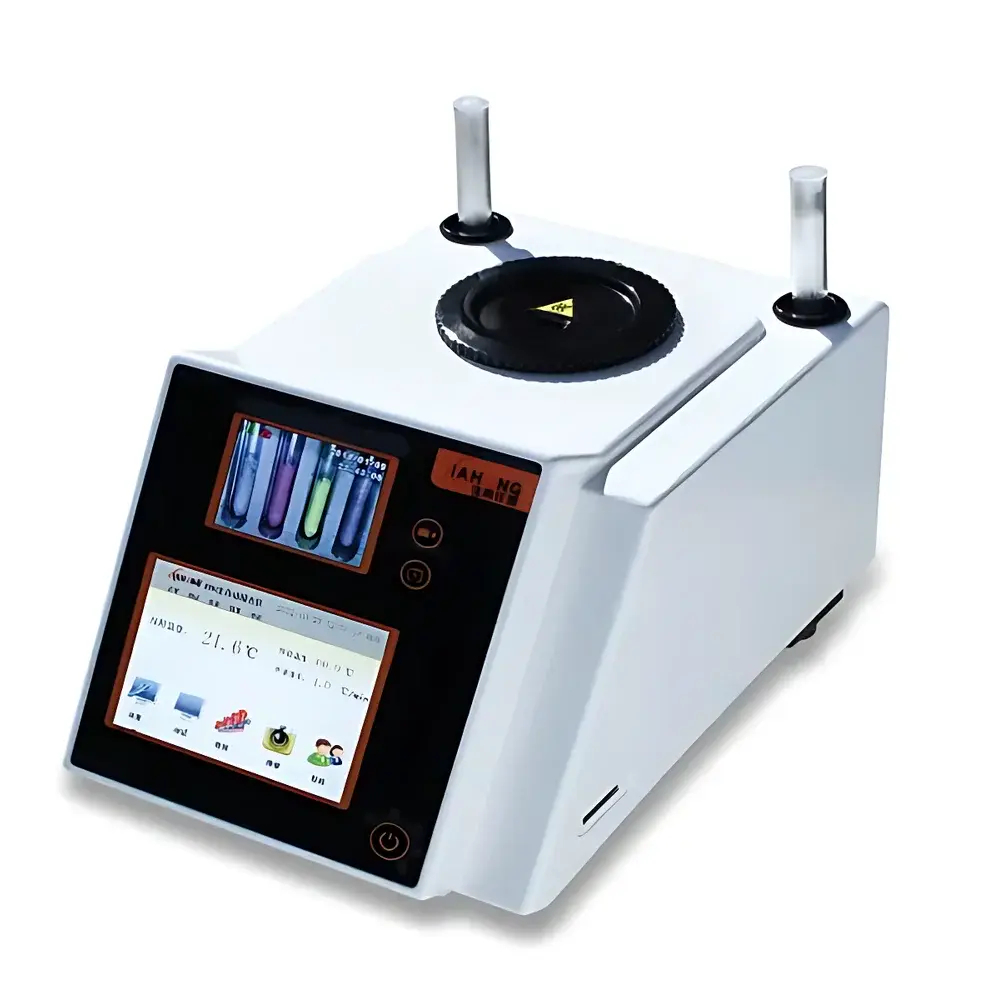
J50 Video Melting Point Apparatus
| Origin | Shanghai, China |
|---|---|
| Manufacturer Type | Authorized Distributor |
| Origin Category | Domestic (PRC) |
| Model | J50 |
| Price Range | USD 7,000–14,000 |
| Temperature Range | Ambient to 400 °C |
| Heating Rate | 0.1–20 °C/min (200-step continuous adjustment) |
| Temperature Repeatability | ±0.1 °C at 0.1 °C/min |
| Temperature Accuracy | ±0.3 °C (<250 °C), ±0.5 °C (>250 °C) |
| Capillary Dimensions | OD 1.4 mm, ID 1.0 mm |
| Sample Capacity | 4 samples per run |
| Temperature Resolution | 0.1 °C |
| Storage | 8 GB internal flash memory |
| Data Storage Capacity | Up to 400 melting thermograms |
| Imaging | HD video capture module with 7× optical magnification |
| Display | TFT high-definition color touchscreen |
| Power Supply | 220 V AC, 50 Hz, 120 W |
| Interfaces | USB, RS-232, Ethernet |
| Operation Mode | Semi-automatic (automated temperature control, manual endpoint detection) |
Overview
The J50 Video Melting Point Apparatus is a semi-automated thermal analysis instrument engineered for precise determination of melting point and melting range (melting interval) of crystalline organic solids. It operates on the principle of controlled heating under direct visual observation via high-resolution digital video imaging—replacing conventional ocular microscopy with real-time, frame-capturable video monitoring. This architecture enables unambiguous identification of onset, meniscus movement, collapse, and complete liquefaction stages during thermal transition. Designed for compliance with pharmacopeial standards—including USP <741>, EP 2.2.17, and JP 2.60—the J50 delivers traceable, auditable results suitable for QC laboratories operating under GLP or GMP frameworks. Its ambient-to-400 °C temperature range accommodates both low-melting pharmaceutical actives and high-melting polymers or metal-organic frameworks, while its 0.1 °C resolution and calibrated accuracy support method validation per ICH Q5C and ISO 11357-3.
Key Features
- Real-time HD video capture (7× optical magnification) with synchronized timestamped thermal profiling—enabling retrospective review of morphological changes during melting
- Simultaneous four-channel sample processing using standardized 1.4 mm OD / 1.0 mm ID capillaries, minimizing inter-run variability through uniform thermal mass loading
- Programmable heating rate from 0.1 to 20 °C/min in 200 discrete steps, supporting both rapid screening and slow-rate pharmacopeial methods (e.g., 1 °C/min per USP)
- TFT full-color touchscreen interface with intuitive workflow navigation, offline data browsing, and embedded playback controls for captured video sequences
- Integrated 8 GB flash storage supporting up to 400 complete thermograms with associated video clips, metadata, and operator annotations
- Multi-interface connectivity (USB, RS-232, Ethernet) for LIMS integration, remote firmware updates, and secure data export in CSV and MP4 formats
- Thermal calibration traceable to NIST-traceable reference standards, with documented accuracy verification across three points (50 °C, 150 °C, 300 °C)
Sample Compatibility & Compliance
The J50 accepts standard glass capillaries conforming to ASTM E324 and ISO 6329 specifications. It supports powdered, granular, and small solid fragments (≤3 mm); optional melt-cell accessories enable testing of viscous melts or hygroscopic materials requiring sealed environment handling. All thermal profiles are logged with audit trail metadata—including operator ID, date/time stamp, heating protocol, and capillary batch number—satisfying FDA 21 CFR Part 11 requirements when paired with validated user management (8 configurable accounts with role-based access). Instrument qualification documentation (DQ/IQ/OQ) templates are provided to support laboratory validation against ISO/IEC 17025 and WHO TRS 986 Annex 4 guidelines.
Software & Data Management
Data acquisition and visualization are handled by embedded firmware with no external PC dependency. Each test generates a structured record containing: (1) time-temperature curve with annotated melting onset/offset points, (2) compressed MP4 video file (H.264, 1280×720 @ 30 fps), (3) raw thermal sensor readings at 0.5-second intervals, and (4) operator-entered sample ID and batch information. Exported datasets include embedded checksums for integrity verification. The system supports CSV export for statistical analysis in JMP or Minitab, and MP4 files are compatible with common digital lab notebook platforms (e.g., LabArchives, Benchling). Firmware versioning and change logs are retained internally for regulatory inspection readiness.
Applications
- Pharmaceutical QC: Identity confirmation and purity assessment of APIs and excipients per USP monographs
- Chemical synthesis: Reaction endpoint monitoring and intermediate characterization in fine chemical R&D
- Food safety labs: Detection of adulteration in fats, waxes, and cocoa butter equivalents
- Academic research: Polymorph screening, eutectic behavior mapping, and thermal stability ranking of novel crystalline materials
- Regulatory submission support: Generation of compliant melting data packages for ANDA, NDA, and CMC sections
- Materials science: Characterization of organic semiconductors, MOFs, and co-crystal systems where narrow melting ranges indicate phase homogeneity
FAQ
Is the J50 compliant with pharmacopeial melting point test methods?
Yes—it meets the instrumental requirements of USP <741>, EP 2.2.17, and JP 2.60, including specified heating rate control, temperature accuracy, and visual observation capability.
Can video recordings be exported and archived externally?
Yes—via USB drive or network transfer in MP4 format with embedded timecode and thermal metadata; files retain original resolution and synchronization fidelity.
What calibration standards are recommended for routine verification?
NIST SRM 742a (indium, mp 156.598 °C), SRM 720e (tin, mp 231.928 °C), and SRM 746a (zinc, mp 419.527 °C) are recommended for three-point verification across the operating range.
Does the system support multi-user environments with audit trails?
Yes—eight configurable user accounts with password protection, session logging, and immutable record timestamps satisfy 21 CFR Part 11 electronic record requirements when used with enabled security settings.
How is temperature uniformity ensured across all four sample positions?
Each capillary well is individually thermally coupled to a precision Peltier-controlled heating block with distributed platinum RTD sensing; inter-well deviation is ≤±0.2 °C at 200 °C under steady-state conditions.



