
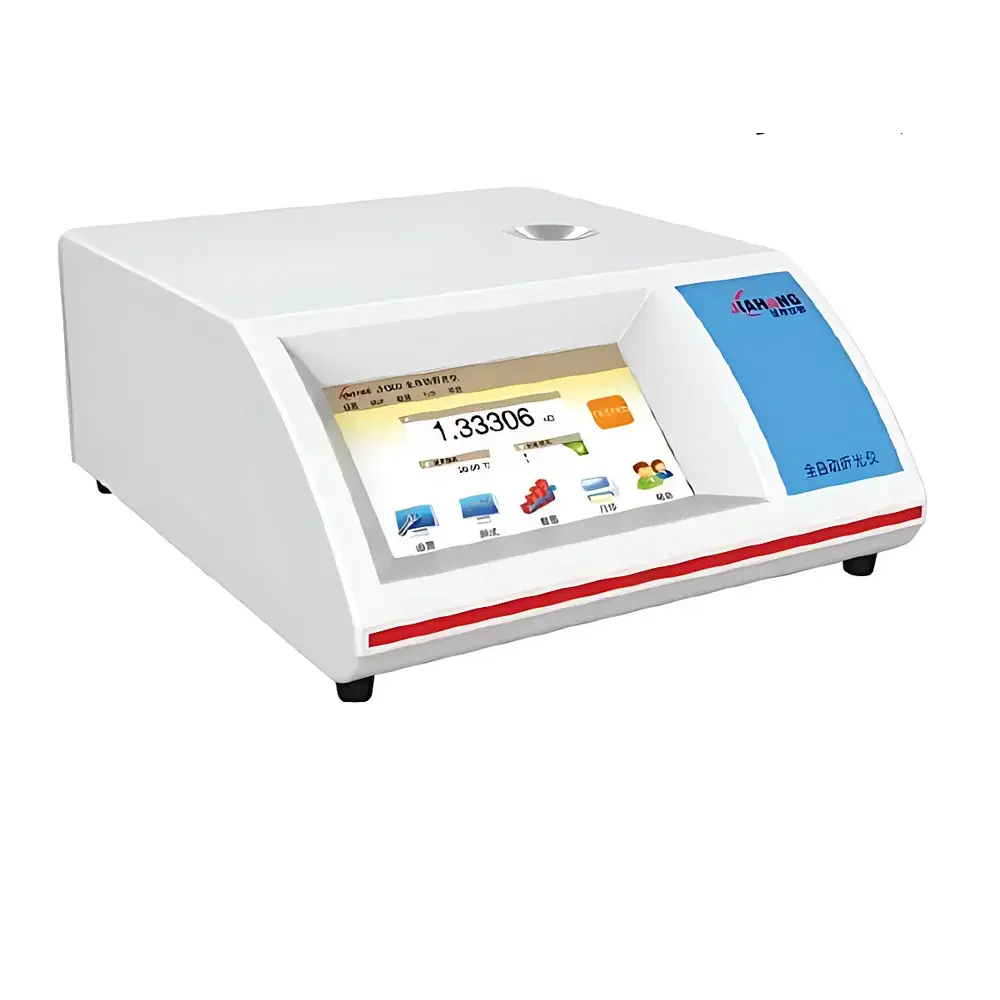
J600 Automated Digital Refractometer
| Origin | Shanghai, China |
|---|---|
| Manufacturer Type | Authorized Distributor |
| Origin Category | Domestic (PRC) |
| Model | J600 |
| Price Range | USD 2,100–7,000 |
| Instrument Type | Benchtop Refractometer |
| Temperature Control | Peltier-based |
| Digital Display | Yes |
| Refractive Index Range | 1.30000–1.70000 (nD) |
| Refractive Index Accuracy | ±0.00002 |
| Brix Range | 0–100.00% |
| Brix Accuracy | ±0.01% |
| Temperature Control Range | 5–90 °C |
| Temperature Stability | ±0.01 °C |
| Light Source | LED (589 nm) |
| Prism Material | Sapphire-grade |
| Sample Cell | Stainless Steel |
| Detector | High-resolution linear CCD array |
| Display | 7-inch TFT color touchscreen |
| Interface | USB + RS-232 |
| Power Supply | 220 V AC / 50 Hz |
Overview
The J600 Automated Digital Refractometer is a precision benchtop instrument engineered for high-reproducibility measurement of refractive index (nD) and Brix concentration in liquid and semi-liquid samples. Based on the principle of total internal reflection at a solid–liquid interface, it employs a fixed-wavelength (589 nm) LED light source aligned with a sapphire-grade prism surface to determine the critical angle of refraction. This optical configuration—combined with real-time signal acquisition via a high-resolution linear CCD sensor—enables sub-micro-level resolution in nD determination. The instrument’s fully automated operation eliminates manual calibration drift and human parallax error, delivering traceable, operator-independent results compliant with fundamental metrological requirements for routine QC and R&D workflows.
Key Features
- Sapphire-grade prism assembly: Provides exceptional scratch resistance, chemical inertness, and long-term optical stability—critical for repeated exposure to aggressive solvents, viscous oils, or abrasive suspensions.
- Peltier-based dual-zone temperature control: Actively regulates both prism and sample chamber temperatures within 5–90 °C, maintaining thermal equilibrium at ±0.01 °C stability—ensuring nD measurements conform to standardized reference conditions (e.g., ASTM D1218, ISO 287, USP <781>).
- High-resolution linear CCD detection system: Captures full angular intensity profiles across the critical edge with >4096-pixel resolution, enabling robust peak-fitting algorithms and minimizing sensitivity to sample turbidity or coloration.
- 7-inch TFT capacitive touchscreen interface: Supports intuitive navigation, multi-language UI (English, German, French, Spanish), configurable measurement protocols, and on-device data review—including trend charts, statistical summaries, and pass/fail thresholds.
- Benchtop architecture with stainless-steel sample cell: Designed for rapid cleaning, minimal carryover, and compatibility with low-volume (≥0.5 mL) or high-viscosity samples without dilution or pre-filtration.
Sample Compatibility & Compliance
The J600 accommodates transparent, translucent, deeply colored, and moderately viscous liquids—including crude oil fractions, glycerin-based formulations, pharmaceutical syrups, fruit concentrates, and polymer solutions—without requiring filtration or solvent dilution. Its optical design mitigates scattering-induced bias common in traditional Abbe-style instruments. All measurement outputs are traceable to NIST-traceable refractive index standards. The system supports GLP-compliant operation through user-accessible audit trails, electronic signatures (via optional software module), and adherence to FDA 21 CFR Part 11 data integrity principles when integrated with validated LIMS or ELN platforms.
Software & Data Management
The J600 includes embedded firmware supporting CSV export via USB or RS-232, with optional PC software (Windows 10/11 compatible) providing advanced functions: method templating, batch report generation (PDF/Excel), SPC charting (X̄–R, Cpk), and automated compliance checks against user-defined specification limits. Data files retain full metadata—including timestamp, operator ID, temperature log, and raw CCD intensity arrays—for retrospective analysis and regulatory review. Exported datasets comply with ASTM E1382 and ISO/IEC 17025 documentation requirements for accredited testing laboratories.
Applications
- Petrochemical QA: Quantification of hydrocarbon blend ratios, solvent purity assessment, and naphtha cut verification per ASTM D1218.
- Pharmaceutical manufacturing: Excipient concentration monitoring (e.g., sucrose, sorbitol), syrup density validation, and cleaning verification in multi-product facilities.
- Food & beverage QC: Brix determination in juice, honey, wine must, and dairy-based emulsions—aligned with AOAC 932.12 and ISO 2173 methodologies.
- Chemical R&D: Real-time monitoring of polymerization reactions, solvent recovery efficiency, and formulation consistency during scale-up.
- Academic research: Teaching optics fundamentals, calibrating spectrophotometric methods, and supporting material science studies involving sol-gel transitions or colloidal stability.
FAQ
What standards does the J600 comply with for refractive index measurement?
It meets core requirements of ASTM D1218, ISO 287, ISO 2173, and USP <781> for instrument performance, temperature control fidelity, and reporting resolution.
Can the J600 measure samples with suspended solids or high turbidity?
It handles mildly turbid or colored liquids effectively due to its CCD-based edge-detection algorithm; however, highly particulate or opaque slurries require centrifugation or filtration prior to analysis.
Is temperature calibration traceable to national standards?
Yes—the integrated Peltier system is factory-calibrated using NIST-traceable thermistors, and users may perform verification with certified reference thermostats per ISO/IEC 17025 Clause 6.5.
Does the instrument support automatic Brix-to-density conversion for non-sucrose solutions?
The base firmware applies standard sucrose-based Brix tables; custom calibration curves can be loaded via PC software for ethanol–water, glycerol, or sodium chloride systems.
What maintenance is required for long-term accuracy?
Annual verification using certified nD reference fluids (e.g., bromonaphthalene, distilled water) is recommended; prism cleaning with lens-grade tissue and reagent-grade ethanol suffices for daily use.



