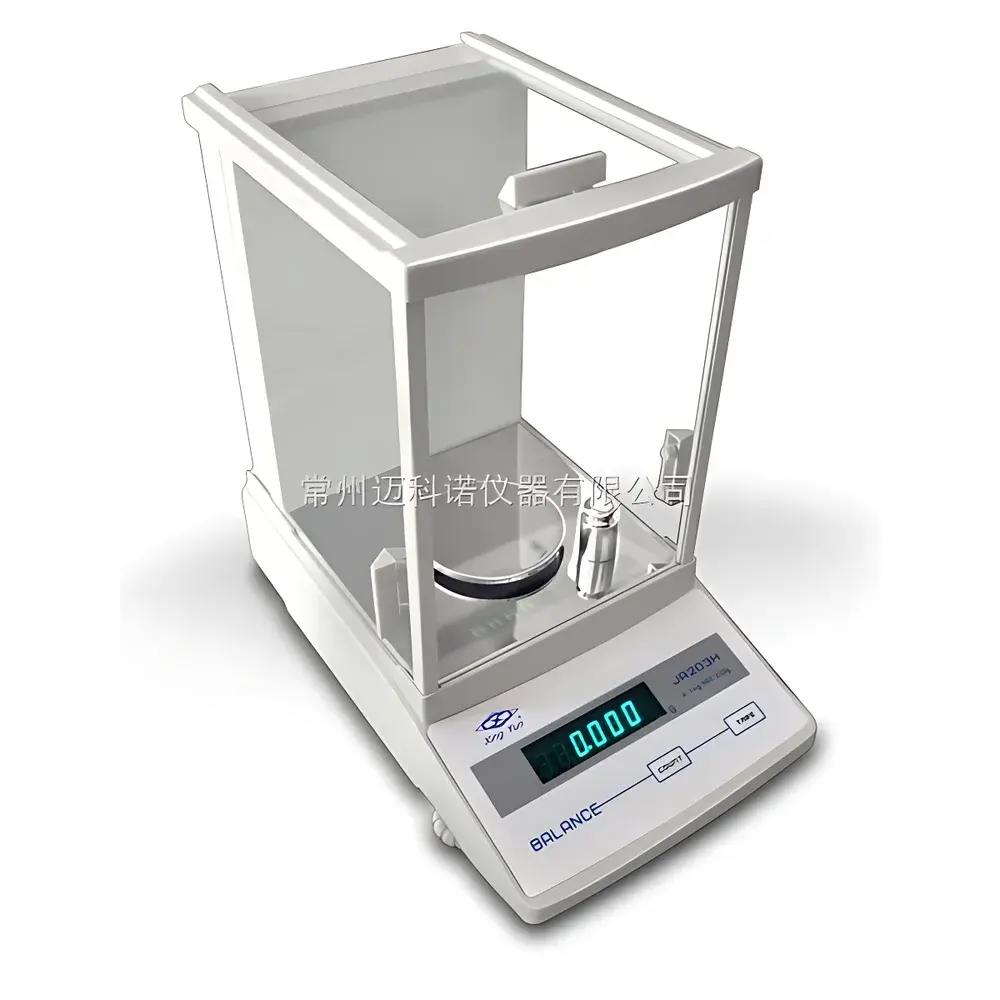
JA103H Analytical Balance
| Origin | Zhejiang, China |
|---|---|
| Manufacturer Type | Distributor |
| Product Origin | Domestic (China) |
| Model | JA103H |
| Price Range | USD 570–700 (FOB) |
| Instrument Type | Precision Analytical Balance |
| Maximum Capacity | 100 g |
| Readability | 0.001 g |
| Repeatability | ±0.001 g |
| Linearity Error | ±0.005 g |
| Stabilization Time | ≤3 s |
| Minimum Weight (according to USP <41>) | 6 mg |
| Sensor Type | HBM Strain-Gauge Load Cell |
| Display | Backlit LCD (large-character, 20 mm digit height) |
| Weighing Pan Diameter | Φ90 mm |
| Draft Shield Dimensions | 240 × 185 × 265 mm (W×D×H) |
| Operating Temperature Range | 17.0–25.5 °C |
| Environmental Humidity Range | 45–85 % RH (non-condensing) |
| Interface | RS-232 serial port with standard data cable |
| Calibration | External calibration using 100 g weight |
| Counting Function | Yes |
| Tare & Preset Tare | Yes |
| Housing Material | Die-cast aluminum chassis with tempered glass draft shield |
| Packaging | Inner box 415 × 285 × 430 mm |
Overview
The JA103H Analytical Balance is a high-reliability, entry-level precision weighing instrument engineered for routine quantitative analysis in quality control laboratories, academic teaching labs, and pharmaceutical R&D environments. It operates on the principle of electromagnetic force compensation combined with a high-stability strain-gauge load cell (HBM-certified), delivering consistent mass measurement performance across its full 100 g capacity range with 1 mg readability. Unlike traditional electromagnetic balance architectures, the JA103H integrates a robust mechanical auto-compensation mechanism that enhances long-term zero stability and reduces drift under ambient thermal fluctuations. Its design adheres to fundamental metrological requirements defined in ISO/IEC 17025:2017 for testing and calibration laboratories, and supports compliance with pharmacopeial guidelines including USP for minimum weight verification and USP for analytical balance qualification.
Key Features
- High-contrast backlit LCD display with 20 mm digit height ensures legibility under varied lighting conditions, including low-illumination cleanroom settings.
- Five-button intuitive interface enables rapid access to tare, counting, unit conversion, and calibration functions—no menu navigation required.
- Large-diameter (Φ90 mm) stainless steel weighing pan accommodates standard volumetric flasks, crucibles, and sample vials without interference from pan edges.
- Sliding tempered glass draft shield (240 × 185 × 265 mm) provides unobstructed operator visibility while maintaining aerodynamic stability during microgram-level measurements.
- Die-cast aluminum housing delivers mechanical rigidity and thermal mass, minimizing vibration transmission and improving resistance to ambient temperature gradients.
- RS-232 serial interface supports direct connection to PCs, printers, or LIMS systems for automated data capture—compatible with standard ASCII output protocols.
- External calibration with certified 100 g weight satisfies traceability requirements per ISO/IEC 17025 and facilitates routine user verification without service technician involvement.
Sample Compatibility & Compliance
The JA103H is validated for use with solid powders, granules, lyophilized APIs, reference standards, and small-volume liquid samples in containment vessels. Its minimum weight capability of 6 mg (per USP at k = 2) ensures suitability for low-mass dosing applications in formulation development and analytical method validation. The balance meets general requirements for GxP environments when operated within specified environmental limits (17.0–25.5 °C, 45–85 % RH non-condensing). While not pre-configured for 21 CFR Part 11 compliance, its RS-232 output enables integration with validated third-party data acquisition software supporting audit trail, electronic signature, and role-based access control—essential for GLP and GMP workflows.
Software & Data Management
No proprietary software is bundled with the JA103H; however, its standardized RS-232 ASCII output protocol (9600 baud, 8N1) ensures seamless interoperability with common laboratory informatics platforms—including LabWare LIMS, Thermo Fisher SampleManager, and open-source tools such as SerialPort Logger or Python-based PySerial scripts. All weight readings include timestamp (when triggered externally), unit identifier (g), and status flags (e.g., “STABLE”, “OVERLOAD”). Users may configure automatic data logging intervals, batch ID prefixes, and CSV-formatted export templates via host-side configuration—enabling full traceability without firmware modification.
Applications
- Weighing active pharmaceutical ingredients (APIs) and excipients during tablet formulation and blend uniformity studies.
- Preparation of standard solutions and calibration standards in chemical and environmental testing labs.
- Gravimetric moisture content determination per ASTM D2231 and ISO 1189.
- Sample preparation for ICP-MS, HPLC, and GC-MS analyses where precise mass input directly impacts quantitation accuracy.
- Teaching laboratories conducting stoichiometry experiments, molar mass determinations, and gravimetric analysis coursework.
- QC release testing of raw materials against pharmacopeial monographs requiring 0.1 % mass tolerance.
FAQ
What is the minimum weight this balance can reliably measure?
According to USP , the minimum weight for the JA103H is 6 mg at a confidence level of k = 2, assuming proper environmental control and calibrated operation.
Does the balance support internal calibration?
No—the JA103H requires external calibration using a Class M1 100 g weight traceable to national standards.
Can it be connected to a networked LIMS system?
Yes—via RS-232 to USB converter and compatible middleware that maps ASCII output to LIMS field identifiers.
Is the draft shield removable for cleaning?
Yes—the sliding glass shield is tool-free detachable and compatible with isopropyl alcohol wiping per ISO 14644-1 cleanliness protocols.
What documentation is provided for IQ/OQ qualification?
A factory test report (including linearity, repeatability, and eccentricity data) and user manual with qualification guidance are supplied; full GMP IQ/OQ protocols must be developed in-house or by a qualified third party.