
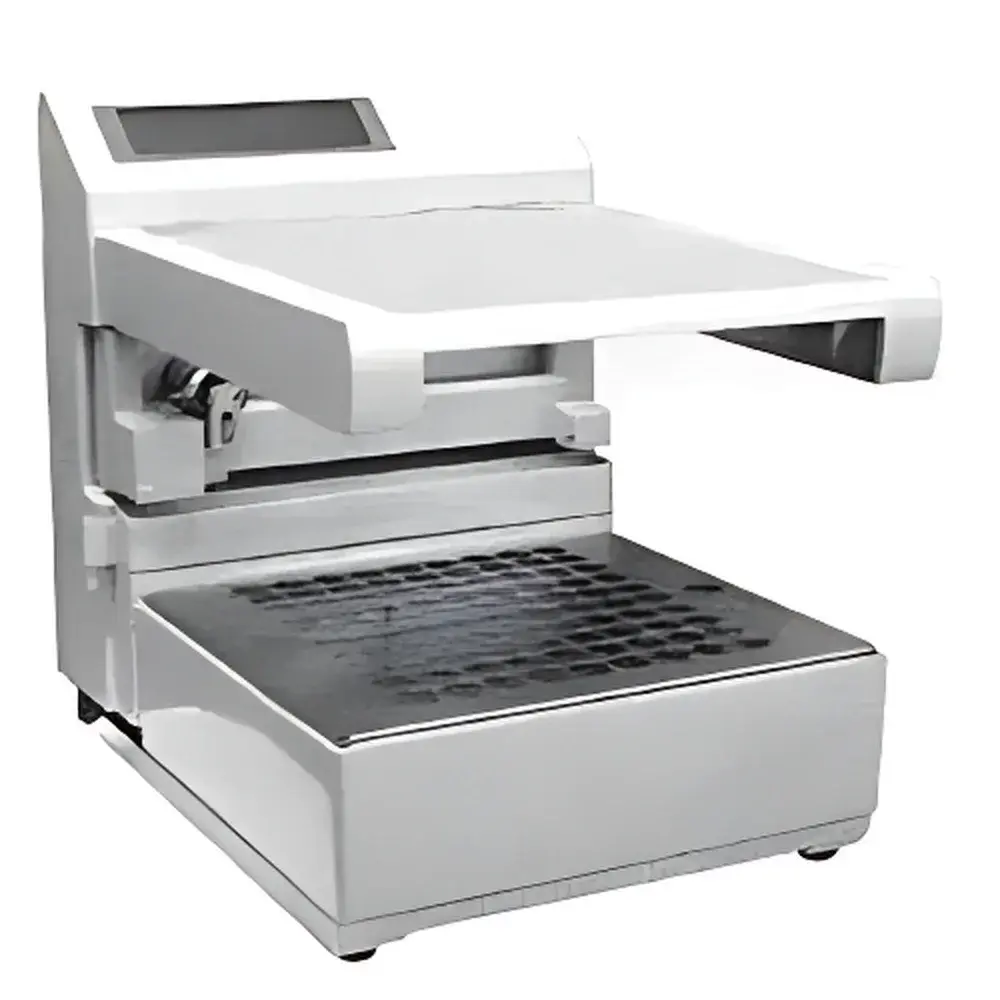
JAI JHF-122 Automated Fraction Collector
| Brand | JAI |
|---|---|
| Origin | Japan |
| Model | JHF-122 |
| Fraction Capacity | 90 positions |
| Collection Modes | Time-based, Peak-triggered, Manual, Memory-programmed |
| Input Signals | Start/Stop TTL-compatible (10 mV / 1 V threshold) |
| Output Signals | Event Marker (TTL) |
| Program Storage | One dedicated file per collection method |
| Accessories | Benchtop mounting stand, 20 × glass collection tubes (standard size), 20 × PTFE inlet tubing, 3-way solenoid valve |
| Dimensions (W×H×D) | 286 × 335 × 387 mm |
| Power Supply | AC 100–240 V, 50/60 Hz, 50 VA |
| Weight | 8 kg |
Overview
The JAI JHF-122 Automated Fraction Collector is a precision-engineered laboratory instrument designed for synchronized integration with liquid chromatography (LC), high-performance liquid chromatography (HPLC), and preparative chromatography systems. It operates on a programmable logic-controlled fractionation principle, enabling precise temporal or event-driven sample segmentation based on external analog/digital triggers—most commonly UV/VIS detector output signals or system timing pulses. Unlike basic manual collectors, the JHF-122 implements deterministic actuation of its 3-way solenoid valve and motorized fraction carousel to ensure reproducible tube positioning and minimal carryover between fractions. Its compact benchtop architecture supports seamless placement beneath column effluent lines or post-detector flow cells, maintaining laminar flow integrity and reducing dead volume—critical for preserving peak resolution in downstream analysis or compound recovery.
Key Features
- 90-position fraction capacity using standardized glass collection tubes—optimized for compatibility with common LC vial dimensions and automated sample handling workflows.
- Multi-mode triggering: configurable collection initiation via time intervals, analog peak detection (threshold-based on 10 mV or 1 V input sensitivity), manual start/stop, or preloaded memory programs.
- Dedicated program memory storage: each collection protocol—including trigger conditions, dwell time, tube advance logic, and event marker output timing—is saved as an independent configuration file for rapid recall and audit-ready repeatability.
- TTL-compatible input/output interface: accepts standard Start/Stop signals from chromatography data systems (CDS) or analog detectors; emits Event Marker pulses for synchronization with external recording devices or mass spectrometers.
- Robust electromechanical design: stepper-motor-driven carousel ensures positional accuracy within ±0.5°; PTFE-lined fluid path minimizes adsorption of polar or hydrophobic analytes.
- Universal power input (100–240 V AC, 50/60 Hz) and low thermal load (50 VA) enable stable operation across global laboratory environments without additional voltage regulation.
Sample Compatibility & Compliance
The JHF-122 accommodates standard 12–16 mm OD glass test tubes and is compatible with aqueous, organic, and mixed-solvent eluents commonly used in reversed-phase, normal-phase, and ion-exchange chromatography. Its inert PTFE fluidic components resist corrosion from acetonitrile, methanol, THF, chloroform, and dilute acidic/basic mobile phases. While the unit itself does not bear CE or UL certification markings, its electrical architecture complies with IEC 61010-1 safety requirements for laboratory equipment. When deployed in regulated environments (e.g., pharmaceutical QC labs), the JHF-122 supports GLP/GMP-aligned workflows through deterministic, non-volatile program storage and traceable event logging via external CDS—particularly when paired with FDA 21 CFR Part 11-compliant software platforms that capture timestamped start/stop and marker events.
Software & Data Management
The JHF-122 operates as a hardware controller without embedded GUI or onboard software. Configuration and execution are managed externally via front-panel push-button navigation or integrated command sets sent from third-party chromatography data systems (e.g., Agilent OpenLab, Waters Empower, Shimadzu LabSolutions). All collection parameters—including trigger thresholds, fraction duration, tube indexing sequence, and marker pulse width—are defined and stored in human-readable ASCII files, facilitating version control, backup, and validation documentation. Event Marker outputs provide hardware-level synchronization points for correlating fraction boundaries with chromatograms, peak integrations, or MS acquisition windows—essential for method transfer and regulatory submissions.
Applications
- Preparative HPLC purification of natural products, synthetic intermediates, and peptide libraries.
- Time-resolved metabolite isolation in pharmacokinetic studies using LC-MS/MS.
- Automated collection of gel filtration fractions for protein oligomer characterization.
- Method development support in affinity chromatography where fraction-specific bioactivity assays follow collection.
- Quality control of botanical extracts requiring multi-fraction potency profiling per USP or EP 2.2.46 guidelines.
FAQ
Does the JHF-122 support real-time peak detection without external software?
No. It requires an analog or digital trigger signal from an external detector or data system; it does not perform on-board peak integration or baseline correction.
Can the collection tube rack be replaced with custom trays?
The mechanical interface is proprietary to JAI’s 90-position carousel; third-party racks are not supported due to positional tolerance and valve alignment constraints.
Is the PTFE tubing included suitable for high-pressure applications?
The supplied PTFE tubing is rated for ≤5 MPa at 25°C—sufficient for analytical and semi-preparative LC but not recommended for >10 mL/min preparative systems without pressure-rated fittings.
How is calibration verified for tube positioning accuracy?
Positional accuracy is factory-validated using optical encoder feedback and documented in the device’s performance qualification (PQ) report; no user calibration routine is provided.
What happens during a power interruption mid-collection?
All active program states are lost; the unit reverts to standby mode upon power restoration. Unsaved progress cannot be recovered—use external CDS logging for continuity assurance.




