
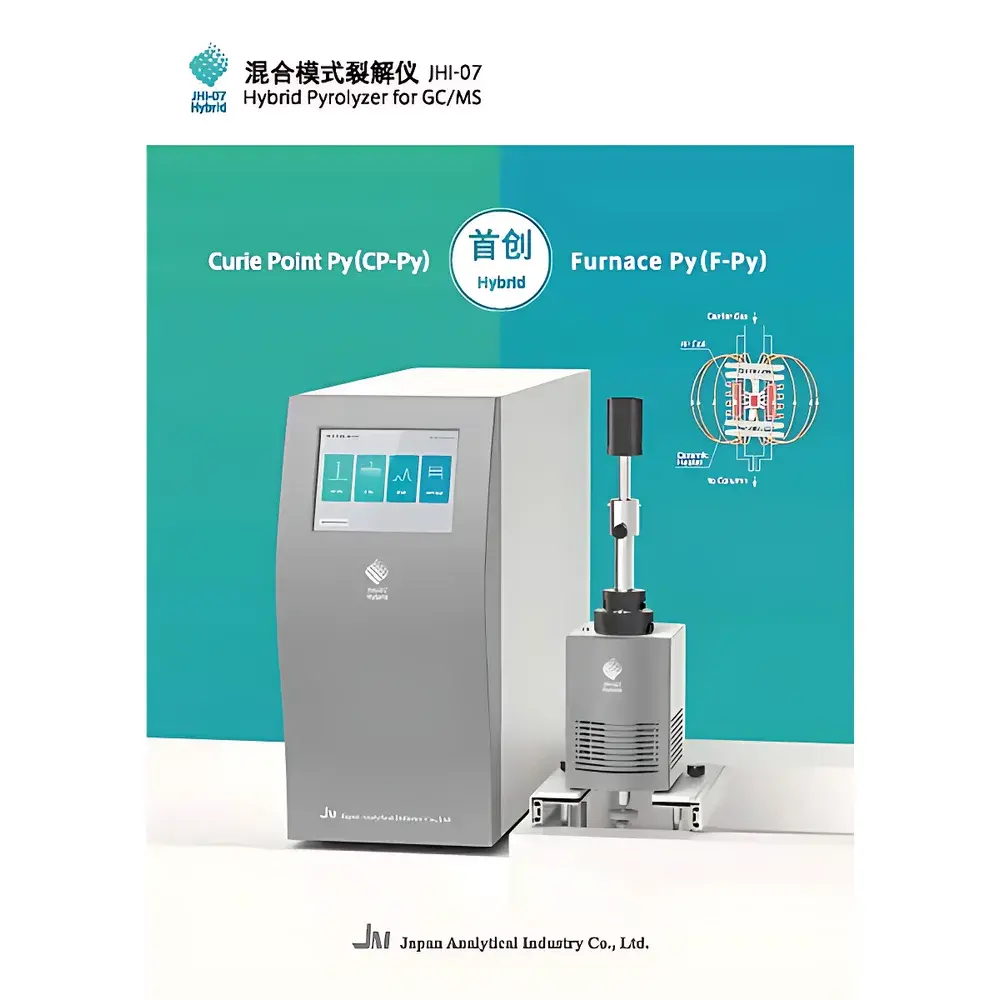
JAI JHI-07 Hybrid-Mode Pyrolyzer
| Brand | JAI |
|---|---|
| Origin | Japan |
| Model | JHI-07 |
| Pyrolyzer Type | Microfurnace Pyrolyzer with Curie-Point Capability |
| Dual-Mode Operation | Curie-Point & Microfurnace |
| EGA Support | Yes |
| Quick-Release Interface | Yes |
| Column Head Cooler Compatibility | CIC-07 (Liquid Nitrogen Cooled) |
| Re-analysis Kit Included | Tenax GR Trap System for Targeted Peak Re-injection |
Overview
The JAI JHI-07 Hybrid-Mode Pyrolyzer is an advanced, dual-function thermal degradation interface engineered for seamless integration with gas chromatography–mass spectrometry (GC–MS) and GC–FID systems. It implements two complementary pyrolytic mechanisms—Curie-point induction heating and precision-controlled microfurnace heating—within a single, compact architecture. The Curie-point mode utilizes commercially available ferromagnetic foil heaters (e.g., Ni–Fe or Fe–Co alloys), enabling rapid, reproducible, and temperature-defined thermal cleavage at material-specific Curie temperatures (typically 350–750 °C). The microfurnace mode provides programmable, ramp-and-hold thermal profiles over a continuous range (e.g., ambient to 1,000 °C), supporting both single-shot and double-shot (pre-pyrolysis + main pyrolysis) protocols. This hybrid design ensures optimal resolution of complex macromolecular structures—including polymers, biomaterials, coals, and environmental particulates—by matching the thermal activation method to sample composition and analytical objective.
Key Features
- Dual-mode operation: Switch between Curie-point and microfurnace pyrolysis without hardware reconfiguration
- Double-shot capability: Enables sequential thermal treatment for selective volatilization of low- and high-boiling fragments
- Evolved Gas Analysis (EGA) support: Real-time monitoring of thermal decomposition profiles via coupled GC detection
- Quick-release interface: Tool-free disassembly of the pyrolysis chamber and transfer line for rapid maintenance and cross-contamination mitigation
- Integrated compatibility with JAI CIC-07 cryogenic column head cooler: Achieves sub-ambient focusing (down to –196 °C using liquid nitrogen) for retention and sharpening of early-eluting, volatile pyrolyzates
- Re-analysis kit (Tenax GR trap system): Selectively captures target peaks during Py-GC or EGA runs; trapped analytes are thermally desorbed and re-introduced into the GC–MS for confirmatory identification or quantification
Sample Compatibility & Compliance
The JHI-07 accommodates solid, powder, and thin-film samples (≤ 1 mg typical loading) with minimal pretreatment. It supports regulatory-compliant workflows aligned with ASTM D7269 (standard test method for pyrolysis–GC analysis of polymers), ISO 17202 (plastics—pyrolysis–GC–MS identification), and USP residual solvent screening in pharmaceutical excipients. Its robust stainless-steel construction, inert quartz sample cups, and trace-metal-free flow path meet GLP/GMP requirements for auditable analytical environments. All firmware and control logic are designed to support 21 CFR Part 11–compliant data integrity practices when used with validated GC–MS software platforms.
Software & Data Management
The JHI-07 operates via JAI’s dedicated Pyrolyzer Control Software (v3.x), which provides synchronized timing control between pyrolysis event initiation, GC oven ramping, and MS acquisition triggers. Method templates include pre-configured Curie-point foil libraries and microfurnace temperature programs compliant with common polymer identification standards (e.g., PE, PP, PET, PVC, natural rubber). Audit trails record operator ID, timestamp, parameter settings, and hardware status logs. Export formats include CSV and .mzML for downstream chemometric analysis (PCA, hierarchical clustering) in open-source or commercial spectral libraries (NIST, Wiley, or custom-built).
Applications
- Forensic polymer identification in trace evidence (e.g., automotive paint chips, textile fibers)
- Characterization of thermal stability and degradation pathways in bioplastics and composites
- Source apportionment of organic aerosols and soot particles in atmospheric science
- Quality control of carbon black dispersion in rubber compounds
- Structural elucidation of lignin derivatives and humic substances in soil chemistry
- Screening of counterfeit pharmaceuticals via excipient pyrolysis fingerprinting
FAQ
What types of samples are compatible with the JHI-07?
Solid organic materials including synthetic and natural polymers, elastomers, resins, biomass, coal, sediments, and microplastics. Liquid or highly volatile samples require pre-concentration or adsorption onto inert substrates.
Can the JHI-07 be used with non-JAI GC systems?
Yes—it features standardized 1/8″ or 1/16″ stainless-steel transfer lines and universal pneumatic interfaces compatible with Agilent, Thermo Fisher, Shimadzu, and PerkinElmer GC platforms.
Is the CIC-07 column head cooler required for routine operation?
Not mandatory, but strongly recommended for analyses involving low-molecular-weight pyrolyzates (e.g., formaldehyde, acetaldehyde, benzene) to prevent peak broadening and improve sensitivity.
How is calibration performed for Curie-point mode?
Calibration is foil-specific and verified using certified reference foils (e.g., Ni–Fe 350 °C, Fe–Co 750 °C); no instrument recalibration is needed between foil changes if manufacturer-specified handling protocols are followed.
Does the re-analysis kit support automated trapping and desorption?
Manual triggering is standard; however, optional integration with JAI’s AutoTrap module enables programmable, GC-triggered trap activation and thermal desorption under method control.





