
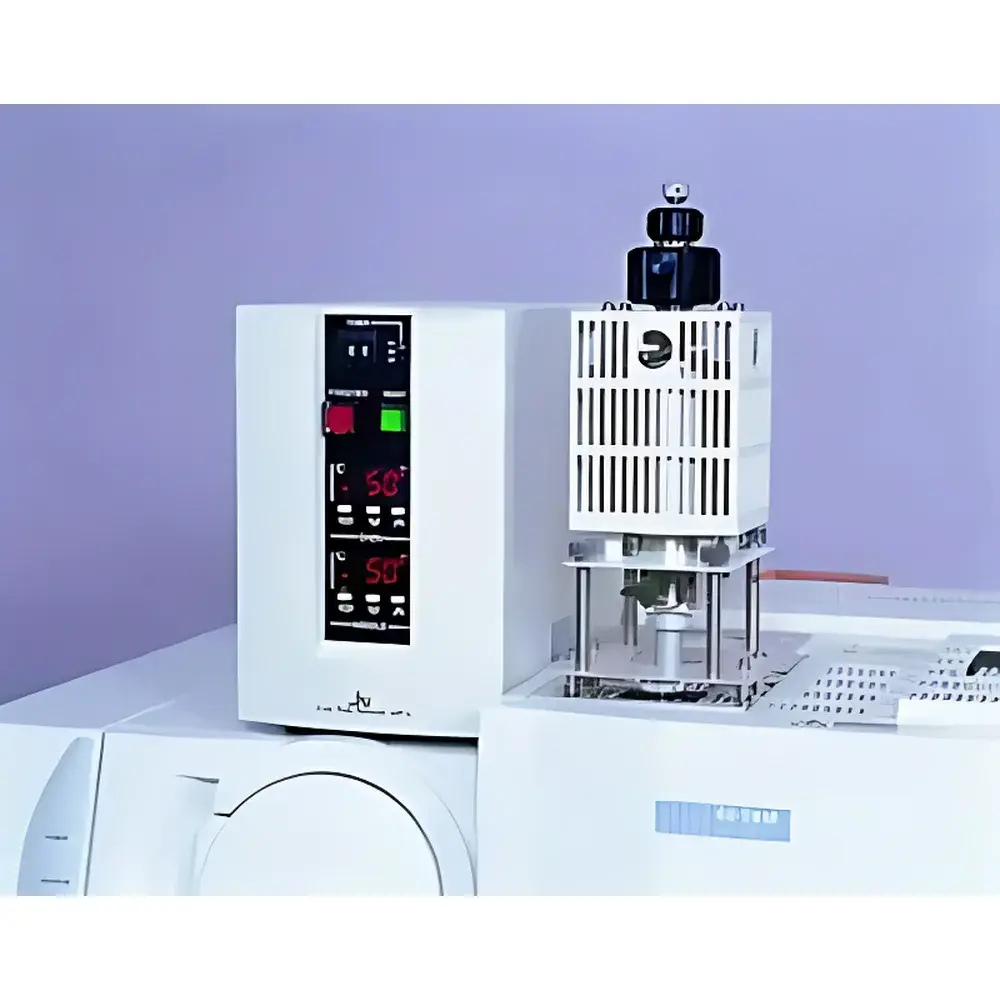
JAI JHP-5 Curie-Point Pyrolyzer
| Origin | Japan |
|---|---|
| Manufacturer Type | Authorized Distributor |
| Origin Category | Imported |
| Model | JHP-5 |
| Instrument Type | Curie-Point Pyrolyzer |
| Heating Method | High-Frequency Induction (600 kHz, 48 W) |
| Pyrolysis Time Range | 1 s – 99 h |
| Flow Path Switching | Solenoid Valve |
| Sensor Unit Dimensions/Weight | 90 × 280 × 160 mm / 2.5 kg |
| RF Power Supply Dimensions/Weight | 160 × 250 × 380 mm / 8 kg |
| Power Input | AC 100–240 V, 5 A |
| GC Compatibility | Universal (all standard GC systems, excluding proprietary non-standard interfaces) |
Overview
The JAI JHP-5 Curie-Point Pyrolyzer is a precision thermal desorption and pyrolysis interface engineered for seamless coupling with gas chromatography (GC) systems. It operates on the fundamental physical principle of Curie-point heating: a ferromagnetic foil or wire—serving as both sample support and heater—is placed within a high-frequency electromagnetic field (600 kHz). As the material absorbs energy, its temperature rises until it reaches its intrinsic Curie temperature—the critical point at which its magnetic permeability collapses abruptly, terminating inductive heating. This self-regulating mechanism ensures highly reproducible, isothermal pyrolysis at a precisely defined temperature (ranging from 160 °C to 1040 °C, depending on the selected ferromagnetic alloy). Unlike resistive or furnace-based pyrolyzers, the JHP-5 achieves ultra-rapid heating rates exceeding 5000 °C/s, enabling true flash pyrolysis. This eliminates thermal gradient effects and sequential decomposition, preserving molecular “fingerprint” integrity in the resulting chromatogram—essential for polymer structural elucidation, microbial identification, and trace-level forensic analysis.
Key Features
- Curie-point self-limiting temperature control ensures ±0.5 °C thermal accuracy without external feedback sensors or PID tuning.
- Ultra-fast thermal ramp (0.1–0.2 s from ambient to Curie temperature) minimizes secondary reactions and maximizes chromatographic peak sharpness and resolution.
- Low-dead-volume direct transfer design delivers pyrolyzates quantitatively into the GC capillary column via solenoid-valve–actuated flow path switching.
- Integrated high-temperature desorption unit prevents carryover by thermally purging adsorbed residues after each run.
- JAI’s proprietary ferromagnetic foil carriers accommodate solid (granules, powders), liquid (non-volatile solutes, volatile analytes pre-absorbed on glass wool), and semi-solid samples without derivatization or matrix interference.
- Modular architecture: sensor unit (2.5 kg) and RF power supply (8 kg) are physically separated for flexible benchtop integration and thermal isolation from GC oven.
Sample Compatibility & Compliance
The JHP-5 supports diverse sample classes including synthetic polymers (e.g., polyacrylates, polyolefins, styrene-butadiene rubber), natural biopolymers (cellulose, chitin, lignin), microbial biomass (bacteria, fungi), pharmaceutical excipients, forensic trace evidence (hair, fibers), environmental solids (soil, sediment), and geological organic matter. Its operation aligns with ASTM D7265 (Standard Test Method for Pyrolysis-GC Analysis of Polymers) and supports GLP/GMP-compliant workflows when integrated with 21 CFR Part 11–enabled GC data systems. The absence of mechanical moving parts in the heating zone and inert foil substrate minimize background contamination—critical for ng-level detection sensitivity and low-noise baseline stability required in regulatory submissions.
Software & Data Management
While the JHP-5 operates as a hardware-integrated peripheral without embedded firmware or standalone software, it is fully compatible with industry-standard GC control platforms (Agilent OpenLab, Thermo Chromeleon, Shimadzu GCsolution). Timing parameters—including pyrolysis hold duration (1 s to 99 h), valve actuation sequence, and GC oven synchronization—are programmable via the host GC software. Audit trails, method versioning, and electronic signatures are maintained at the GC data system level, satisfying FDA 21 CFR Part 11 requirements for analytical traceability. Optional TTL-triggered acquisition enables precise alignment of pyrolysis onset with GC data capture.
Applications
- Quantitative copolymer composition analysis via linear calibration of monomer peak area ratios against reference standards.
- Microbial taxonomy based on reproducible pyrolysis mass fingerprints—validated across culture collections and clinical isolates.
- Rapid derivatization-free fatty acid profiling of lipids using in-situ methylation on heated foil (e.g., triacylglycerol → FAME).
- Forensic toxicology: detection of drug metabolites in hair keratin matrices, as implemented in China’s Ministry of Public Security Forensic Science Center national research programs.
- Materials forensics: structural characterization of aerospace-grade elastomers (e.g., SBR composites for Shenzhou V spacesuits) and acoustic-damping rubbers for naval applications.
- Pharmaceutical surface analysis: coating integrity assessment of tablet film layers and controlled-release polymer matrices.
- Environmental forensics: identification of plastic additives (e.g., phthalates, flame retardants) leached into sediments or paper products.
FAQ
What distinguishes Curie-point pyrolysis from conventional resistive or furnace-based methods?
Curie-point heating provides intrinsic temperature regulation without external thermocouples or feedback loops—eliminating overshoot, drift, and inter-run variability. Its microsecond-scale thermal response yields sharper, more reproducible pyrograms ideal for comparative fingerprinting.
Can the JHP-5 perform thermal desorption in addition to pyrolysis?
Yes. The system supports two operational modes: (1) rapid Curie-point pyrolysis for macromolecular cleavage and (2) controlled low-temperature thermal desorption (up to ~350 °C) for volatile/semi-volatile analyte release—both with automated valve switching and zero dead volume transfer.
Is method transfer between different GC platforms feasible?
Absolutely. The JHP-5 uses standardized electrical and pneumatic interfaces (24 V DC trigger, 1/16″ stainless steel transfer line) and requires no vendor-specific drivers—ensuring full interoperability across Agilent, Thermo, Shimadzu, PerkinElmer, and other major GC platforms.
How is temperature calibration verified?
Calibration is performed using certified Curie-point reference foils (e.g., Ni: 358 °C, Fe: 770 °C, Co–Ni alloys: 480–1040 °C), traceable to NIST SRM standards. Each foil batch is supplied with a certificate of conformity specifying actual measured Curie temperature.
What maintenance is required for long-term reliability?
No routine maintenance is needed beyond periodic visual inspection of foil carriers and cleaning of the quartz liner. The solid-state RF generator has no consumables and demonstrates >10,000-hour MTBF under continuous laboratory use.
Related Products





