
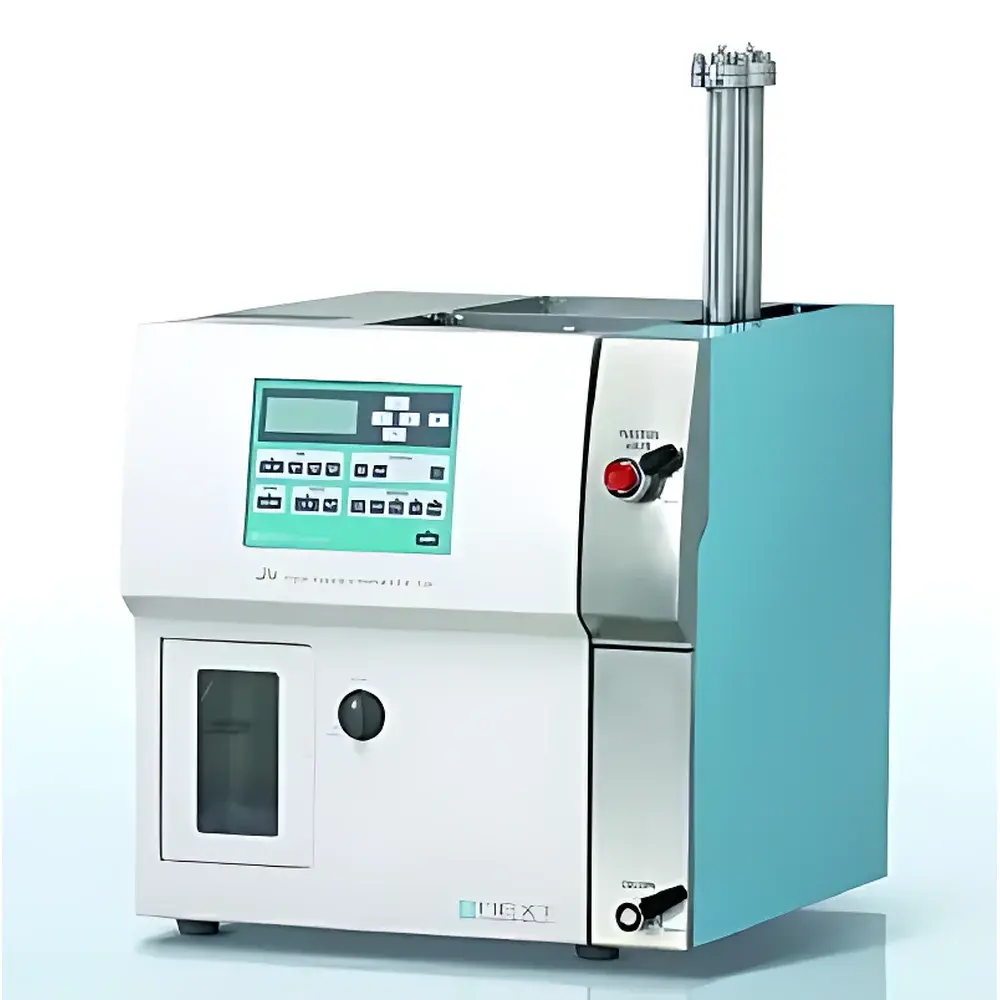
JAI LC-9210NEXT & LC-9225NEXT High-Pressure Preparative Liquid Chromatography Systems
| Brand | JAI |
|---|---|
| Origin | Japan |
| Model | LC-9210NEXT / LC-9225NEXT |
| Instrument Type | High-Pressure Preparative Liquid Chromatograph |
| Pump Type | Dual-Piston Reciprocating Pump |
| Max Pressure | 25 MPa (LC-9225NEXT), 20 MPa @ 0.1–9.9 mL/min (LC-9210NEXT) |
| Flow Rate Range | 0.01–10.0 mL/min (LC-9210NEXT), 0.1–25.0 mL/min (LC-9225NEXT) |
| Injector | Rheodyne 7725i with 3 mL standard loop (5/10 mL optional for LC-9210NEXT |
| Backflow Prevention | Patented electromagnetic valve-based anti-backflow system |
| Auto-Cleaning | Programmable solvent flush module |
| Control Interface | Dedicated function keys for pump, detector, fraction collection, cycle initiation, and cleaning sequence |
| Dimensions (W×H×D) | 464 × 492 × 504 mm |
| Weight | ~38 kg |
| Power Supply | 85–240 V AC, 800 VA |
Overview
The JAI LC-9210NEXT and LC-9225NEXT are high-pressure preparative liquid chromatography systems engineered for reproducible, scalable purification of organic compounds, natural products, pharmaceutical intermediates, and synthetic peptides. Designed around a dual-piston reciprocating pump architecture, these systems operate under precise pressure control up to 25 MPa (LC-9225NEXT) and deliver stable flow rates across wide dynamic ranges—0.01–10.0 mL/min (LC-9210NEXT) and 0.1–25.0 mL/min (LC-9225NEXT). Unlike analytical HPLC platforms, the NEXT series integrates purpose-built hardware for iterative sample recycling—enabling repeated passage of eluent through the same column to enhance resolution of closely eluting components without column re-equilibration. The patented backflow prevention mechanism eliminates reverse solvent migration during high-backpressure cycling, protecting UV detectors from baseline disturbance and preventing sample loss at critical interfaces (e.g., flow cell, column frits, and injection valve rotor seals). This design directly addresses a longstanding operational limitation in conventional recycling preparative HPLC, where transient pressure differentials often compromise detection integrity and fraction purity.
Key Features
- Patented electromagnetic valve-based anti-backflow system ensures unidirectional flow during recycling, eliminating detector saturation and solvent peak distortion caused by pressure transients.
- Front-access modular architecture: infusion pumps, UV-Vis detector, and solvent selection valves are fully removable from the instrument front panel—reducing mean time to repair (MTTR) and simplifying seal replacement, tubing inspection, and pump head maintenance.
- Dedicated function-key interface enables one-touch configuration of all core operational parameters—including flow rate, detection wavelength, collection trigger logic, cycle count, and automated solvent flush protocols—without navigating nested menus.
- Integrated programmable auto-cleaning module executes multi-solvent flush sequences (up to three solvents per program) between runs or prior to column changeover, minimizing carryover and reducing manual solvent exchange steps.
- Rheodyne 7725i manual injector with standardized loop options (3 mL standard on LC-9210NEXT; 10 mL standard on LC-9225NEXT) supports rapid sample loading while maintaining consistent injection volume accuracy and low dead-volume transfer.
- Real-time pressure monitoring with adjustable upper limit setting and audible/visual alert—configurable via front-panel shortcut keys to prevent overpressure events during gradient or column-switching operations.
Sample Compatibility & Compliance
The LC-92NEXT series accommodates standard stainless-steel and PEEK-lined preparative columns (typically 10–50 mm ID) packed with silica, C18, amino, cyano, or ion-exchange media. Its solvent compatibility spans common HPLC-grade mobile phases including water, methanol, acetonitrile, isopropanol, THF, and dilute acids/bases (pH 2–8). All wetted parts meet USP Class VI biocompatibility standards, and the system’s mechanical design complies with IEC 61010-1 for laboratory electrical safety. While not inherently 21 CFR Part 11 compliant, the platform supports audit-trail-ready operation when integrated with validated third-party chromatography data systems (CDS) that provide electronic signature, user access control, and immutable raw data archiving—making it suitable for GLP- and GMP-aligned purification workflows in contract development and manufacturing organizations (CDMOs).
Software & Data Management
The LC-92NEXT operates in standalone mode using its embedded microcontroller and front-panel interface; no PC dependency is required for routine operation. Analog UV output (0–1 V DC) and digital TTL-level event markers (injection, cycle start, fraction collection) are provided for synchronization with external fraction collectors or time-stamped data loggers. For enhanced traceability, users may connect the system to industry-standard CDS platforms (e.g., Chromeleon, Empower, or OpenLab CDS) via analog/digital I/O modules. These integrations enable full method storage, electronic batch records, calibration history tracking, and compliance with ALCOA+ data integrity principles—particularly when paired with timestamped pressure/flow logs and detector signal archives.
Applications
These systems are routinely deployed in academic natural product isolation labs, medicinal chemistry support units, and API purification suites. Typical use cases include: chiral separation of racemic mixtures via recycling on chiral stationary phases; enrichment of minor metabolites from complex botanical extracts; desalting and buffer exchange of oligonucleotides; and recovery of reaction intermediates following Suzuki or Buchwald–Hartwig couplings. Their robust pressure tolerance and precise flow control also support method translation from analytical to semi-preparative scale (e.g., scaling 4.6 mm × 150 mm methods to 20 mm × 250 mm columns), accelerating process development timelines.
FAQ
What is the primary advantage of the patented backflow prevention system?
It physically isolates the detector flow cell from transient pressure reversals during valve actuation in recycle mode—preventing solvent shock, baseline noise, and irreversible adsorption of analytes onto optical surfaces.
Can the LC-9210NEXT and LC-9225NEXT be operated without a connected computer?
Yes. All essential functions—including method setup, run initiation, fraction triggering, and cleaning cycles—are fully controllable via the front-panel shortcut keys and LCD display.
Is the Rheodyne 7725i injector compatible with high-pressure applications up to 25 MPa?
The injector is rated for continuous operation up to 35 MPa; however, maximum system pressure is governed by the pump and column hardware—not the injection valve.
How does the auto-cleaning function reduce downtime between purification runs?
By executing pre-programmed solvent flushes (e.g., 5 min 100% water → 5 min 100% acetonitrile), it removes residual analytes and buffers from the pump head, mixer, and detector flow cell—eliminating manual flushing and verification steps.
Are column switching modules supported on this platform?
Column switching is not natively integrated but can be implemented externally using third-party high-pressure switching valves controlled via the system’s TTL event outputs and analog voltage triggers.



