
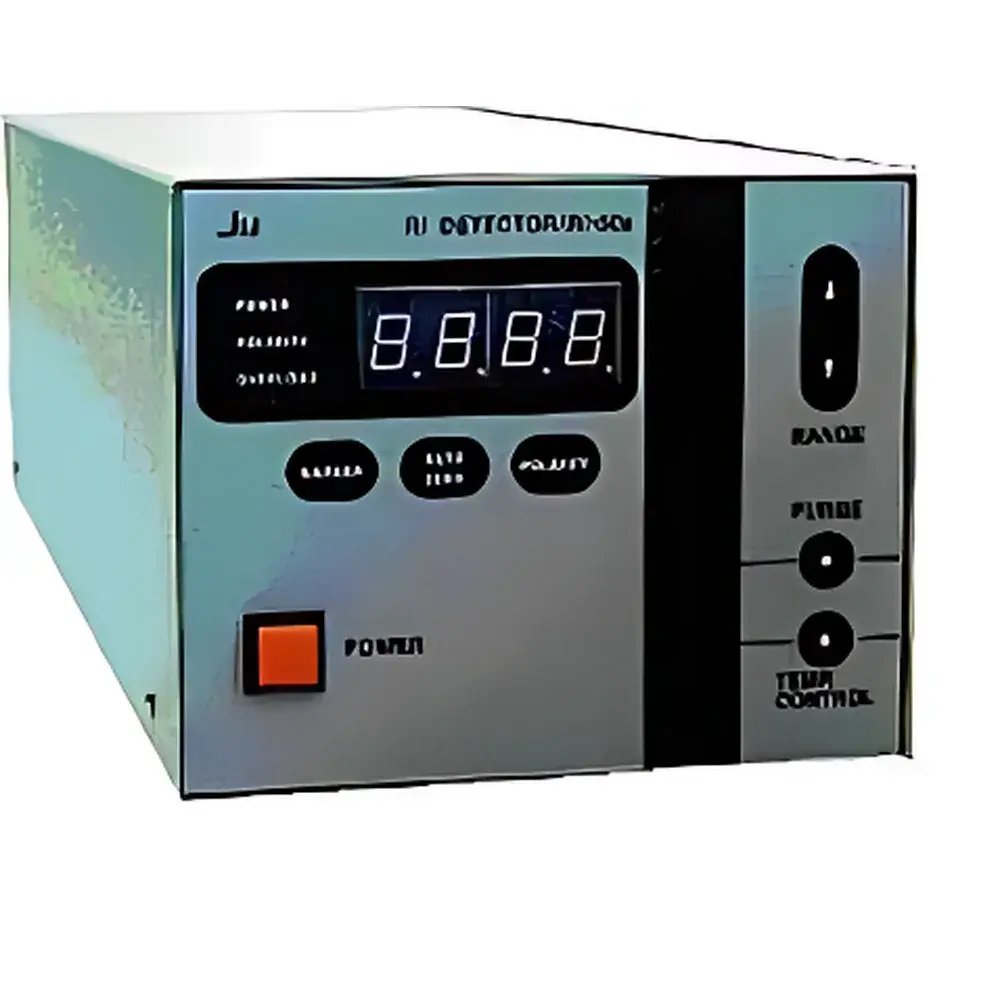
JAI RI-50s Differential Refractometer Detector
| Brand | JAI |
|---|---|
| Origin | Japan |
| Model | RI-50s |
| Detector Type | Differential Refractometer (RID) |
| Flow Cell Volume | 8 µL |
| Refractive Index Range | 1.00–1.75 |
| Attenuation Range | 1–2000 and ∞ (12-step) |
| Temperature Control | Fixed at 34 °C, max 50 °C |
| Reference Cell Cleaning | Solenoid-valve controlled |
| Integrator Output | 1 V |
| Recorder Output | 100 mV / 10 mV |
| Zero Adjustment | Automatic |
| Dimensions (W×H×D) | 150 × 120 × 360 mm |
| Power Supply | AC 85–135 V, 50/60 Hz, 300 VA |
| Weight | 7 kg |
Overview
The JAI RI-50s Differential Refractometer Detector is a precision optical detector engineered for universal solute detection in liquid chromatography systems—particularly where analytes lack chromophores or UV absorbance. Operating on the principle of differential refractometry, the RI-50s measures minute changes in the refractive index between a sample stream and a reference solvent stream passing through matched optical cells. This measurement is inherently concentration-dependent and independent of molecular structure, making it uniquely suited for carbohydrates, polymers, surfactants, organic acids, and other non-UV-active compounds. Unlike UV-Vis or fluorescence detectors, the RI-50s delivers quantitative response across broad compound classes without derivatization. Its fixed-temperature design (34 °C standard, up to 50 °C) ensures thermal stability critical for baseline reproducibility, while the compact 8 µL flow cell balances sensitivity with low dispersion and minimal band broadening—essential for high-resolution HPLC and GPC/SEC applications.
Key Features
- Optically balanced dual-cell architecture with precisely matched sapphire windows for long-term drift suppression and signal stability.
- Automatic zero adjustment circuitry compensates for solvent composition shifts and thermal equilibration effects, reducing manual intervention during method development.
- 12-step attenuation range (1–2000 + ∞) enables seamless dynamic range adaptation—from trace-level polymer analysis to concentrated sugar solutions—without hardware reconfiguration.
- Solenoid-controlled reference cell purge system minimizes carryover and maintains optical path integrity across multi-sample sequences, supporting unattended operation.
- Low-volume (8 µL), temperature-stabilized flow cell optimized for compatibility with analytical- and microbore HPLC columns; pressure rating compatible with systems up to 40 MPa.
- Robust mechanical housing (150 × 120 × 360 mm, 7 kg) with vibration-damped base plate ensures operational stability in shared laboratory environments.
Sample Compatibility & Compliance
The RI-50s is compatible with all common HPLC mobile phases—including aqueous buffers, alcohols, THF, chloroform, and DMF—provided refractive index differentials exceed instrument resolution thresholds (~1 × 10⁻⁶ RIU). It supports isocratic and gradient elution (with appropriate compensation protocols), though gradient use requires careful solvent matching and post-run stabilization. The detector meets fundamental requirements for GLP-compliant laboratories: analog output signals (1 V integrator, dual-range recorder outputs) interface directly with legacy and modern data systems; its fixed-temperature operation avoids complex thermal validation protocols required by variable-oven RIDs. While not intrinsically 21 CFR Part 11 compliant, audit-ready operation is achievable when integrated with validated chromatography data systems (CDS) that enforce electronic signatures, change control, and secure audit trails.
Software & Data Management
The RI-50s operates as an analog-output detector and does not include embedded firmware or onboard software. It delivers calibrated voltage signals (1 V full-scale integrator output; selectable 100 mV or 10 mV recorder outputs) compatible with all major third-party chromatography data systems—including Thermo Chromeleon, Agilent OpenLab CDS, Waters Empower, and Shimadzu LabSolutions. Signal linearity is maintained across the full attenuation range, enabling accurate peak area integration without gain switching artifacts. For GPC/SEC applications, the detector’s consistent response factor (independent of molecular weight) allows direct calibration against narrow-standard polystyrene or dextran references per ISO 16014 and ASTM D5296 guidelines. Raw analog traces are fully exportable for post-acquisition processing in MATLAB, Python (SciPy), or custom curve-fitting environments.
Applications
- Gel Permeation Chromatography (GPC) and Size Exclusion Chromatography (SEC) for synthetic polymers, natural polysaccharides, and proteins.
- Carbohydrate analysis in food, beverage, and biofuel feedstocks—especially sucrose, glucose, fructose, and oligosaccharides.
- Surfactant quantification in formulation QC where UV transparency precludes alternative detection.
- Quality control of pharmaceutical excipients (e.g., PEG, povidone, hydroxypropyl cellulose) per USP and Ph. Eur. 2.2.49.
- Process monitoring of fermentation broths and downstream purification streams for non-absorbing metabolites.
FAQ
Is the RI-50s compatible with UHPLC systems?
Yes—provided system backpressure remains within the detector’s mechanical tolerance (up to 40 MPa) and dwell volume effects are accounted for during gradient method transfer.
Does the RI-50s require column temperature control?
No—temperature stabilization is internal (fixed at 34 °C); however, column oven control is recommended to minimize thermal mismatch-induced baseline noise.
Can the RI-50s be used with gradient elution?
Yes, but solvent refractive index matching and extended equilibration times are required; isocratic methods yield optimal precision and reproducibility.
What maintenance is required for long-term stability?
Annual optical alignment verification, quarterly reference cell cleaning via solenoid purge cycle, and routine inspection of flow cell seals per JAI Technical Bulletin TB-RID-03.
Is there a digital communication interface (e.g., RS-232, USB)?
No—the RI-50s is an analog-only detector; digital connectivity must be implemented via the connected data system’s analog input module.




