
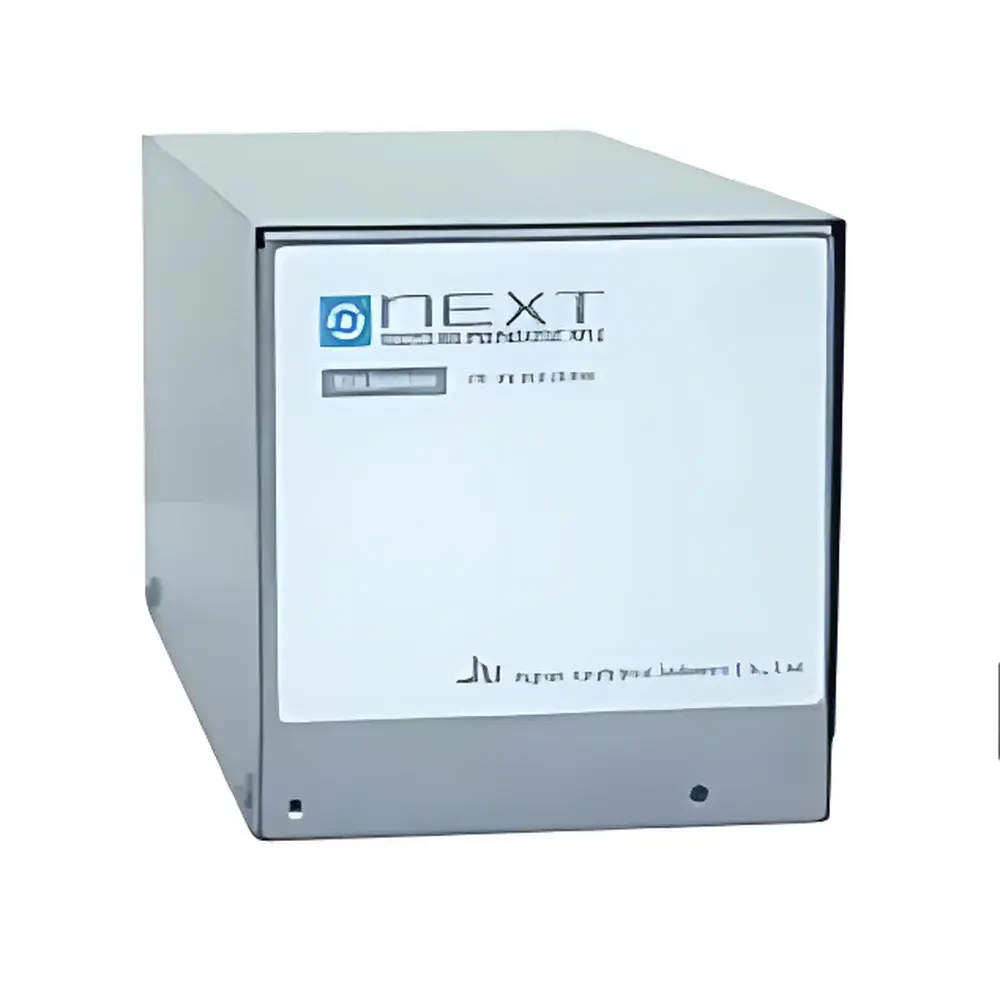
JAI UV-4ch DAD Detector
| Brand | JAI |
|---|---|
| Origin | Japan |
| Model | UV-4ch DAD Detector |
| Detection Principle | Diode Array Detection (DAD) |
| Wavelength Range | 190–840 nm (operational range 200–800 nm) |
| Simultaneous Channels | 4 independent wavelength channels |
| Light Source | Deuterium lamp + Tungsten-halogen lamp |
| Flow Cell Options | 0.3 mm (standard), 1.4 mm, 2.4 mm pathlength |
| Sensitivity | 5 × 10⁻⁵ AUFS |
| Drift | ≤ 1 × 10⁻³ AU/h |
| Zero Adjustment | Automatic |
| Software Compatibility | JAI Scan, Clarity™ (Windows Vista) |
| Power Supply | Direct LC system power |
| Dimensions (W×H×D) | 150 × 157 × 337 mm |
| Weight | ~6.0 kg |
Overview
The JAI UV-4ch DAD Detector is a high-performance diode array detector engineered for precise, multi-wavelength ultraviolet–visible (UV-Vis) absorbance detection in liquid chromatography (LC) and high-performance liquid chromatography (HPLC) systems. Unlike conventional single-wavelength UV detectors, this instrument integrates a full-spectrum photodiode array to enable simultaneous acquisition of spectral data across four user-selectable wavelengths within the 200–800 nm operational range (extendable to 190–840 nm). Its optical architecture employs a dual-light-source configuration—deuterium lamp for deep-UV stability and tungsten-halogen lamp for visible-range consistency—ensuring broad spectral coverage with minimal intensity drift. The detector operates on the principle of real-time spectral scanning: as analytes elute through the flow cell, the entire UV-Vis spectrum (at up to 1 nm resolution) is captured for each data point, enabling post-run spectral reconstruction and peak characterization. While real-time contour plotting is supported during acquisition, raw spectral data are fully preserved in Clarity™ for retrospective analysis—including peak purity assessment, spectral library matching, and qualitative structural inference based on absorption maxima, band shape, and shoulder features.
Key Features
- Four independently configurable wavelength channels for concurrent quantitative monitoring at critical λmax positions—ideal for method development, co-elution verification, and multi-analyte assays.
- Full-spectrum scanning capability (200–800 nm) with automatic baseline correction and zero-point stabilization, minimizing manual intervention and enhancing day-to-day reproducibility.
- Modular flow cell design offering three pathlength options (0.3 mm standard; 1.4 mm and 2.4 mm optional) to optimize sensitivity or dynamic range depending on analyte concentration and matrix complexity.
- Low-drift electronics (≤ 0.001 AU/h) and high sensitivity (5 × 10⁻⁵ AUFS) ensure reliable detection of trace-level compounds in pharmaceutical, environmental, and food safety applications.
- Direct LC system power integration eliminates external power supplies, reducing footprint and electromagnetic interference in regulated lab environments.
- Compact benchtop form factor (150 × 157 × 337 mm) with robust mechanical housing designed for continuous operation in GxP-compliant laboratories.
Sample Compatibility & Compliance
The UV-4ch DAD Detector supports standard HPLC-compatible solvents and mobile phases, including aqueous buffers, acetonitrile, methanol, and THF—provided they remain optically transparent within the detection window. It accommodates flow rates typical of analytical-scale LC systems (0.1–5.0 mL/min) and is compatible with stainless steel, PEEK, and fused silica capillary tubing. The detector meets essential electromagnetic compatibility (EMC) requirements per IEC 61326-1 and conforms to general safety standards under IEC 61010-1. While not inherently 21 CFR Part 11–compliant, Clarity™ software—when deployed on validated Windows Vista workstations with audit trail enabled—supports GLP/GMP-aligned workflows, including electronic signatures, user access control, and immutable data archiving. Method validation documentation aligns with ICH Q2(R2) and ASTM E2637-22 for UV-Vis detector performance qualification.
Software & Data Management
Data acquisition and processing are managed via two complementary platforms: JAI Scan (for basic setup and real-time monitoring) and Clarity™ (for advanced quantitation, spectral deconvolution, and compliance-ready reporting). Clarity™ stores all spectral scans as native .clr files containing time-resolved absorbance matrices (wavelength × retention time), enabling retrospective extraction of full UV-Vis spectra at any chromatographic point. Integrated tools support peak purity evaluation using spectral correlation algorithms, threshold-based peak tracking, and overlay comparison against reference standards. Export formats include CSV, ASCII, and PDF reports compliant with internal QA templates. Raw data integrity is preserved without compression or interpolation, satisfying ALCOA+ principles (Attributable, Legible, Contemporaneous, Original, Accurate, Complete, Consistent, Enduring, Available).
Applications
- Pharmaceutical QC/QA: Assay validation, impurity profiling, and forced degradation studies leveraging spectral consistency across batches.
- Natural product analysis: Identification of flavonoids, alkaloids, and polyphenols via characteristic λmax shifts and fine-structure absorption patterns.
- Environmental monitoring: Simultaneous detection of PAHs, nitroaromatics, and chlorinated hydrocarbons in water extracts using multi-wavelength ratio metrics.
- Food and beverage testing: Quantification of preservatives (e.g., benzoic acid, sorbic acid) and colorants (e.g., tartrazine, sunset yellow) with built-in spectral libraries.
- Academic research: Reaction monitoring in preparative LC, kinetic studies requiring time-resolved spectral snapshots, and method transfer between labs.
FAQ
Can the detector perform real-time spectral deconvolution during acquisition?
No—full spectral deconvolution and peak purity analysis are post-acquisition functions executed in Clarity™. Real-time output is limited to chromatograms at the four selected wavelengths and live contour plots.
Is the 0.3 mm flow cell suitable for high-concentration samples?
Yes—the 0.3 mm pathlength provides optimal sensitivity for low-abundance analytes; for concentrated samples (e.g., >15% benzene in mobile phase), the 1.4 mm or 2.4 mm cells reduce signal saturation and extend linear dynamic range.
Does the detector support spectral library search functionality?
Clarity™ includes a customizable spectral library module allowing users to import reference spectra (in .spc or .jdx format) and perform correlation-based identification with adjustable similarity thresholds.
What is the minimum dwell time required for reliable 4-channel quantitation?
At standard scan speeds (10–20 Hz), the detector maintains <100 ms dwell per wavelength channel—sufficient for most analytical HPLC methods with peak widths ≥10 s.
Can raw spectral data be exported for third-party chemometric analysis?
Yes—Clarity™ exports full absorbance matrices as tab-delimited ASCII files, preserving wavelength accuracy, time stamps, and detector gain settings for PCA, MCR-ALS, or other multivariate modeling workflows.





