
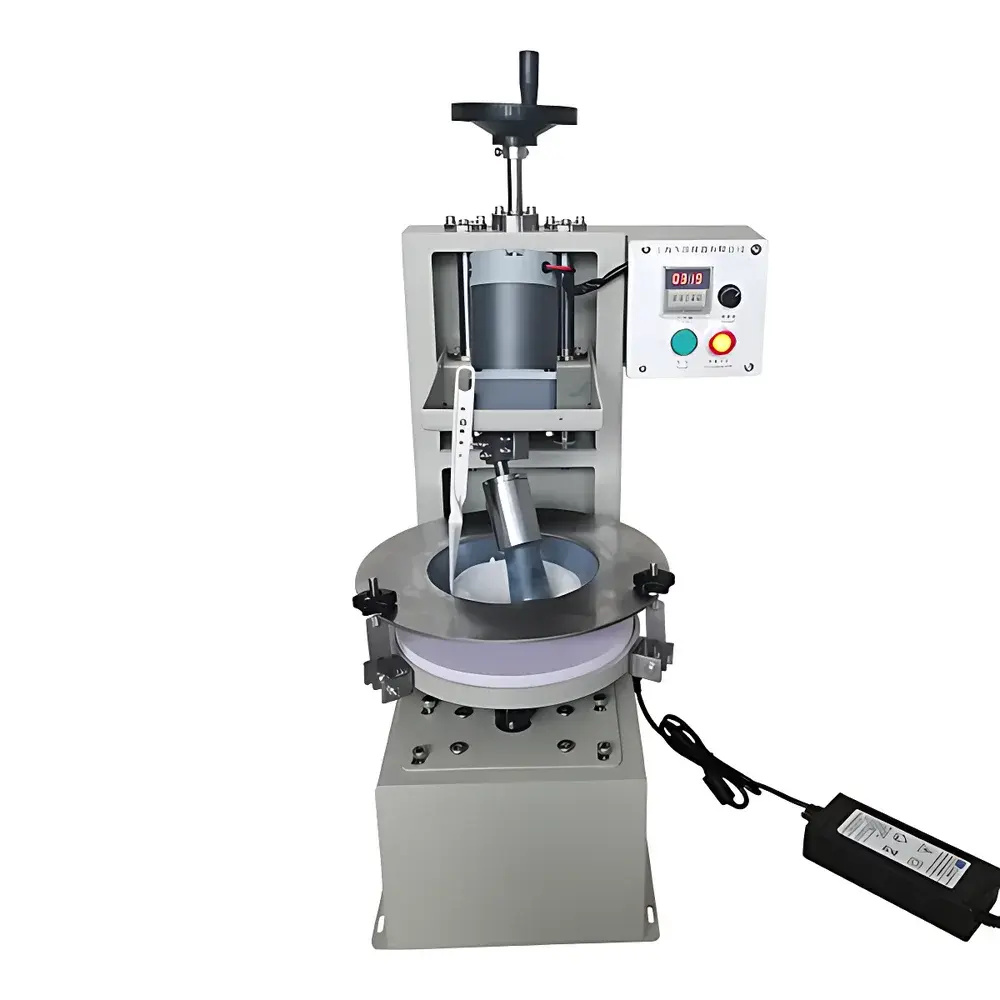
JB-120 Pharmaceutical Grinder by Jiubin Instruments
| Brand | Jiubin Instruments |
|---|---|
| Model | JB-120 |
| Type | Automatic Mortar Grinder |
| Sample Type | Hard, Brittle Solids |
| Output Particle Size | ≥ 0.5 mm |
| Mortar Diameter | 120 mm |
| Pestle Rotation Speed | 1–120 rpm |
| Mortar Rotation Speed | 10 rpm |
| Pestle Motor Power | 40 W |
| Construction Materials | Agate or Alumina Mortar & Pestle |
| Dimensions (L×W×H) | 320 × 240 × 630 mm |
| Weight | 15 kg |
| Voltage | AC 220 V |
| Programmable Runtime | Yes |
| Compliance | CE-marked for laboratory use (IEC 61010-1), GLP-compatible operation log |
Overview
The JB-120 Pharmaceutical Grinder is an automated mortar-and-pestle grinding system engineered for reproducible, low-contamination size reduction of hard, brittle solid samples in regulated pharmaceutical, chemical, and materials research laboratories. Unlike high-energy ball mills or jet mills, this device operates on the principle of controlled shear and compressive force generated by synchronized rotation of a stationary mortar and a vertically oscillating pestle—mimicking traditional manual grinding but with precise speed, pressure, and time regulation. Its design prioritizes sample integrity, minimal heat generation (< 5 °C rise during standard 2-min cycles), and avoidance of metal contamination—critical when processing active pharmaceutical ingredients (APIs), excipients, or reference standards where elemental impurity profiles must comply with ICH Q3D and USP /. The JB-120 is not intended for nano-scale comminution or ductile polymer grinding; its validated operational envelope targets coarse-to-medium particle size reduction (D90 ≥ 0.5 mm) prior to downstream analytical preparation (e.g., dissolution testing, HPLC sampling, or tablet formulation trials).
Key Features
- Programmable dual-axis motion control: Independent adjustment of pestle rotational speed (1–120 rpm) and fixed 10 rpm mortar rotation ensures consistent mechanical energy input across batches.
- Chemically inert grinding chamber: Interchangeable agate or alumina mortars and pestles eliminate metallic leaching—essential for trace-element-sensitive assays and GMP-compliant stability studies.
- Adjustable vertical loading force: Integrated compression spring and hand-crank height adjustment enable fine-tuning of normal force between pestle and sample bed, optimizing fracture efficiency for varying hardness (e.g., crystalline lactose vs. amorphous mannitol).
- GLP-aligned operation logging: Built-in timer with user-defined runtime (1 sec–99 min) supports audit-ready documentation; no internal data storage, but external lab notebook integration is facilitated via standardized run parameters.
- Modular maintenance architecture: Tool-free access to motor housings, quick-release mortar clamping, and replaceable ceramic wear surfaces reduce downtime and extend service life beyond 10,000 operational cycles.
Sample Compatibility & Compliance
The JB-120 accepts dry, non-fibrous, non-adhesive solids with Mohs hardness ≤ 7 (e.g., sodium chloride, paracetamol monohydrate, microcrystalline cellulose, calcium carbonate). It is unsuitable for hygroscopic, thermolabile, or oily substances without pre-drying or cryogenic conditioning. All wetted components meet ISO 8573-1 Class 4 purity requirements for compressed-air-assisted variants (optional upgrade). Device construction complies with IEC 61010-1:2010 for electrical safety in laboratory environments. While not FDA 21 CFR Part 11 certified out-of-the-box, its deterministic, non-software-controlled operation allows full validation under Annex 11 and EU GMP Chapter 4 for use in qualified QC labs handling Category 1–3 pharmaceutical intermediates.
Software & Data Management
The JB-120 operates via a dedicated front-panel control box with tactile rotary encoder and LED status indicators—no embedded OS or network interface. Parameter settings (runtime, pestle rpm) are retained in volatile memory only during power-on; no firmware updates or cloud connectivity are supported. This minimalist architecture eliminates cybersecurity risks and simplifies IQ/OQ/PQ protocol development. For electronic recordkeeping, users integrate grinder operation into existing LIMS or ELN workflows using standardized metadata fields: “Grinder_ID”, “Mortar_Material”, “Pestle_RPM”, “Runtime_sec”, “Operator_Init”, and “Batch_ID”. Audit trails rely on procedural adherence—not digital signatures.
Applications
- Pre-analytical sample homogenization for USP disintegration testing of immediate-release tablets.
- Particle size standardization of placebo powders used in dissolution method development (ICH Q5A).
- Preparation of reference material blends for near-infrared (NIR) calibration models in PAT environments.
- Routine grinding of silica gel TLC plates for GC-MS derivatization support.
- Controlled fragmentation of sintered ceramic standards prior to XRF pellet pressing.
FAQ
Can the JB-120 achieve sub-100 µm particle sizes?
No. Its mechanical design and energy input profile are optimized for D90 ≥ 0.5 mm. For finer grinding, consider planetary ball milling (e.g., Retsch PM 100) or cryogenic impact milling.
Is cleaning validation supported?
Yes—agate and alumina surfaces permit swab recovery studies per USP ; residue limits are established based on worst-case API solubility and therapeutic dose.
Does it support continuous operation?
No. Duty cycle is limited to 5 minutes ON / 10 minutes OFF to prevent motor thermal overload; intermittent use aligns with ASTM E11-22 sieving preparation protocols.
Can I use stainless-steel pestles?
Not recommended. Metallic components violate USP particulate matter requirements and risk catalytic degradation of peroxide-sensitive APIs.
What calibration is required?
Annual verification of pestle rpm accuracy (±2% tolerance) using a handheld tachometer and visual confirmation of mortar rotation synchronicity per manufacturer’s Technical Bulletin TB-JB120-Rev.D.



