
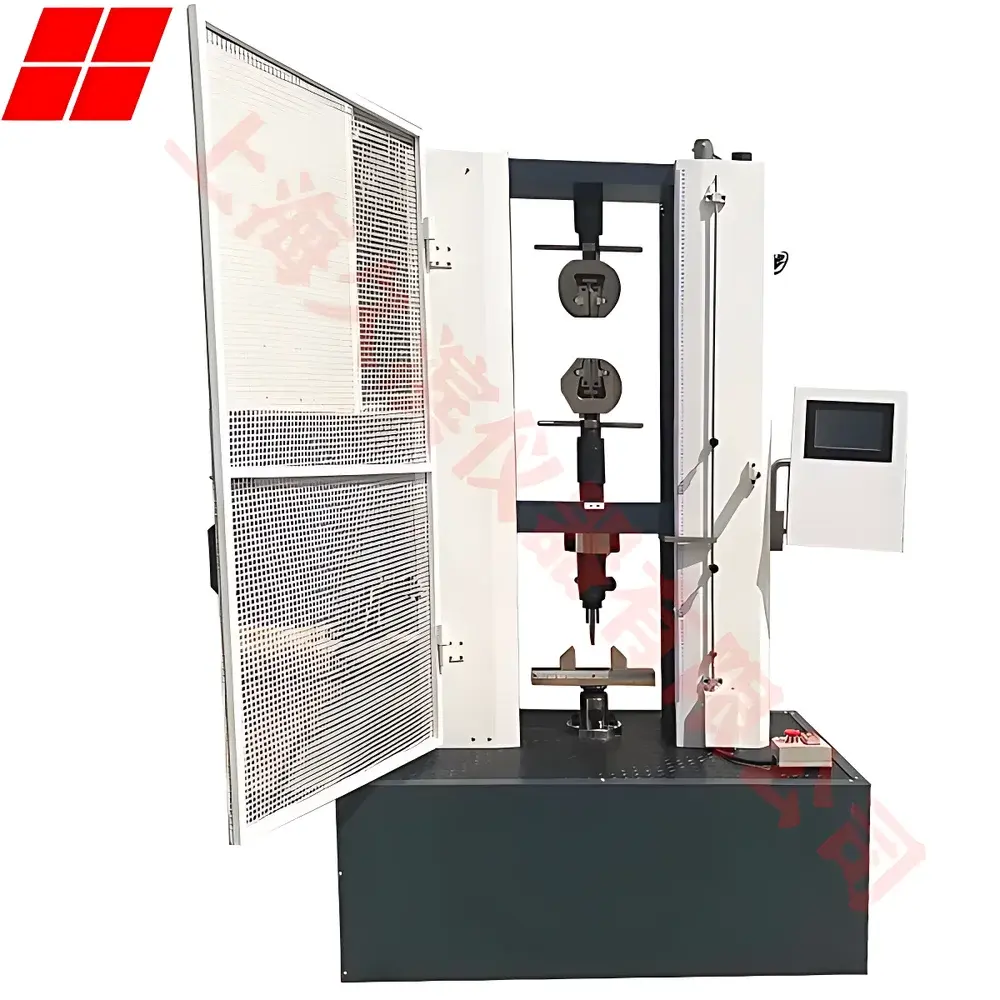
JB–120A 10-Ton Electronic Universal Testing Machine
| Brand | Jiubin Instruments |
|---|---|
| Origin | Shanghai, China |
| Model | JB–120A |
| Type | Electromechanical Universal Testing Machine |
| Load Capacity | 100 kN (10 Ton) |
| Compliance | GB/T 228.1–2021, ISO 6892–1:2019, ASTM E8/E8M |
| Control System | Digital Closed-Loop Servo Control |
| Test Modes | Tensile, Compression, Bending, Yield Strength, Elongation at Break, Modulus of Elasticity |
| Data Acquisition Rate | Up to 1,000 Hz |
| Force Accuracy | ±0.5% of full scale |
| Displacement Resolution | 0.001 mm |
| Crosshead Speed Range | 0.001–500 mm/min |
| Software | JiubinTest v3.2 (GLP-compliant audit trail, user permission levels, FDA 21 CFR Part 11 ready configuration) |
Overview
The JB–120A 10-Ton Electronic Universal Testing Machine is a precision electromechanical system engineered for static mechanical property characterization of metallic, polymeric, composite, and ceramic materials under controlled uniaxial loading conditions. Based on closed-loop servo-controlled load cell feedback and high-resolution linear encoder displacement measurement, the system implements standardized force–displacement transduction per ISO 6892–1:2019 (metallic tensile testing), GB/T 228.1–2021 (Chinese national standard equivalent), and ASTM E8/E8M (tension tests of metallic materials). Its 100 kN (10-ton) capacity supports routine quality control and R&D-grade evaluation of yield strength, ultimate tensile strength, elongation at break, reduction in area, modulus of elasticity, and flexural properties via three-point or four-point bending configurations. The machine’s rigid dual-column frame, preloaded ball-screw drive, and thermally stable load cell architecture ensure high reproducibility across repeated test cycles—critical for laboratories operating under GLP or GMP-aligned workflows.
Key Features
- Electromechanical actuation with digital servo control for precise crosshead positioning and constant-rate loading (0.001–500 mm/min)
- 100 kN high-accuracy load cell calibrated to ±0.5% of full scale, traceable to national metrological standards
- Integrated high-resolution linear encoder (0.001 mm displacement resolution) for strain-independent elongation measurement
- Dual-column heavy-duty steel frame with reinforced base plate and adjustable leveling feet for vibration damping
- Modular grip systems: wedge-action pneumatic grips for metals, screw-action grips for polymers, and custom bending fixtures (ASTM D790/D790M compliant)
- Real-time data acquisition at up to 1,000 Hz, enabling accurate capture of yield point onset and necking behavior
- Overload protection, emergency stop circuitry, and interlocked safety guarding meeting IEC 61508 SIL2 requirements
Sample Compatibility & Compliance
The JB–120A accommodates specimens ranging from thin films (≥0.1 mm thickness) to structural bars (≤40 mm diameter) and flat coupons (up to 120 mm wide × 300 mm gauge length). Standardized test configurations include tensile testing per ISO 6892–1, compression per ISO 7500–1, and flexure per ISO 178 and ASTM D790. All hardware and firmware comply with electromagnetic compatibility (EMC) directives (IEC 61326–1) and low-voltage safety standards (IEC 61000–6–2/–4). The system supports audit-ready documentation workflows aligned with GLP (OECD Principles), ISO/IEC 17025, and FDA 21 CFR Part 11 when configured with JiubinTest v3.2’s electronic signature, role-based access control, and immutable audit trail functionality.
Software & Data Management
JiubinTest v3.2 is a Windows-based, multi-language test control and analysis platform designed for regulatory compliance and traceability. It provides real-time force–displacement curve visualization, automatic yield point detection (0.2% offset method), modulus calculation (linear fit over specified strain range), and statistical reporting (mean, SD, CV%) across test batches. Raw data export is supported in CSV, XML, and PDF formats; all metadata—including operator ID, calibration date, environmental temperature/humidity logs, and instrument serial number—is embedded. Audit trails record every parameter change, test initiation, and report generation event with timestamp and user attribution. Optional integration with LIMS via ASTM E1384-compliant HL7 or ODBC interfaces enables seamless laboratory-wide data synchronization.
Applications
This system serves as a core mechanical characterization tool across academic research labs (e.g., Tsinghua University, Shanghai Jiao Tong University), industrial QC departments (BYD, Geely, SAIC Motor), pharmaceutical packaging validation (Kangmei Pharmaceutical), advanced material development (Beijing Graphene Institute), and third-party certification bodies (CTI, Huace Testing). Typical use cases include: tensile property mapping of aluminum alloys for automotive crash simulation; elongation-to-failure assessment of medical-grade silicone tubing per ISO 5840; flexural modulus determination of fiber-reinforced composites used in wind turbine blades; and creep rupture evaluation of geosynthetic clay liners under sustained load per ASTM D5262.
FAQ
What is the maximum specimen height accommodated in compression mode?
The effective test space between platens is 1,200 mm, supporting specimens up to 1,100 mm in height with standard platens.
Does the system support high-temperature testing?
The base configuration operates at ambient temperature (10–35°C); optional furnace modules (–70°C to +1,200°C) are available with thermal shielding and load cell compensation.
Can test methods be saved and recalled as templates?
Yes—JiubinTest v3.2 allows creation, versioning, and password-protected storage of fully parameterized test methods, including speed profiles, trigger conditions, and post-test actions.
Is calibration certificate included with delivery?
A factory calibration certificate traceable to CNAS-accredited reference standards is supplied; on-site verification and ISO/IEC 17025 calibration services are available upon request.
How is data integrity ensured during power interruption?
The system features non-volatile memory that retains active test data and configuration settings; uninterruptible power supply (UPS) integration is recommended for mission-critical environments.



