
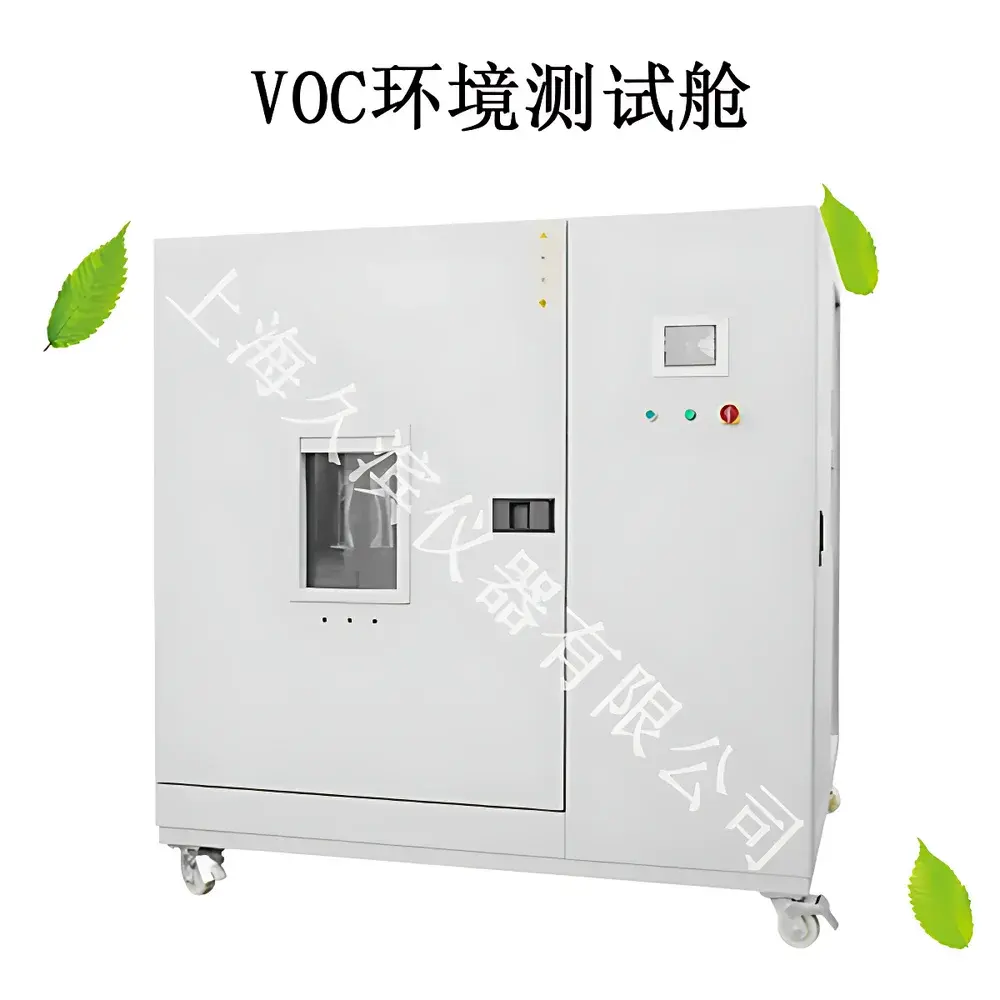
JB-220E 1 m³ Formaldehyde Emission Climate Chamber
| Brand | Jiubin Instruments |
|---|---|
| Origin | Shanghai, China |
| Model | JB-220E |
| Measurement Principle | Photometric Method (based on acetylacetone derivatization) |
| Chamber Volume | 1 m³ |
| Temperature Control Range | 15–30 °C (±0.5 °C uniformity) |
| Relative Humidity Control Range | 30–70 % RH (±3 % RH stability) |
| Air Exchange Rate | 0.5–1.5 h⁻¹ (adjustable, calibrated per ISO 12460-1) |
| Internal Surface Material | Stainless Steel 316L with electropolished finish |
| Sample Capacity | Up to 1.0 m² test specimen (standardized board or furniture panel) |
| Compliance | ISO 12460-1, GB/T 17657–2013, ASTM D6007–22, JIS A 1460 |
Overview
The JB-220E 1 m³ Formaldehyde Emission Climate Chamber is a precision-engineered environmental test system designed for standardized determination of formaldehyde emission rates from wood-based panels, laminates, adhesives, and finished furniture components. It operates on the principle of dynamic chamber testing: test specimens are conditioned under strictly controlled temperature, relative humidity, and air exchange rate; emitted formaldehyde accumulates in the recirculating air stream and is periodically sampled via impinger absorption in acetylacetone solution. The resulting chromophore is quantified photometrically at 412 nm using a calibrated spectrophotometer—fully aligned with the reference method specified in ISO 12460-1 and GB/T 17657–2013. Unlike passive or diffusion-based analyzers, this chamber provides gravimetrically traceable, time-resolved emission data essential for compliance certification, material development, and quality assurance in regulated supply chains.
Key Features
- Stainless steel 316L chamber interior with electropolished surface finish—minimizing formaldehyde adsorption and ensuring long-term measurement reproducibility.
- Microprocessor-controlled dual-loop HVAC system delivering ±0.5 °C temperature uniformity and ±3 % RH stability across the full 1 m³ working volume.
- Calibrated, mass-flow-controlled air exchange system (0.5–1.5 h⁻¹), independently verified using SF₆ tracer gas per ISO 12460-1 Annex B.
- Integrated sample support rack accommodating up to 1.0 m² of standardized test specimens (e.g., 500 mm × 500 mm panels at 1:1 surface-area-to-volume ratio).
- Real-time monitoring of chamber conditions (T, RH, airflow) with audit-trail-capable data logging compliant with GLP requirements.
- Modular design enabling seamless integration with external HPLC or UV-Vis spectrophotometers for post-sampling analysis.
Sample Compatibility & Compliance
The JB-220E accommodates solid, flat, or low-porosity materials including particleboard, MDF, plywood, laminate flooring, engineered wood composites, and coated substrates. Specimens must be conditioned per ISO 12460-5 prior to loading. The chamber meets structural and operational requirements of ISO 12460-1:2022, ASTM D6007–22 (Standard Test Method for Formaldehyde Release from Wood Products Using a Small-Scale Environmental Chamber), JIS A 1460:2021, and China’s national standard GB/T 17657–2013 (Section 4.59). All control algorithms and calibration protocols are documented per ISO/IEC 17025:2017 for testing laboratories. Optional IQ/OQ documentation packages support GMP and FDA-regulated environments.
Software & Data Management
The embedded controller runs deterministic real-time firmware with local storage of all environmental parameters at 1-minute intervals. Exported CSV files include timestamps, setpoints, measured values, and operator annotations—structured for direct import into LIMS or statistical process control platforms. Audit trail functionality records user logins, parameter changes, and calibration events with immutable timestamps, satisfying 21 CFR Part 11 requirements when paired with validated third-party spectrophotometry software. No cloud connectivity or remote access is implemented by default—ensuring data sovereignty and network isolation in secure laboratory networks.
Applications
- Formaldehyde emission certification for CE-marked furniture and construction products entering EU markets.
- R&D validation of low-emission resin formulations (e.g., UF, PF, MUF adhesives) in industrial R&D labs.
- Batch release testing for flooring manufacturers supplying to LEED-certified building projects.
- Third-party verification for CNAS-accredited testing laboratories performing GB 18580–2017 compliance assessments.
- Long-term aging studies assessing emission decay kinetics under accelerated climatic stress (e.g., 23 °C / 50 % RH → 28 °C / 70 % RH transitions).
- Interlaboratory comparison exercises coordinated under APAC or ILAC MRA frameworks.
FAQ
What formaldehyde sampling method does the JB-220E require?
It uses the standard impinger-based acetylacetone (AA) derivatization method. Samples are collected in 10 mL of AA reagent at defined intervals (e.g., days 7, 14, 28), followed by spectrophotometric analysis at 412 nm.
Is the chamber suitable for VOC co-emission profiling?
No—the JB-220E is purpose-built for formaldehyde only. For multi-analyte profiling (e.g., TVOC, benzene, toluene), a GC-MS coupled dynamic chamber system is required.
Can it operate continuously for 28-day tests without manual intervention?
Yes. With scheduled sampling ports and pre-programmed environmental profiles, unattended operation for up to 30 days is supported, provided impinger solutions are pre-loaded and temperature/humidity setpoints remain within specification.
Does the system include factory calibration certificates?
Each unit ships with NIST-traceable calibration reports for temperature sensors, RH probes, and mass flow controllers—valid for 12 months from date of shipment.
What maintenance is required between tests?
After each test cycle, the chamber interior must be purged with zero-air for ≥4 hours, followed by visual inspection and wipe-down of stainless surfaces with IPA. Annual recalibration of all sensors is recommended.







