
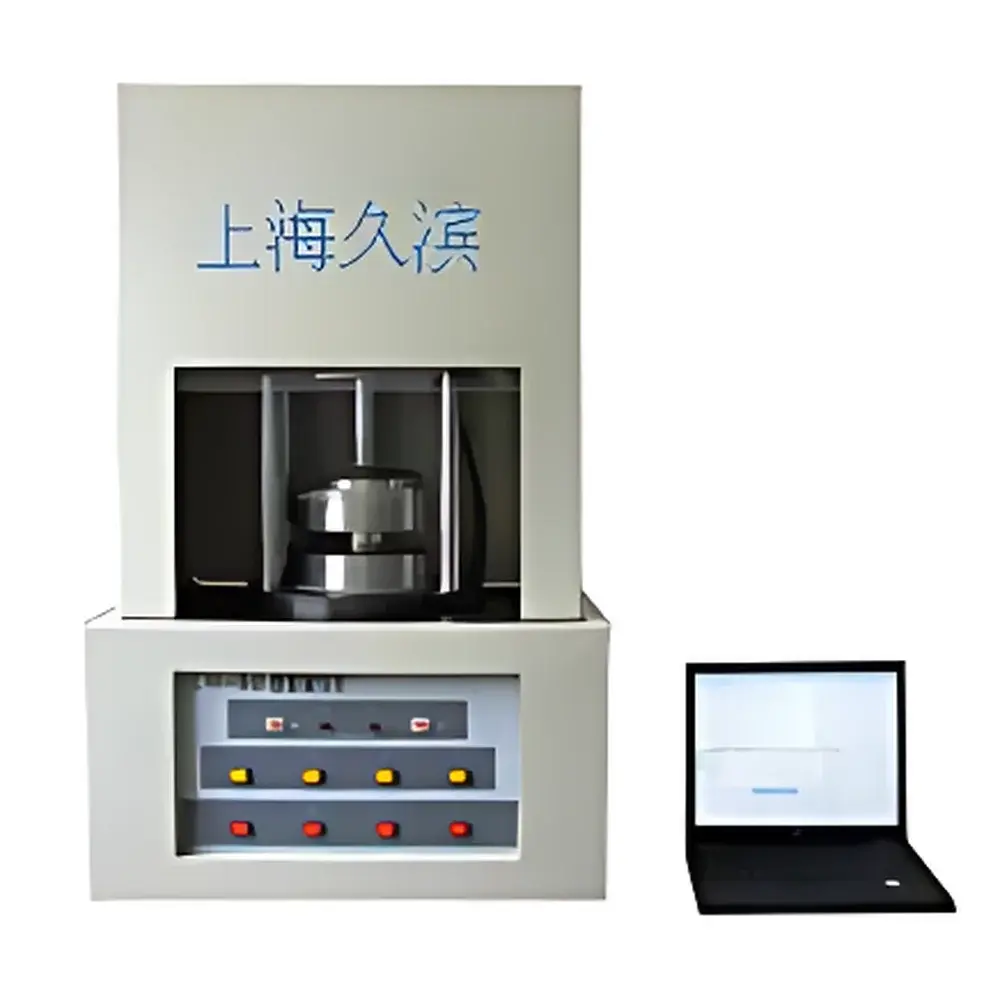
JB-236 Vulcanizometer (Rotating and Oscillating Rotor Types) by Jiubin Instruments
| Brand | Jiubin Instruments |
|---|---|
| Origin | Shanghai, China |
| Model | JB-236 |
| Temperature Control Range | 100–200 °C |
| Heating Time | <10 min |
| Oscillation Frequency | 1.7 ± 0.1 Hz (100 rpm) |
| Oscillation Angle | 0.5° or 1° |
| Rotor Diameter (with rotor) | 35.55 ± 0.07 mm |
| Torque Range | 0–30 N·m |
| Torque Resolution | 0.01 N·m |
| Power Supply | 220 V AC |
| Pneumatic Pressure Requirement | 0.5 MPa |
| Output | Date, Time, Temperature, Manufacturer ID, Vulcanization Curve, Temperature Profile, ML, MH, t90, and Related Curing Parameters |
Overview
The JB-236 Vulcanizometer is a precision-cured elastomer characterization instrument engineered for quantitative evaluation of rubber compound vulcanization kinetics under controlled thermal and mechanical conditions. Based on the principle of oscillatory shear rheometry—either via rotating or oscillating rotor configurations—the system measures torque response as a function of time during crosslinking, enabling derivation of critical cure parameters including scorch time (ts1, ts2), optimum cure time (t90), minimum and maximum torque (ML, MH), and cure rate index (CRI). Designed in accordance with ASTM D5289 and ISO 6502 standards, the JB-236 supports both quality assurance in production environments and formulation development in R&D laboratories across tire manufacturing, aerospace sealing, automotive NVH components, and industrial rubber goods sectors.
Key Features
- Modular microprocessor-based control architecture with real-time PID temperature regulation across 100–200 °C, achieving ±0.3 °C thermal stability over full operating range
- Dual-mode rotor configuration: selectable oscillating (0.5° or 1° amplitude) and rotating rotor variants to accommodate diverse compound viscoelastic profiles and industry-specific test protocols
- High-resolution torque transduction system with 0.01 N·m resolution and 0–30 N·m dynamic range, calibrated traceable to national metrology institutes
- Integrated pneumatic actuation system (0.5 MPa supply) ensuring consistent rotor engagement force and minimized mechanical hysteresis
- Onboard thermal profiling capability with synchronized temperature logging alongside torque acquisition, supporting correlation of thermal history with cure state evolution
- Comprehensive data export interface (USB and RS-232) compatible with third-party LIMS and statistical process control (SPC) platforms
Sample Compatibility & Compliance
The JB-236 accommodates standard ASTM D5289 and ISO 6502 sample geometries—including 40 mm diameter × 10 mm thick discs—and is validated for use with natural rubber (NR), styrene-butadiene rubber (SBR), ethylene propylene diene monomer (EPDM), nitrile rubber (NBR), silicone (VMQ), and fluoroelastomers (FKM). All firmware and hardware design elements comply with IEC 61000-6-2/6-4 electromagnetic compatibility requirements. The instrument’s operational documentation and calibration records support GLP-compliant environments; audit trails for parameter changes and test execution are maintained per internal SOPs aligned with FDA 21 CFR Part 11 principles where electronic records are deployed.
Software & Data Management
Bundled Windows-compatible software provides real-time curve visualization, automatic parameter extraction (ts1, t90, ML, MH, ΔM), comparative overlay of multiple runs, and customizable report generation including timestamped metadata, operator ID, and environmental conditions. Raw torque/time and temperature/time datasets are exported in CSV format for advanced modeling in MATLAB, Python (SciPy), or JMP. Software validation packages—including IQ/OQ documentation templates—are available upon request to support regulated laboratory qualification processes.
Applications
- Formulation optimization: Quantifying effects of accelerator type/concentration, sulfur loading, filler dispersion, and plasticizer addition on cure onset and network development
- Batch-to-batch consistency monitoring: Statistical analysis of t90 and MH variation to validate raw material lot acceptance criteria
- Processing window definition: Determination of safe processing temperatures and times prior to scorch onset in extrusion and calendering operations
- Aging and reversion studies: Isothermal and non-isothermal protocols to assess post-cure degradation behavior under elevated temperature exposure
- Quality control in Tier-1 automotive supply chains: Integration into automated QC workflows with pass/fail thresholds linked to customer-specified ML/MH ratios and t90 tolerances
FAQ
What standards does the JB-236 comply with for vulcanization testing?
ASTM D5289, ISO 6502, and GB/T 16584 are fully supported through standardized test routines, sample geometry definitions, and parameter calculation algorithms embedded in firmware.
Can the JB-236 be integrated into an existing LIMS or MES environment?
Yes—via ASCII-based serial protocol (RS-232) or USB virtual COM port, enabling direct data ingestion into laboratory information management systems without proprietary middleware.
Is calibration traceability provided with the instrument?
Each unit ships with a factory calibration certificate referencing NIM (National Institute of Metrology, China) traceable torque and temperature standards; annual recalibration services are available globally through authorized service centers.
Does the system support non-standard oscillation frequencies or amplitudes?
No—the JB-236 operates exclusively at 1.7 ± 0.1 Hz (100 rpm) and fixed angular displacements of 0.5° or 1° to ensure inter-laboratory reproducibility per international standard requirements.
What maintenance is required for long-term operational reliability?
Routine cleaning of rotor cavity and die surfaces after each test, periodic verification of pneumatic pressure regulator output, and annual verification of temperature sensor drift using certified reference thermocouples.
Related Products






