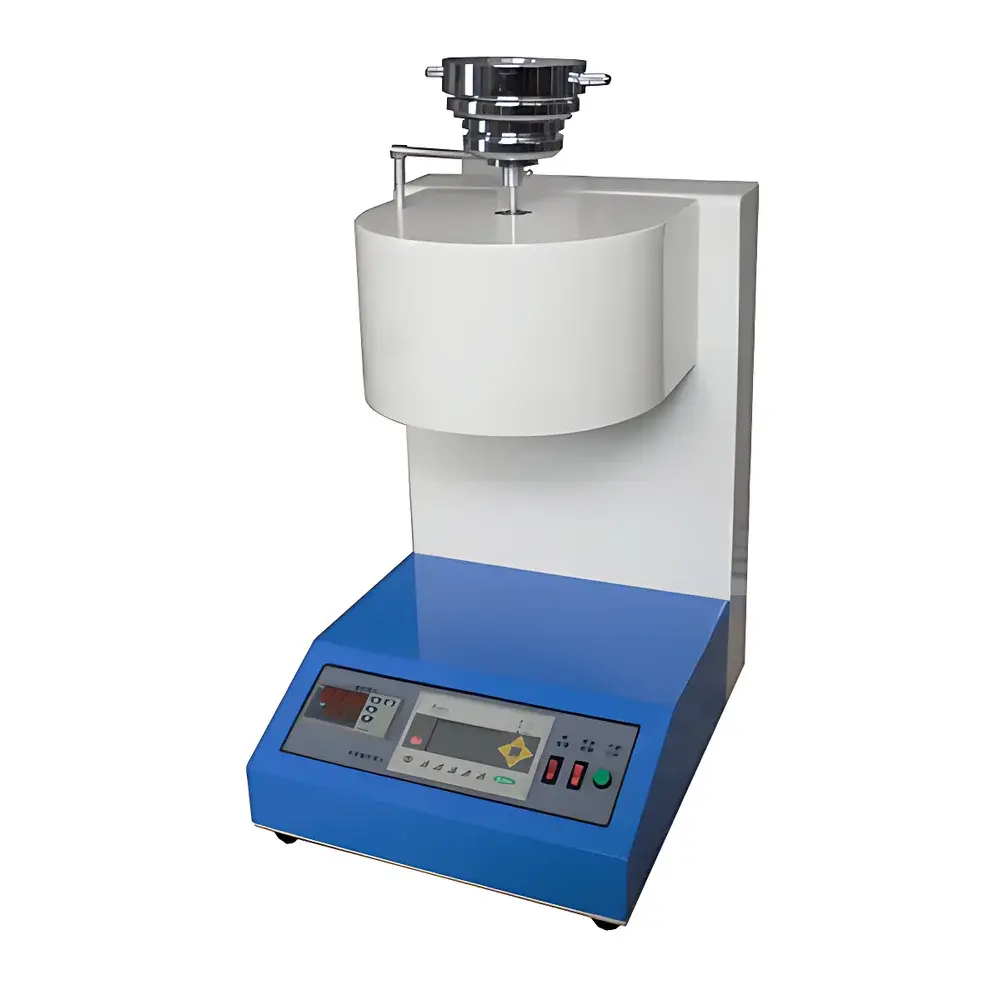
JB-280B Dual-Method Melt Flow Indexer – Jiubin Instruments
| Key | Brand: Jiubin Instruments |
|---|---|
| Model | JB-280B |
| Origin | Shanghai, China |
| Temperature Range | 50–400 °C |
| Temperature Accuracy | ±0.2 °C |
| Display Resolution | 0.1 °C |
| Die Diameter | 2.095 ±0.005 mm |
| Barrel ID | 9.550 ±0.025 mm |
| Piston Head OD | 9.475 ±0.01 mm |
| Piston Length | 6.35 ±0.1 mm |
| Stroke Detection Range | 30 mm |
| Displacement Accuracy | ±0.1 mm |
| Standard Load Levels | 3.185 N, 11.76 N, 21.168 N, 37.24 N, 49 N |
| Max Power Consumption | ≤500 W |
| Temperature Recovery Time | 4 min |
Overview
The JB-280B Dual-Method Melt Flow Indexer is a precision-engineered instrument designed for the quantitative determination of melt mass flow rate (MFR) and melt volume flow rate (MVR) of thermoplastic polymers under standardized thermal and mechanical conditions. Based on the fundamental principle of extrusion rheometry—where molten polymer is forced through a standardized capillary die under controlled temperature and applied load—the JB-280B complies with international test standards including ISO 1133-1:2011, ASTM D1238-22, and GB/T 3682.2–2018 (for MVR) and GB/T 3682.1–2018 (for MFR). Its dual-method architecture enables seamless transition between gravimetric (Method A) and volumetric (Method B) measurement protocols without hardware reconfiguration, supporting routine quality control in polymer compounding, extrusion, and injection molding facilities.
Key Features
- Integrated high-stability heating block fabricated from nickel-chromium alloy via precision die-casting—engineered to maintain uniform thermal distribution across the 50–400 °C operating range with minimal thermal drift.
- Dual-mode operation: automatic MFR calculation per ISO 1133-1 Annex A (mass-based cut-and-weigh), and MVR derivation via optical displacement sensing of piston travel (Method B), compliant with ISO 1133-1 Annex B.
- Full-featured embedded controller with 4.3-inch color TFT LCD interface supporting both Chinese and English language modes—designed for intuitive navigation by operators in multilingual manufacturing environments.
- Automated workflow execution: programmable start/stop via wireless remote control, auto-timed extrusion cycles, motorized cutter activation, real-time piston position tracking, and on-board calculation of MFR (g/10 min) and MVR (cm³/10 min).
- Thermal performance validated to ±0.2 °C accuracy with 0.1 °C display resolution; temperature recovery to setpoint within 4 minutes after load insertion, ensuring repeatability across sequential tests.
- Robust mechanical architecture featuring precision-ground barrel (ID 9.550 ±0.025 mm), hardened piston (OD 9.475 ±0.01 mm, length 6.35 ±0.1 mm), and certified capillary die (ID 2.095 ±0.005 mm), all traceable to NIST-traceable dimensional calibration protocols.
Sample Compatibility & Compliance
The JB-280B is validated for use with a broad spectrum of thermoplastics, including polyethylene (PE), polypropylene (PP), acrylonitrile-butadiene-styrene (ABS), polystyrene (PS), polyamide (PA6, PA66), polyoxymethylene (POM), polycarbonate (PC), poly(methyl methacrylate) (PMMA), and fluoropolymers (e.g., PTFE, PVDF). It supports all standard test loads defined in ISO 1133 and ASTM D1238—five calibrated force levels (3.185 N to 49 N) generated via certified stainless-steel weights with documented mass uncertainty ≤±0.05%. The system meets requirements for GLP-compliant laboratories when paired with audit-trail-enabled data export; while the instrument itself does not embed FDA 21 CFR Part 11 electronic signature functionality, raw test logs (timestamped MFR/MVR values, temperature profiles, cut timestamps) are exportable via USB for integration into LIMS or validated QA documentation systems.
Software & Data Management
The onboard firmware stores up to 100 test records with full metadata: test date/time, operator ID (manually entered), material grade, test method (A/B), load level, temperature setpoint, measured MFR/MVR, piston displacement curve (for Method B), and pass/fail status against user-defined specification limits. Data output includes ASCII-formatted CSV files compatible with Excel, MATLAB, or statistical process control (SPC) platforms. Optional PC-based software (Jiubin MFI-Link v2.1) provides advanced features: multi-instrument fleet monitoring, SPC charting (X-bar/R, Cp/Cpk), automated report generation per ISO/IEC 17025 templates, and configurable PDF export with lab header, technician signature field, and calibration certificate references.
Applications
- Routine QC testing of incoming polymer resin batches against supplier specifications and internal material release criteria.
- Process validation of extrusion screw design and melt temperature profiles via comparative MFR analysis at multiple shear rates.
- Stability assessment of polymer degradation during repeated processing cycles (e.g., regrind studies).
- Correlation of MFR with mechanical properties (tensile strength, impact resistance) in formulation development labs.
- Supporting ISO 9001:2015 and IATF 16949 audits through documented traceability of test parameters, calibration records, and operator training logs.
FAQ
Does the JB-280B comply with ASTM D1238 Condition E (2.16 kg load at 190 °C for PE)?
Yes—Condition E is fully supported using the 2.16 kg weight set (Level 3, 21.168 N) and temperature setpoint of 190.0 °C.
Can MVR be calculated without installing the optional B-method optical sensor?
No—MVR requires precise piston displacement measurement; the optical encoder kit must be installed and calibrated for Method B operation.
What is the recommended calibration frequency for the temperature system?
Per ISO/IEC 17025, temperature verification using a calibrated reference thermometer (e.g., platinum RTD Class A) is required before each daily shift and after any maintenance affecting the heating block.
Is the micro-printer capable of generating GLP-compliant hardcopy reports?
The built-in thermal printer outputs time-stamped results with test ID, but for full GLP compliance (e.g., audit trail, operator ID, calibration status), digital export and external report generation are recommended.
Are replacement dies and pistons supplied with NIST-traceable calibration certificates?
Yes—certified spare parts (die, piston, barrel) are available with individual calibration reports traceable to CNAS-accredited metrology labs, including dimensional verification and thermal expansion coefficient data.