
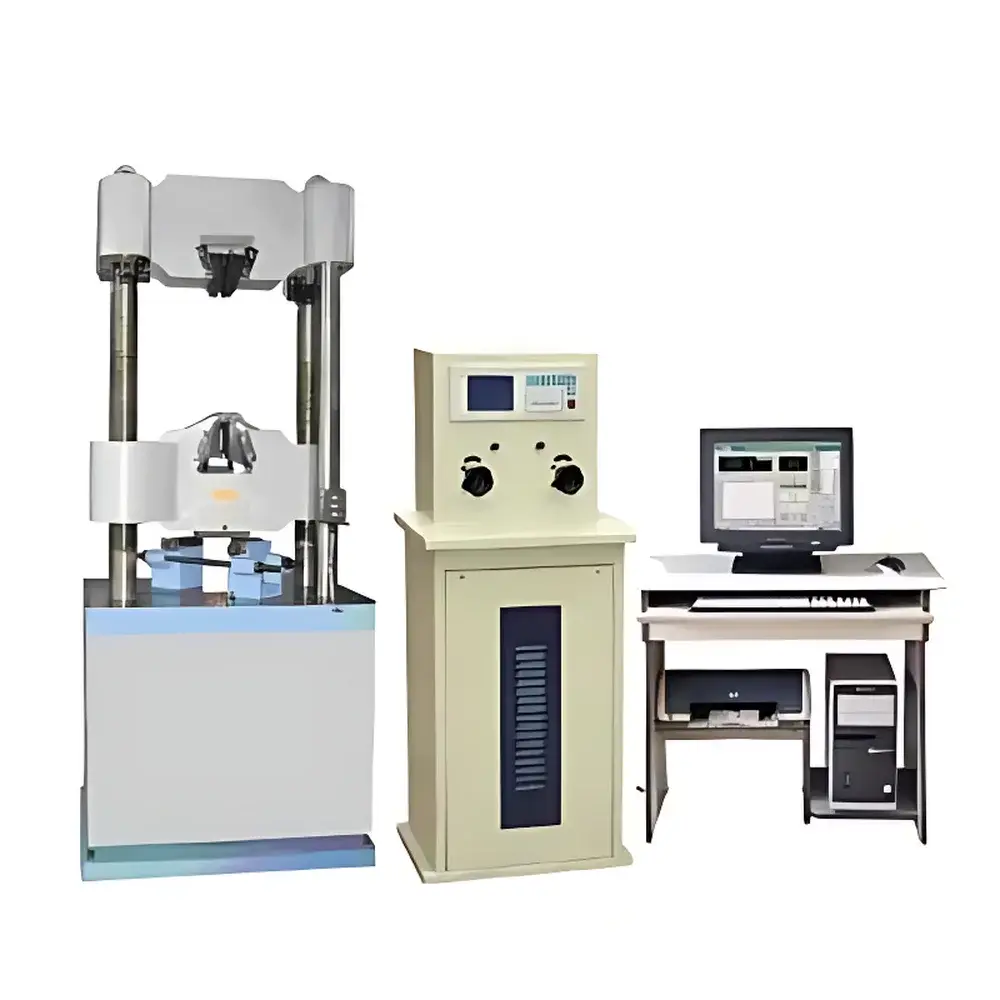
JB-300A Hydraulic Universal Testing Machine
| Brand | Jiubin Instruments |
|---|---|
| Origin | Shanghai, China |
| Model | JB-300A |
| Capacity | 0–300 kN (selectable within range) |
| Load Cell | High-precision U.S.-manufactured load cell |
| Load Accuracy | ±1% of full scale |
| Effective Test Width | 300 mm |
| Max. Tensile Travel | 550 mm |
| Drive System | Hydraulic actuation with electro-hydraulic servo control |
| Test Speed Range | 5–500 mm/min |
| Display & Control | Dual-mode interface — embedded microcomputer + PC-based software |
| Unit Options | g, kg, N, kN, lbf, lb |
| Fixture Mounting | Standard T-slot crosshead and base |
| Optional Accessories | PC workstation, thermal/inkjet printer, extensometer (contact or non-contact), ISO/ASTM-compliant test software module |
| Net Weight | 1580 kg |
| Compliance | Designed to meet general requirements of ISO 6892-1, ASTM E4, ASTM E8, and GB/T 228.1 |
Overview
The JB-300A Hydraulic Universal Testing Machine is an industrial-grade electromechanical testing system engineered for high-force static mechanical characterization of metallic, polymeric, composite, elastomeric, textile, and electrical component materials. It operates on a closed-loop electro-hydraulic servo principle, where hydraulic pressure—regulated by a proportional servo valve—is precisely modulated in response to real-time feedback from a high-stability U.S.-sourced load cell and position encoder. This architecture delivers consistent force application across the full 0–300 kN capacity range, enabling reliable execution of tensile, compression, flexural (3-point & 4-point bend), shear, peel, tear, and stripping tests under controlled displacement or load-rate conditions. The machine’s structural frame is fabricated from high-rigidity steel with reinforced column and crosshead assemblies, minimizing deflection during high-load testing and ensuring long-term metrological stability.
Key Features
- Robust hydraulic actuation system with integrated servo-valve control for smooth, low-noise force application and exceptional repeatability across extended test cycles.
- Dual-display architecture: embedded microcomputer panel for quick setup and real-time monitoring, plus full-featured PC software for advanced parameter configuration, curve analysis, and report generation.
- Modular fixture interface compliant with ISO 26203-2 and ASTM E1012 standards—supports interchangeable wedge-action, pneumatic, hydraulic, or screw-type grips tailored to specimen geometry and surface sensitivity.
- Five-step adjustable test speed selection (5–500 mm/min) via front-panel controls; programmable ramp-hold profiles supported through PC software for multi-stage loading protocols.
- Integrated unit conversion engine supporting SI and imperial units (N, kN, lbf, kgf, MPa, psi) with automatic scaling of stress-strain curves and tabular outputs.
- Structural footprint optimized for laboratory floor integration: floor-standing design with anti-vibration base mounting points and ergonomic access height for operator safety and workflow efficiency.
Sample Compatibility & Compliance
The JB-300A accommodates specimens up to 300 mm wide and 550 mm in active gauge length, making it suitable for standardized test bars (e.g., ASTM E8 rectangular coupons), wire ropes, cable terminations, molded plastic parts, laminated composites, and coated fabric substrates. Its mechanical compliance aligns with fundamental calibration and verification requirements outlined in ISO 7500-1 (Class 1 accuracy), ASTM E4 (load verification procedures), and GB/T 228.1 (metallic materials tensile testing). While not certified for GLP/GMP-regulated environments out-of-the-box, the system supports audit-ready data logging when paired with optional 21 CFR Part 11-compliant software modules—including electronic signatures, user access tiers, and immutable audit trails.
Software & Data Management
The standard test software provides real-time acquisition of load, displacement, and strain (when equipped with extensometer), with synchronized plotting of engineering stress–strain, true stress–strain, and load–time curves. Users may define custom test methods—including preload steps, yield point detection algorithms (0.2% offset, tangent, or automatic inflection), ultimate tensile strength (UTS), elongation at break, modulus calculation windows, and fracture energy integration. Raw data exports to CSV, Excel, or XML formats; reports are fully customizable using WYSIWYG templates compliant with ISO 14289-1 (PDF/A-1a) archival standards. Multi-curve overlay and statistical batch analysis tools facilitate comparative evaluation across material lots or process variations.
Applications
This system serves quality assurance laboratories in automotive Tier-1 suppliers (testing brake hoses, seat frames, fasteners), wire & cable manufacturers (conductor pull-out, insulation crush resistance), footwear R&D centers (sole adhesion, upper tear strength), and electronics assembly facilities (connector retention force, PCB flexural endurance). It is routinely deployed for incoming raw material verification against supplier specifications, in-process validation of heat-treated alloys, and failure mode analysis of field-return components. Educational institutions utilize the JB-300A for undergraduate mechanics of materials labs due to its intuitive interface, repeatable output, and compatibility with open-source data post-processing platforms (e.g., Python/Pandas, MATLAB).
FAQ
What is the maximum allowable specimen thickness for compression testing?
The effective compression platen gap is adjustable up to 550 mm; maximum specimen height is constrained only by platen parallelism tolerance—typically ≤150 mm for optimal load uniformity per ISO 376 guidelines.
Can the system perform cyclic fatigue testing?
No—the JB-300A is designed exclusively for quasi-static monotonic and stepwise loading. For dynamic or high-cycle fatigue applications, a dedicated servo-hydraulic fatigue testing system with waveform generator and closed-loop strain control is required.
Is third-party calibration documentation included with delivery?
A factory-assembled calibration certificate traceable to NIM (China National Institute of Metrology) is provided; users must arrange periodic recalibration per ISO/IEC 17025-accredited providers based on usage frequency and regulatory requirements.
Does the software support automated pass/fail evaluation against preset limits?
Yes—threshold-based logic rules can be configured for parameters such as yield strength, elongation %, or load at specified displacement; results trigger visual alerts and auto-classify outcomes into Accept/Reject categories.
What maintenance intervals are recommended for hydraulic oil and filter replacement?
Hydraulic fluid should be replaced every 2,000 operating hours or biannually (whichever occurs first); the return-line filter requires inspection every 500 hours and replacement if differential pressure exceeds 3 bar.



