
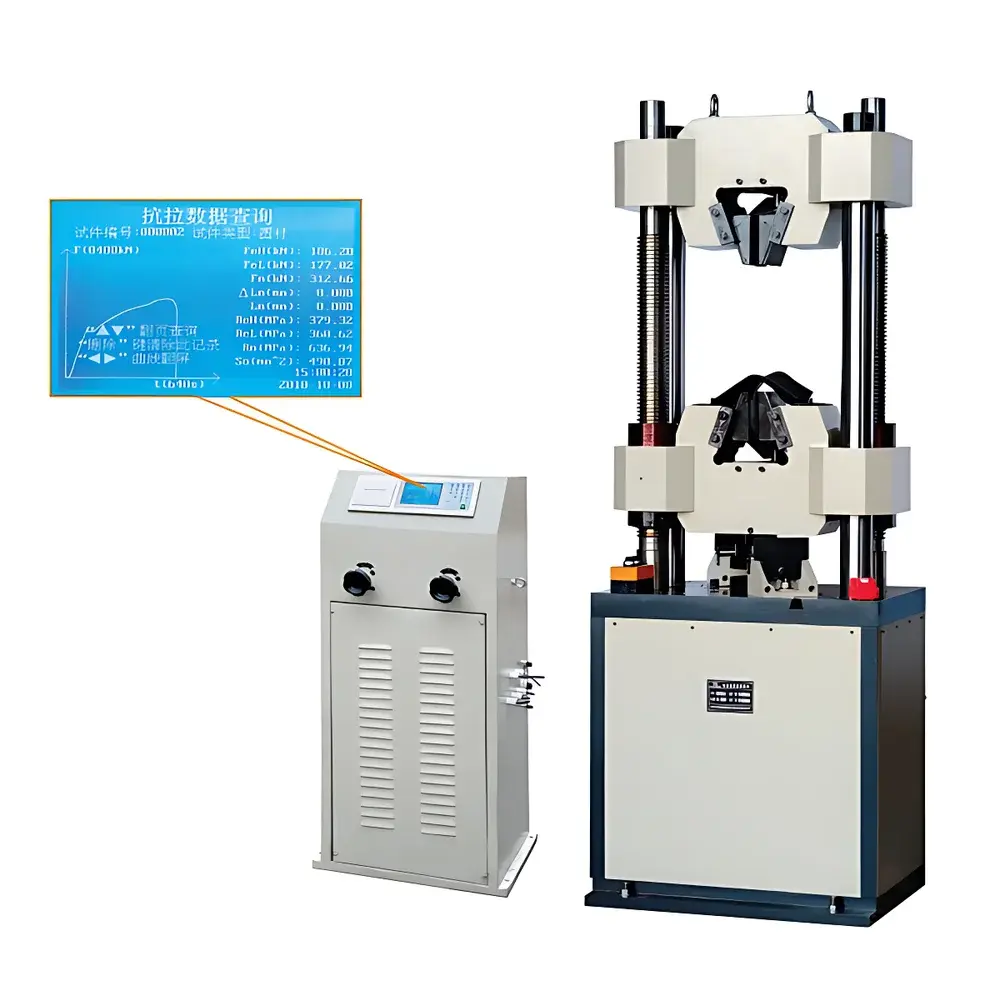
JB/WE-300B Hydraulic Universal Testing Machine by Jiubin Instruments
| Brand | Jiubin Instruments |
|---|---|
| Origin | Shanghai, China |
| Model | JB/WE-300B |
| Type | Hydraulic Universal Testing Machine |
| Max. Test Force | 300 kN |
| Force Measurement Range | 12–300 kN |
| Force Accuracy | ≤ ±1% of reading |
| Force Resolution | 0.01 kN |
| Tensile Space | 550 mm |
| Compression Space | 380 mm |
| Piston Stroke | 150 mm |
| Round Specimen Grip Range | Φ6–Φ26 mm |
| Flat Specimen Grip Thickness | 0–15 mm |
| Flat Specimen Max. Width | 70 mm |
| Compression Platen Diameter | φ160 mm |
| Bend Span (Two-Point) | 450 mm |
| Bend Roller Width | 120 mm |
| Bend Roller Diameter | Φ30 mm |
| Piston Speed | 50 mm/min |
| Clamping Method | Manual |
| Host Dimensions (W×D×H) | 720×580×1950 mm |
| Control Console Dimensions (W×D×H) | 1000×700×1400 mm |
Overview
The JB/WE-300B Hydraulic Universal Testing Machine is a robust, oil-cylinder-underneath configured mechanical testing system engineered for precision static mechanical property evaluation of metallic and non-metallic materials under uniaxial loading conditions. Based on the classical principle of hydraulic force amplification and load cell-based force transduction, it delivers stable, repeatable axial force application across tension, compression, bending, and—when equipped with optional shear fixtures—shear modes. Its low-profile structural design (total height < 2 m) and compact footprint make it especially suitable for field laboratories, construction site QA/QC units, prefabrication facilities, and educational institutions where ceiling clearance or floor space is constrained. The machine complies with fundamental mechanical testing geometries defined in ISO 6892-1 (tension), ISO 7500-1 (calibration of force-proving instruments), and ASTM E4 (load verification of testing machines), supporting traceable calibration and routine verification protocols.
Key Features
- Oil-cylinder-underneath architecture ensures low center of gravity, enhanced operational stability, and simplified specimen alignment—critical for high-force compression tests on concrete cylinders or steel columns.
- High-stability load cell (supplied by Zhenhai, Ningbo) with 0.01 kN resolution and ≤ ±1% indication error across 4%–100% of full scale (12–300 kN), meeting Class 1 accuracy per ISO 7500-1.
- Integrated LCD control panel displays real-time load–time curves, peak load, yield force (for materials exhibiting distinct yield points), and user-input parameters including specimen ID and cross-sectional area.
- Direct calculation of tensile strength, yield strength (upper/lower), modulus of elasticity (via manual slope measurement on curve), and percentage elongation—eliminating post-test manual computation.
- Manual wedge-type gripping system optimized for rapid specimen changeover; accommodates round specimens from Φ6 to Φ26 mm and flat specimens up to 70 mm wide × 15 mm thick.
- Dedicated compression platen (φ160 mm) and dual-point bending fixture (span adjustable to 450 mm, rollers Φ30 mm × 120 mm width) enable standardized testing per ISO 15630-1 (reinforcing steels) and GB/T 228.1 (Chinese national standard equivalent to ISO 6892-1).
Sample Compatibility & Compliance
The JB/WE-300B supports standardized mechanical characterization of ferrous and non-ferrous metals (e.g., structural steel, aluminum alloys, stainless grades), cementitious composites (concrete cubes/cylinders per ISO 4012), thermoplastics (rigid bars per ISO 527-2), and civil engineering components (welded joints, anchor bolts, chain links). Its configuration satisfies minimum requirements for ISO/IEC 17025-accredited laboratories performing routine mechanical verification, provided periodic calibration is performed using certified reference load cells and verified via dead-weight or hydraulic calibration systems. While not inherently 21 CFR Part 11 compliant (lacking electronic audit trail and user access controls), its data output—via built-in thermal printer—supports GLP-aligned record retention when paired with controlled documentation procedures.
Software & Data Management
The system operates via embedded firmware without external PC dependency. All test parameters—including specimen ID, nominal area, test mode (tension/compression/bend), and operator code—are entered via membrane keypad prior to testing. Real-time load–time traces are rendered on the monochrome LCD; numeric results (peak load, yield point, calculated strength values) are stored in non-volatile memory for up to 999 test records. Data export is limited to hardcopy output via integrated thermal printer (no USB/network interface). For laboratories requiring digital archiving, third-party analog voltage output (±5 V or 0–10 V proportional to load) allows connection to external DAQ systems or SCADA platforms for time-synchronized waveform capture and long-term trend analysis.
Applications
- Tensile testing of reinforcing bars (rebar) and welded wire mesh per ASTM A615/A1064 and ISO 15630-1.
- Compression testing of concrete cores (100 mm or 150 mm diameter) and mortar cubes per ASTM C39/C109 and ISO 4012.
- Bending evaluation of structural sections (I-beams, channels) and weldments using two-point loading geometry.
- Quality conformance checks for fasteners, chains, and lifting hardware per ISO 898-1 and EN 818-2.
- Educational demonstrations of stress–strain behavior, yielding, necking, and fracture modes in undergraduate materials science labs.
FAQ
What standards does the JB/WE-300B comply with for force measurement accuracy?
It meets ISO 7500-1 Class 1 requirements for static force verification, with ≤ ±1% indication error over 4–100% of full scale (12–300 kN) and 0.01 kN resolution.
Can this machine perform cyclic or fatigue testing?
No—it is designed exclusively for quasi-static monotonic loading. It lacks closed-loop displacement/strain control, servo-hydraulic actuation, or programmable load sequencing required for fatigue or creep testing.
Is the system compatible with ASTM E8/E9 test methods?
Yes—its geometry, force range, and grip configurations support ASTM E8 (tension) and E9 (compression) specimen dimensions and alignment tolerances when used with appropriate fixtures and calibration.
Does the machine include software for automated report generation?
No—the system provides only local display and thermal printout. Automated reporting requires integration with external DAQ software or manual transcription into LIMS-compatible formats.
What maintenance is required for long-term reliability?
Monthly hydraulic oil level inspection and annual replacement; biannual cleaning and lubrication of grip wedges and guide rods; annual recalibration of the load cell and verification of piston alignment per manufacturer’s service manual.



