
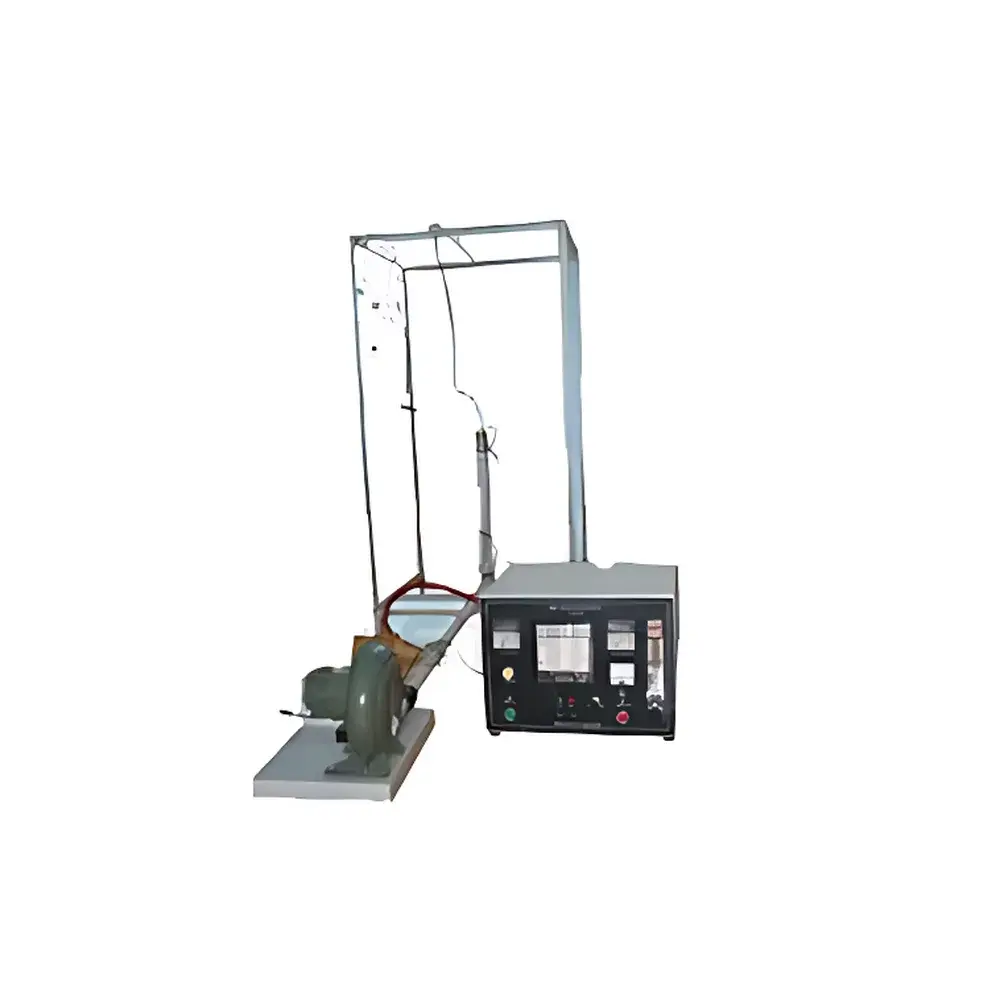
JB-322A Flame Spread Property Tester by Jiubin Instruments
| Brand | Jiubin Instruments |
|---|---|
| Model | JB-322A |
| Standard Compliance | GB 15442.2 |
| Test Principle | Vertical Furnace Method for Fire-Retardant Coating Performance |
| Sample Mounting | Single-Sided Coated Combustible Substrate |
| Alarm Threshold | Back-Surface Temperature ≥ 220 °C |
| Data Logging | Time-Temperature Curve Recording |
| Dimensions (L×W×H) | Test Stand 820 × 1500 mm |
| Warranty | 12-Month Parts & Labor, Lifetime Technical Support |
| Origin | Shanghai, China |
Overview
The JB-322A Flame Spread Property Tester is a vertically oriented furnace-based testing system engineered for quantitative evaluation of flame spread resistance and thermal barrier performance of intumescent and non-intumescent fire-retardant coatings applied to combustible substrates. Designed in strict accordance with the Chinese national standard GB 15442.2–2021, “Test Methods for Fire-Retardant Coatings for Steel Structures – Part 2: Determination of Flame Spread Index,” this instrument implements a controlled vertical furnace exposure protocol to simulate real-world fire exposure conditions. During operation, the coated test specimen is mounted on a rigid support frame and exposed to a defined thermal flux from a propane-fueled radiant panel or integrated furnace assembly. The system continuously monitors the temperature evolution on the unexposed (back) surface of the substrate using calibrated thermocouples—providing direct insight into coating insulation effectiveness and time-to-thermal-failure. This measurement principle aligns with fundamental heat transfer theory governing conductive and radiative energy transmission through layered composite systems under fire conditions.
Key Features
- Automated time–temperature data acquisition system with synchronized logging of back-surface thermocouple readings at user-defined intervals (default: 10 s resolution)
- Integrated thermal alarm logic: audible and visual alert triggered when back-surface temperature reaches or exceeds 220 °C—a critical threshold indicating loss of thermal integrity per GB 15442.2
- Dedicated mechanical test stand optimized for standardized specimen geometry (typically 450 mm × 450 mm × 12 mm wood or particleboard substrates per GB 15442.2 Annex A)
- Modular control cabinet housing programmable logic controller (PLC), solid-state relays, and isolated analog input modules for high-noise immunity in laboratory environments
- Compliance-ready documentation package including calibration traceability statement, GB 15442.2 test procedure reference guide, and maintenance log template
- Rugged steel-frame construction with insulated furnace chamber and viewing window for real-time observation without compromising thermal boundary conditions
Sample Compatibility & Compliance
The JB-322A supports standardized test specimens consisting of commercially available combustible substrates—including softwood, medium-density fiberboard (MDF), and particleboard—coated with single- or multi-layer fire-retardant formulations. Specimen preparation follows GB 15442.2 requirements for film thickness (measured via magnetic induction or micrometer), drying/curing conditions, and conditioning (23 ± 2 °C, 50 ± 5% RH for ≥48 h). While primarily aligned with GB 15442.2, the system’s thermal profile control and data recording architecture permit adaptation for comparative assessments against ASTM E84 (Surface Burning Characteristics) or ISO 834-1 (Fire Resistance Tests) when paired with appropriate calibration and reporting protocols. All hardware components meet CE-marked electrical safety standards (IEC 61000-6-3, IEC 61000-6-4) and are compatible with GLP-compliant laboratory quality systems.
Software & Data Management
Data capture is performed via embedded firmware with USB export capability for raw time–temperature datasets (.csv format). No proprietary software installation is required; exported files are directly importable into MATLAB, Excel, or LIMS platforms for statistical analysis, curve fitting, and report generation. The system records timestamps with millisecond precision and embeds metadata—including operator ID, sample ID, ambient lab conditions (manually entered), and calibration date—into each dataset header. Audit trail functionality is supported through external logging when integrated with laboratory information management systems (LIMS) compliant with ISO/IEC 17025:2017 clause 7.9 and FDA 21 CFR Part 11 requirements for electronic records.
Applications
- Quality assurance of intumescent coatings during batch release testing in manufacturing facilities
- R&D validation of novel flame-retardant additives (e.g., phosphorus-nitrogen synergists, nano-clay composites) under standardized thermal stress
- Regulatory submission support for building material certification (e.g., China CCC mark, local fire department approvals)
- Comparative benchmarking of coating performance across varying substrate types and application methods (brush, roller, spray)
- Educational use in fire science laboratories for teaching principles of thermal degradation kinetics and char layer formation dynamics
FAQ
Does the JB-322A comply with international fire testing standards beyond GB 15442.2?
The system is configured and validated specifically for GB 15442.2. Adaptation to ASTM E84 or ISO 834 requires additional hardware modifications (e.g., furnace configuration, airflow control) and method validation per ISO/IEC 17025.
What substrate materials are recommended for routine testing?
Softwood (e.g., pine) and MDF meeting GB/T 9846–2015 specifications are routinely used. Substrate density, moisture content, and grain orientation must be documented per test report requirements.
Is third-party calibration service available?
Yes—Jiubin Instruments provides NIST-traceable thermocouple calibration certificates upon request, with optional annual recalibration scheduling and on-site verification support.
Can the system interface with existing LIMS or SCADA infrastructure?
Raw data export via USB enables integration with most LIMS platforms. For direct RS-485 or Modbus TCP connectivity, custom firmware configuration and protocol mapping services are available under separate technical agreement.



