
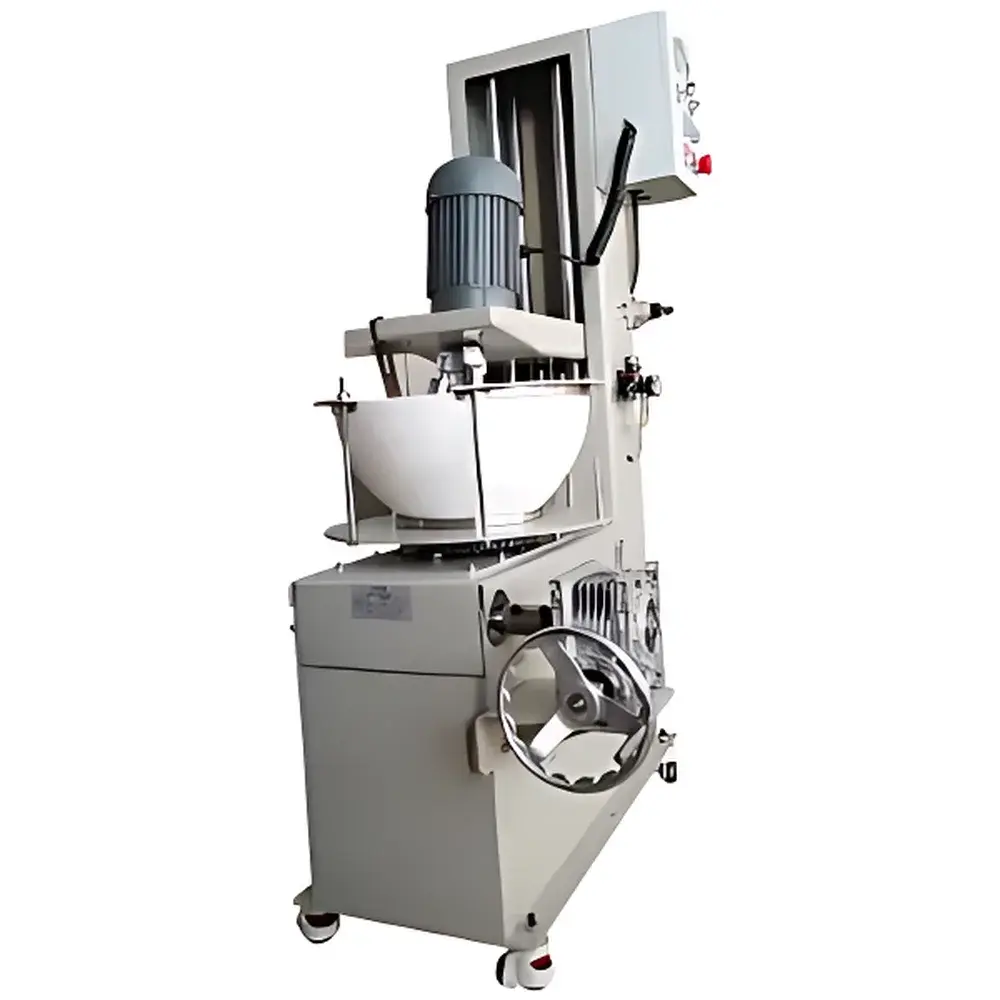
JB-400 Pneumatic-Lift Mortar-Type Grinder
| Brand | Jiubin Instruments |
|---|---|
| Model | JB-400 |
| Type | Mortar-and-Pestle Grinder |
| Drive | Pneumatic Lift Mechanism |
| Grinding Chamber Material | Alumina Ceramic (95% Al₂O₃) |
| Pestle Quantity | 3 |
| Pestle Rotation Speed | 0–180 rpm (Variable-Frequency Control) |
| Mortar Rotation Speed | 7 rpm (Fixed) |
| Pestle Motor Power | 750 W |
| Mortar Motor Power | 200 W |
| Mortar Dimensions | Ø400 mm × Depth 200 mm |
| Maximum Batch Capacity | 5 L |
| Final Particle Size | <0.01 mm (10 µm) |
| Sample Compatibility | Hard & Brittle Solids,膏-like Pastes (Wet Grinding) |
| Operating Pressure | 0.5 MPa (Recommended) |
| Grinding Time Range | 0–99 h 99 min |
| Overall Dimensions | 700 mm (L) × 1000 mm (W) × 1500 mm (H) |
| Net Weight | 200 kg |
| Electrical Supply | AC 220 V, 50/60 Hz |
Overview
The JB-400 Pneumatic-Lift Mortar-Type Grinder is an industrial-scale, programmable mortar-and-pestle grinding system engineered for high-integrity size reduction of hard, brittle, and semi-paste materials in regulated laboratory and pilot-scale production environments. Unlike rotor-stator or ball-mill configurations, this instrument operates on the principle of controlled compressive-shear comminution: three rotating alumina ceramic pestles orbit within a stationary, deep-walled alumina ceramic mortar while the mortar itself rotates slowly (7 rpm) to ensure uniform material feed and radial distribution. The pneumatic lift mechanism enables precise vertical positioning of the pestle assembly—critical for maintaining consistent gap geometry, minimizing thermal load, and preventing mechanical overloading during extended grinding cycles. Designed for reproducible microgrinding down to ≤10 µm (D₉₀), the JB-400 supports both dry and wet grinding protocols, making it suitable for applications demanding low contamination, minimal amorphization, and strict particle morphology control.
Key Features
- Triple-pestle configuration with independent variable-frequency drive (0–180 rpm) ensures balanced torque distribution and reduced localized heating during prolonged operation.
- Pneumatic lift system (0.5 MPa supply) provides repeatable, backlash-free vertical actuation of the pestle head—enabling rapid setup, maintenance access, and safe loading/unloading without manual lifting.
- Monolithic 95% alumina ceramic mortar (Ø400 mm × 200 mm depth) and matching pestles offer exceptional wear resistance, chemical inertness, and negligible metal ion leaching—essential for pharmaceutical, electronic, and dental material processing.
- Programmable timer (0–99 h 99 min) with non-volatile memory retains settings across power cycles; integrated motor interlocks prevent simultaneous pestle/mortar stall conditions.
- Integrated scraper blade mounted on the mortar lid actively clears adhered material from pestle shafts and chamber walls, improving throughput consistency and reducing manual cleaning frequency.
- Heavy-duty cast-iron base with locking casters (100 mm diameter) ensures operational stability at full 5 L batch load; overall footprint optimized for ISO Class 7 cleanroom integration.
Sample Compatibility & Compliance
The JB-400 accommodates a broad spectrum of challenging feedstocks: crystalline pharmaceutical actives (e.g., ibuprofen, paracetamol), silicon carbide and boron nitride powders, dental zirconia pastes, conductive carbon black dispersions, and high-viscosity pigment-oil systems. Its sealed grinding chamber design complies with general requirements for containment of fine particulates per ISO 14644-1 (Class 7). While not intrinsically rated for ATEX Zone 21, optional nitrogen purging ports can be specified for oxygen-sensitive or pyrophoric materials. The system meets mechanical safety standards per EN 61000-6-2/6-4 and is compatible with GLP-compliant documentation workflows when paired with external audit-trail-capable data loggers.
Software & Data Management
The JB-400 operates via a front-panel membrane keypad with LED status indicators—no embedded software or network interface is included. However, all operational parameters (pestle speed, runtime, lift position confirmation) are relay-output enabled for integration into centralized SCADA or MES platforms. For regulated environments, users may connect third-party programmable logic controllers (PLCs) to capture timestamped event logs—including start/stop signals, motor current draw anomalies, and pneumatic pressure drop events—supporting 21 CFR Part 11-aligned electronic record retention when deployed with validated data acquisition hardware.
Applications
- Pharmaceutical: Top-down micronization of API crystals prior to dry powder inhaler (DPI) formulation; granule size homogenization in direct compression blends.
- Electronics: Deagglomeration of conductive metal oxide nanoparticles (e.g., ITO, AZO) without introducing metallic contamination.
- Dentistry: Controlled rheological modification of zirconia-based dental pastes to achieve target green-body density and sintering shrinkage profiles.
- Advanced Ceramics: Pre-sintering particle size refinement of Si₃N₄ and AlN feedstocks to suppress abnormal grain growth.
- Food Science: Cell-wall disruption of botanical extracts and enzymatic activity preservation in spice micronization under cryogenic assist (optional).
FAQ
Is the JB-400 suitable for continuous operation?
Yes—its dual-motor thermal management system (separate cooling paths for pestle and mortar drives) and ceramic-on-ceramic tribology enable uninterrupted grinding up to 99 hours, provided ambient temperature remains ≤25°C and airflow around the base is unobstructed.
Can wet grinding be performed without solvent loss or splashing?
The mortar lid features a double-lip silicone gasket and clamping ring that maintains seal integrity at rotational speeds up to 7 rpm; recommended maximum fill level is 60% of chamber volume to prevent vortex-induced ejection during paste processing.
What maintenance intervals are recommended for the pneumatic system?
The inline oiler-fogger unit requires bi-weekly refilling with ISO VG 32 pneumatic lubricant; the air filter element should be replaced every 6 months or after 2,000 operating hours, whichever occurs first.
Does the JB-400 support IQ/OQ protocol execution?
Yes—Jiubin Instruments provides mechanical calibration certificates (torque, speed, pressure) and dimensional verification reports upon request; full qualification packages require user-defined test scripts aligned with internal SOPs and ASTM E2917-22 guidelines.
How is particle size distribution verified post-grinding?
The JB-400 does not include integrated particle analysis; users typically pair it with laser diffraction (e.g., Malvern Mastersizer) or dynamic image analysis (e.g., Sympatec QICPIC) systems downstream—validated correlation studies show strong repeatability (RSD <2.3% for D₅₀ across five consecutive 5 L batches of fused silica).



