
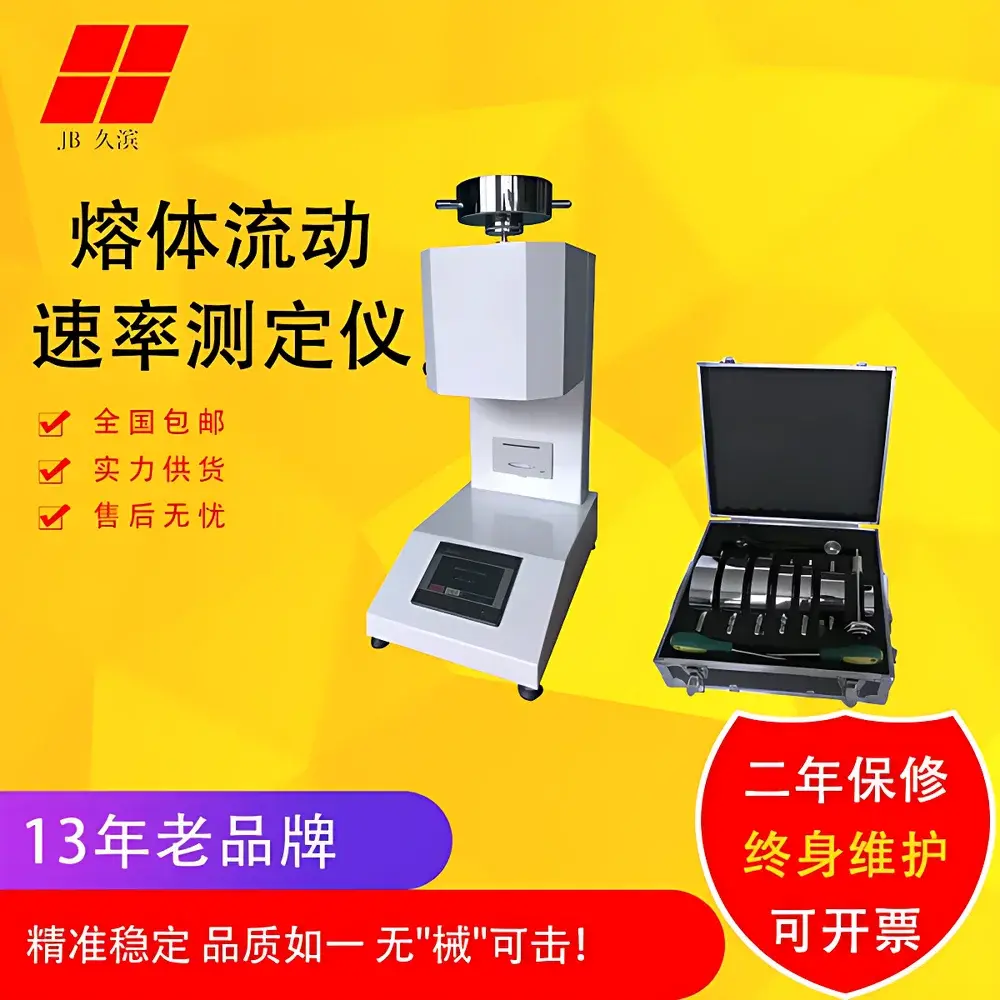
JB-400H Melt Flow Indexer for Polypropylene Meltblown Specialty Resins
| Brand | Jiubin Instruments |
|---|---|
| Origin | Shanghai, China |
| Model | JB-400H |
| Compliance | GB/T 3682.1–2018, ASTM D1238, ISO 1133–1 |
| Temperature Control Range | 100–400 °C (±0.2 °C) |
| Load Options | 0.325 kg, 1.2 kg, 2.16 kg, 5.0 kg, 10.0 kg, 21.6 kg |
| Piston Travel Detection | High-resolution optical encoder (0.01 mm resolution) |
| Extrudate Cutting | Automatic timed or manual mode |
| Sample Preheating Time | Programmable (0–999 s) |
| Data Output | USB and RS232 interfaces |
| Display | 7-inch TFT touchscreen with real-time melt flow curve visualization |
Overview
The JB-400H Melt Flow Indexer is a precision-controlled, microprocessor-driven instrument engineered for the quantitative determination of melt mass-flow rate (MFR) and melt volume-flow rate (MVR) of thermoplastic polymers—specifically optimized for polypropylene (PP) meltblown specialty resins used in high-efficiency filtration media, medical nonwovens, and battery separator applications. Operating on the fundamental principle of extrusion plastometry per ISO 1133–1 and ASTM D1238, the JB-400H applies a defined load to molten polymer extruded through a standardized die under controlled temperature conditions. The resulting extrudate mass or volume over a fixed time interval yields reproducible rheological indices critical for raw material qualification, process validation, and batch-to-batch consistency monitoring in high-volume PP fiber production.
Key Features
- High-stability PID temperature control system with ±0.2 °C uniformity across the barrel zone, ensuring compliance with GB/T 3682.1–2018 thermal ramping and soak requirements.
- Multi-load configuration support (0.325–21.6 kg) via calibrated dead-weight loading system, enabling measurement across standard and extended MFI ranges—from ultra-high-viscosity PP grades (>1000 g/10 min) to low-MFI structural copolymers.
- Optical encoder-based piston displacement sensing with 0.01 mm resolution, facilitating accurate MVR calculation and real-time flow profile analysis—including detection of melt fracture onset and shear-thinning behavior.
- 7-inch industrial-grade TFT touchscreen interface with embedded test protocol library, user-defined method storage (up to 100 methods), and on-device graphical display of melt flow curves.
- Automatic extrudate cutting module with programmable timing (1–999 s intervals), synchronized with piston position tracking to minimize operator-induced variability.
- Dual communication interfaces (USB 2.0 and RS232) compatible with LIMS integration and external data logging; supports CSV export for traceable reporting in GLP/GMP environments.
Sample Compatibility & Compliance
The JB-400H accommodates standard cylindrical polymer pellets, granules, or pre-dried powder forms of polypropylene homopolymers, random copolymers, and impact-resistant grades—particularly those formulated with controlled molecular weight distribution (MWD) and tailored rheology for meltblown die-pack stability. It meets the dimensional and operational specifications outlined in ISO 1133–1:2011 (Plastics — Determination of the melt mass-flow rate (MFR) and melt volume-flow rate (MVR)), ASTM D1238–22 (Standard Test Method for Melt Flow Rates of Thermoplastics by Extrusion Plastometer), and Chinese national standard GB/T 3682.1–2018. Instrument calibration is traceable to NIM (National Institute of Metrology, China) certified reference materials, and routine verification follows internal SOPs aligned with ISO/IEC 17025 requirements for testing laboratories.
Software & Data Management
The JB-400H operates with embedded firmware supporting full audit trail functionality—including user login credentials, method version history, timestamped test records, and parameter change logs. All test data are stored locally with automatic backup to USB flash drives. Optional PC-based software (JB-DataLink v3.2) provides advanced post-processing capabilities: statistical trend analysis (X̄–R charts), comparative MFR/MVR overlay plots, outlier detection algorithms, and automated report generation compliant with FDA 21 CFR Part 11 electronic record requirements when deployed with digital signature modules. Data export formats include CSV, PDF, and XML for seamless ingestion into enterprise quality management systems (QMS) or ERP platforms.
Applications
- Quality release testing of PP meltblown masterbatches and functionalized resins prior to extrusion line feeding.
- R&D screening of peroxide-controlled rheology modifiers, nucleating agents, and flame-retardant additives affecting melt elasticity and die swell.
- Process troubleshooting of fiber breakage, web non-uniformity, or inconsistent basis weight in meltblown lines—correlating MFR shifts with upstream compounding deviations.
- Regulatory documentation for ISO 13485-certified medical nonwoven manufacturers requiring documented material equivalency between resin lots.
- Third-party certification testing per IEC 60601–1 biocompatibility requirements where melt flow stability impacts extractables profiling.
FAQ
Does the JB-400H support both MFR and MVR measurements?
Yes—the instrument calculates both melt mass-flow rate (g/10 min) and melt volume-flow rate (cm³/10 min) using real-time piston displacement and density input (user-definable or auto-populated from material database).
Is calibration verification required before each test series?
Per ISO 1133–1 Clause 8.2, temperature calibration verification using certified indium or zinc reference materials is recommended at least once per shift when operating above 200 °C; load verification with traceable weights is performed quarterly.
Can the JB-400H be integrated into an automated lab environment?
Yes—it supports Modbus RTU protocol over RS232 for PLC interfacing and includes hardware triggers for external robotic sample handling and cutter synchronization.
What maintenance routines are specified for long-term reliability?
Daily cleaning of die and piston with brass brush and solvent; monthly barrel bore inspection using optical borescope; annual recalibration of temperature sensor and encoder by authorized service center.
Does the instrument meet regulatory requirements for pharmaceutical excipient testing?
While primarily designed for polymer manufacturing QC, its data integrity architecture and audit trail features align with USP and ICH Q5E guidance for physicochemical characterization of synthetic polymers used in drug delivery systems.
Related Products



