
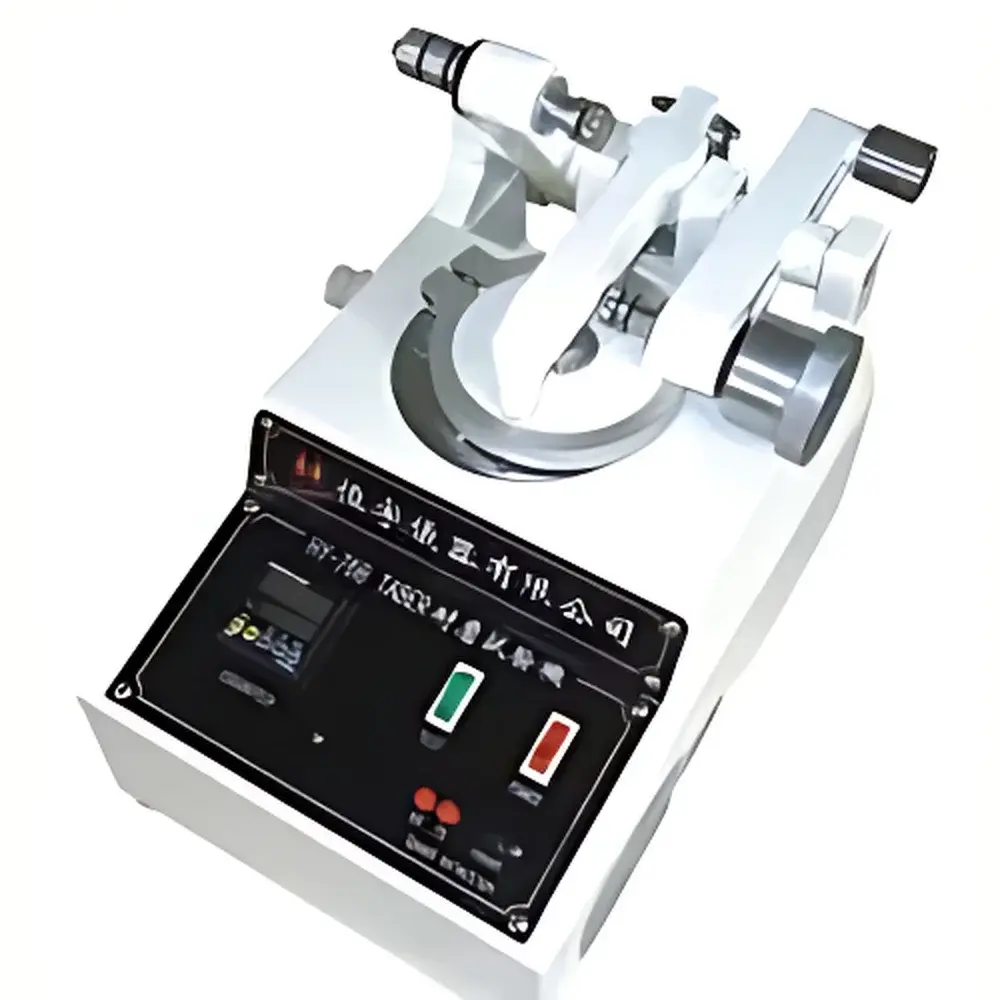
JB-768 Tribological Tester by Jiubin Instruments
| Brand | Jiubin Instruments |
|---|---|
| Origin | Shanghai, China |
| Model | JB-768 |
| Power Supply | AC/DC 100–240 V |
| Counting Pulse Width | 16.7 ms (30 Hz), 0.17 ms (3 kHz), 0.33 ns (1.5 kHz) |
| Count Range | 0–999,999 |
| Input Signal Type | Non-contact or Contact |
| Input Impedance | ≥4.7 kΩ |
| Input Voltage Range | 0–2 V (low-level), 4–30 V (high-level) |
| Reset Modes | Front-panel button, external terminal, auto-reset (adjustable 0.01–9.99 s) |
| DC Power Output | 12 V / 100 mA (dual channels for sensor powering) |
| Relay Output Rating | 3 A / 250 V AC (resistive load) |
| Data Retention | ~5 years during power loss |
| Power Consumption | ≤4 VA |
| Transistor Output | 500 mA / 30 V |
Overview
The JB-768 Tribological Tester is a precision-engineered benchtop instrument designed for quantitative evaluation of wear resistance, friction coefficient, and surface degradation under controlled mechanical loading conditions. Built upon the Couette–Pin-on-Disk and oscillating block-on-ring configurations—commonly adopted in standardized tribological testing—the JB-768 enables reproducible simulation of sliding, reciprocating, and rotary contact modes between material pairs. Its architecture supports both dry and lubricated test environments, making it suitable for R&D laboratories and quality control departments validating polymer composites, coated metals, elastomers, and engineered ceramics against internationally recognized wear protocols.
Key Features
- Multi-mode counting system with selectable pulse width resolution (16.7 ms to 0.33 ns), enabling high-fidelity cycle tracking across low-speed durability tests and high-frequency fatigue simulations.
- Dual-voltage input compatibility (0–2 V and 4–30 V) ensures seamless integration with a wide range of commercial displacement transducers, load cells, and proximity sensors without external signal conditioning.
- Configurable reset logic—including manual front-panel actuation, external TTL-triggered reset, and programmable auto-reset intervals (0.01–9.99 s)—supports automated multi-cycle test sequences and synchronized data acquisition workflows.
- Dual independent 12 V / 100 mA regulated DC outputs supply stable excitation for two onboard sensors, eliminating reliance on external power supplies and reducing measurement noise from ground loops.
- Industrial-grade relay output (3 A / 250 V AC resistive) and open-collector transistor output (500 mA / 30 V) permit direct interfacing with PLCs, safety interlocks, and environmental chamber controllers for closed-loop test automation.
- Non-volatile memory retains accumulated cycle counts for up to five years following power interruption—critical for long-duration ASTM D4157 abrasion or ISO 7148-2 fretting wear studies requiring unattended operation.
Sample Compatibility & Compliance
The JB-768 accommodates flat, curved, and textured specimens up to Ø100 mm × 25 mm height, with interchangeable test fixtures supporting pin-on-disk, block-on-ring, and linear reciprocating configurations. Standardized test geometries conform to DIN 53754 (abrasion resistance of coatings), DIN 53799 (wear of plastics), DIN 53109 (rubber abrasion), DIN 52437 (adhesion testing), TAPPI T476 (paper surface durability), and ASTM D4157 (oscillating sandpaper abrader). The system’s mechanical repeatability (< ±0.5% coefficient of variation over 10 repeated runs) meets GLP-compliant documentation requirements for method validation and regulatory submission packages.
Software & Data Management
While the JB-768 operates as a stand-alone hardware counter and controller, its digital I/O architecture is fully compatible with third-party DAQ systems (e.g., National Instruments CompactDAQ, Keysight U2300A) and SCADA platforms via TTL-level trigger and status lines. All reset events, relay state transitions, and count register snapshots can be time-stamped and logged using industry-standard protocols (Modbus RTU over RS-485 or ASCII serial framing). For laboratories operating under FDA 21 CFR Part 11 or ISO/IEC 17025, optional firmware upgrades support audit-trail-enabled count logging with user authentication and electronic signature capture—ensuring traceability from raw cycle data to final wear index reporting.
Applications
- Quantitative ranking of automotive interior trim materials against TAPPI T476 scratch resistance criteria.
- Accelerated wear life assessment of orthopedic implant coatings per ASTM F732 and ISO 14242-1.
- Frictional stability profiling of brake pad formulations under variable normal loads and sliding velocities.
- Validation of anti-wear additive performance in industrial lubricants using DIN 51354-2 compliant test rigs.
- Quality gate testing of printed circuit board solder mask integrity prior to wave soldering.
- Correlation of surface roughness evolution (measured post-test via profilometry) with cumulative cycles to establish wear rate models (mm³/N·m).
FAQ
What standards does the JB-768 directly support out-of-the-box?
The JB-768 is mechanically and electronically configured to execute test procedures defined in DIN 53754, DIN 53799, DIN 53109, DIN 52437, TAPPI T476, and ASTM D4157 without hardware modification.
Can the JB-768 interface with LabVIEW or Python-based automation frameworks?
Yes—its TTL-compatible digital inputs and outputs, along with ASCII serial command set, allow full programmatic control via standard USB-to-serial or RS-485 interfaces.
Is calibration certification included with delivery?
Calibration of the internal timing oscillator and voltage thresholds is performed at factory level; NIST-traceable calibration certificates are available upon request for metrological validation.
Does the JB-768 provide real-time friction force measurement?
No—the JB-768 is a dedicated cycle counter and control unit; force/torque sensing requires integration with external load cells and compatible amplifiers.
What maintenance intervals are recommended for long-term reliability?
Annual verification of relay contact resistance, transistor output saturation voltage, and power supply regulation accuracy is advised; no consumable parts require scheduled replacement.
Related Products



