
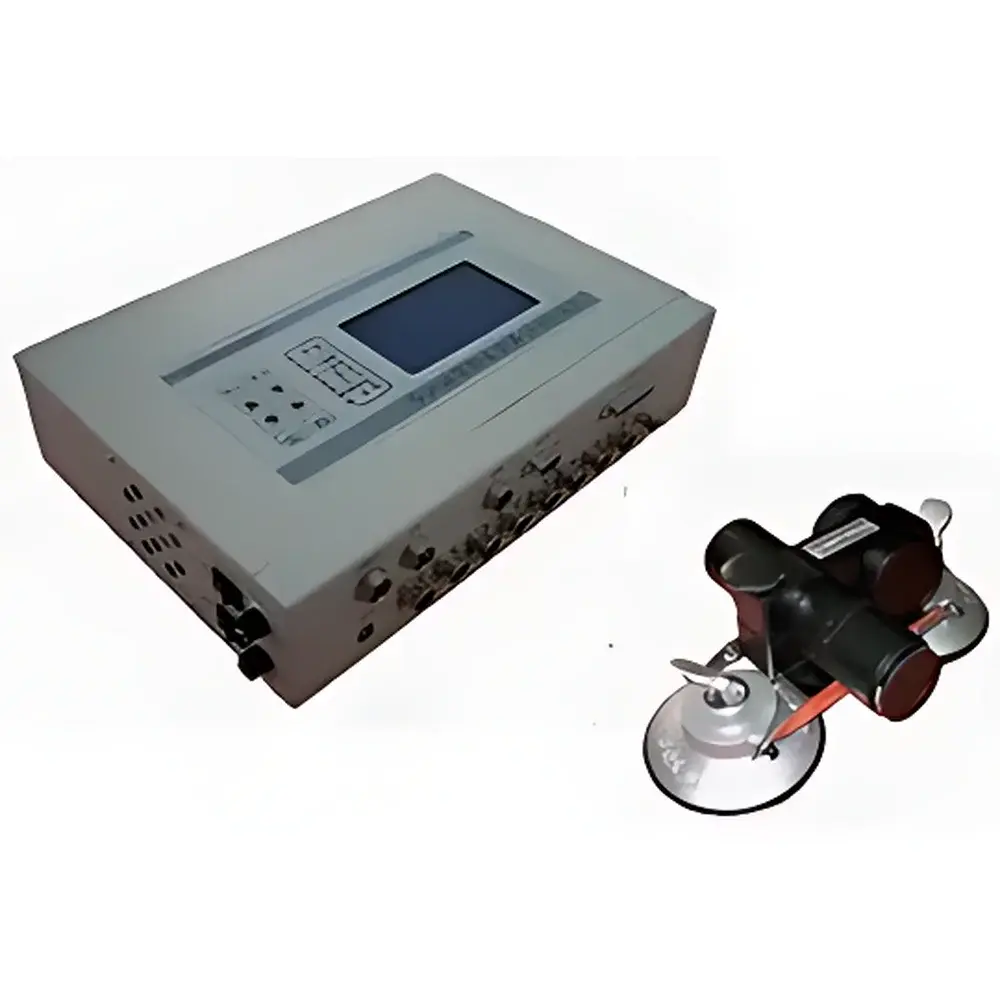
JB-810 Automotive & Tractor Comprehensive Performance Tester by Jiubin Instruments
| Key | Brand: Jiubin Instruments |
|---|---|
| Model | JB-810 |
| Origin | Shanghai, China |
| Power Consumption | <10 W (static: 5 W) |
| Built-in Power | DC 9.6 V (8 × 1.2 V / 4 Ah Ni-Cd battery) |
| External Power Input | DC 12 V |
| Communication Interface | RS232 (9-pin, TTL-level, 9600 bps, 8N1) |
| Dimensions | 370 × 260 × 90 mm |
| Weight | 4.5 kg (including battery) |
| Operating Temperature | −15 °C to +45 °C |
| Relative Humidity | 30–80 % RH |
| Display | 240 × 128 dot-matrix LCD with Chinese UI |
| Integrated Printer | 40-column thermal micro-printer |
| Self-test Signal | 2.048 kHz TTL square wave (calibration reference: 1.0000 photoelectric coefficient → 29.5 km/h) |
Overview
The JB-810 Automotive & Tractor Comprehensive Performance Tester is an integrated field-deployable instrumentation system engineered for standardized road and chassis dynamometer-based evaluation of motor vehicles and agricultural tractors. Designed in strict compliance with China’s national technical standards—including GB/T 7258-2012 Technical Requirements for Safe Operation of Motor Vehicles and GB 17993 General Technical Capability Requirements for Motor Vehicle Comprehensive Performance Inspection Stations—the JB-810 serves as a primary data acquisition platform for regulatory verification, R&D validation, and fleet maintenance diagnostics. Its modular architecture supports synchronized multi-sensor input from photogates, fuel flow meters, load cells, rotational encoders, and wheel speed sensors, enabling concurrent measurement of dynamic, energetic, and kinematic parameters across eight configurable test modes. Unlike standalone single-function testers, the JB-810 implements real-time signal conditioning, digital filtering, and time-stamped event logging to ensure traceability and repeatability under variable ambient conditions.
Key Features
- High-resolution 240 × 128 monochrome LCD with native Chinese character rendering and real-time graphical overlay of time-series curves (e.g., velocity vs. time, deceleration vs. distance)
- Menu-driven interface with context-sensitive prompts; no command-line entry required
- Persistent non-volatile memory for sensor calibration coefficients, user-defined test protocols, and system configuration—retained after power loss
- Onboard 40-column thermal printer supporting direct output of numerical results, statistical summaries, and annotated dynamic plots
- Standard RS232 serial interface (DB9) compliant with EIA/TIA-232-F electrical specifications; configured at 9600 bps, 8 data bits, 1 stop bit, no parity
- Integrated self-diagnostic TTL signal generator (2.048 kHz square wave) for end-to-end verification of optical encoder scaling and timing integrity
- Low-power embedded design: <10 W total draw (5 W standby), optimized for extended battery operation using eight 1.2 V / 4 Ah Ni-Cd cells
Sample Compatibility & Compliance
The JB-810 is validated for use with passenger cars, light- and medium-duty commercial vehicles, motorcycles, and wheeled agricultural tractors operating on paved or graded off-road surfaces. It does not require vehicle-specific firmware variants; instead, test configuration is parameterized via user-selectable vehicle class templates aligned with GB/T 7258-2012 Annexes. All reported metrics—including MFDD (Mean Fully Developed Deceleration), specific fuel consumption (g/kWh), traction slip ratio (%), and gear-shift transition timing—are computed using algorithms derived directly from the referenced standards. The instrument’s measurement uncertainty budget accounts for sensor linearity, sampling jitter (<1 ms), and environmental drift compensation per ISO 16750-4 (road vehicle electrical loads). While not certified to ISO/IEC 17025, its calibration traceability chain is documented per JJF 1001–2011 (General Metrological Terms).
Software & Data Management
Data export is supported exclusively via ASCII-formatted serial transmission, compatible with generic terminal emulators (e.g., Tera Term, PuTTY) and custom LabVIEW or Python-based acquisition scripts. Each test record includes header metadata (test ID, date/time stamp, operator code, vehicle VIN placeholder), raw channel samples (time-aligned at 10 Hz nominal rate), and post-processed indices (e.g., braking distance at 100 km/h, 100-km fuel consumption corrected to 20 °C). No proprietary binary format or closed-source driver is employed. Audit trail functionality is limited to timestamped print logs; electronic records do not implement FDA 21 CFR Part 11-compliant electronic signatures or audit trails. For GLP/GMP environments, users must implement external data archiving with manual linkage to printed hard copies.
Applications
- Regulatory compliance testing per GB/T 7258-2012: brake performance (distance, MFDD), coast-down energy loss, steady-state fuel economy, and acceleration response
- Fleet maintenance benchmarking: longitudinal force profiling during hill-climb traction tests, gear-shift efficiency analysis, and long-term fuel consumption trend monitoring
- Tractor field performance certification: drawbar pull vs. engine RPM, slippage-corrected PTO power, and specific fuel consumption under variable load
- R&D validation of powertrain control strategies: correlation of CAN bus torque commands with measured wheel torque and fuel flow under transient cycles (e.g., six-mode driving cycle)
- Training and certification of vehicle inspection personnel in accredited testing stations
FAQ
Does the JB-810 support wireless data transmission?
No. The device provides only a wired RS232 interface. Bluetooth or Wi-Fi modules are not integrated nor supported as add-ons.
Can test results be exported in CSV or Excel format?
Yes—via serial ASCII output. Users must parse the tab- or comma-delimited fields externally; no built-in file generation capability exists.
Is firmware upgrade available?
Firmware updates are distributed by Jiubin Instruments as HEX files for reprogramming via dedicated ISP hardware; no over-the-air or USB-based update path is provided.
What is the calibration interval recommendation?
Annual calibration against NIST-traceable references is advised. Sensor-specific recalibration (e.g., load cell shunt check, flow meter K-factor verification) should follow manufacturer guidelines per GB/T 18274–2000.
Is the JB-810 suitable for laboratory bench testing?
It is designed for mobile field use and chassis dyno integration. Its IP rating is not specified; it is not rated for continuous indoor lab operation without supplemental environmental shielding.





