
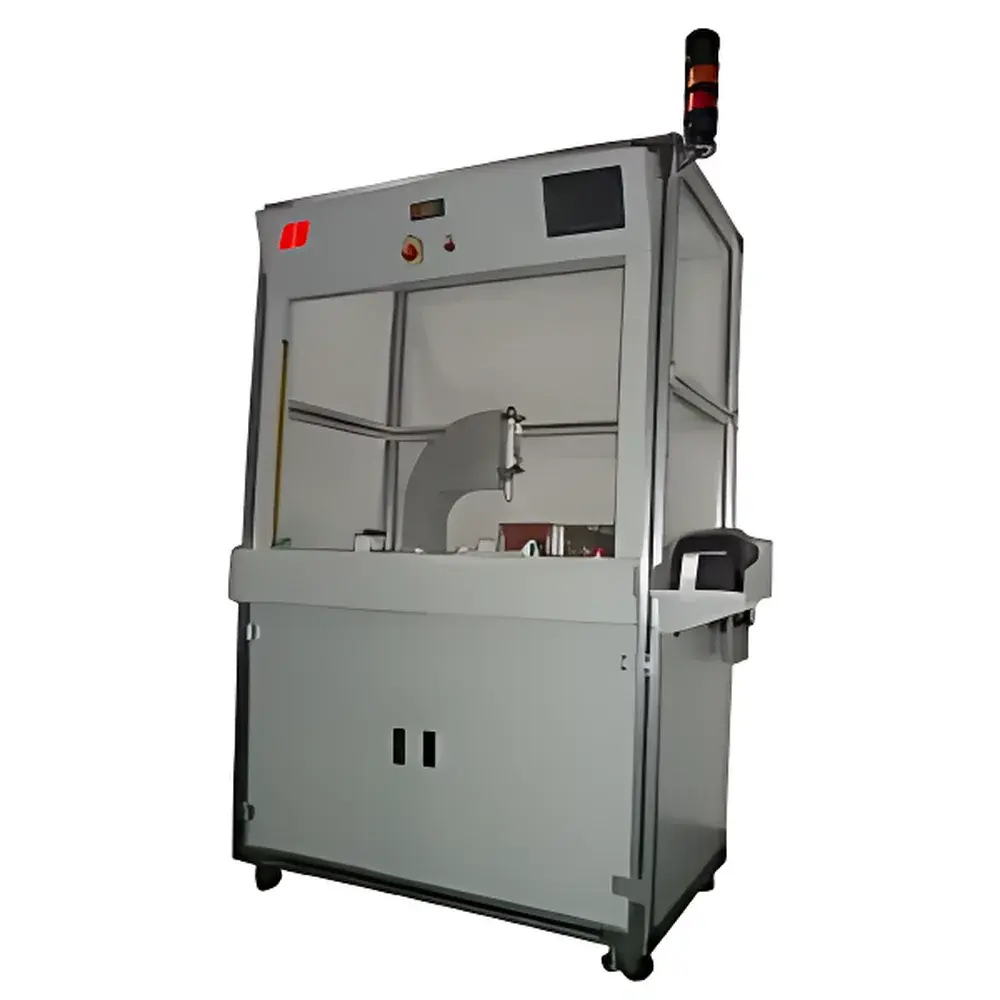
JB-D Automotive HVAC Vent Leak Tester by Jiubin Instruments
| Brand | Jiubin Instruments |
|---|---|
| Origin | Shanghai, China |
| Model | JB-D |
| Pressure Range | 0–1000 Pa |
| Differential Pressure Limit | ≤42 Pa |
| Flow Measurement Range | 10–800 L/h (selectable units: L/h or kg/h) |
| Minimum Detectable Leak Rate | 0.08 L/min |
| Resolution | 0.001 L/min |
| Test Duration Programmable | 1 s to 9999 h/min/s |
| Sample Capacity | 1 vent per cycle |
| Compliance | TPV 8221-75m300, GMW15448 (Apr 2010), IP-0118 V4 |
Overview
The JB-D Automotive HVAC Vent Leak Tester is a semi-automated pressure decay and mass flow-based leakage measurement system engineered for precision quantification of air leakage through automotive HVAC outlet vents. It operates on the principle of controlled pressurization followed by real-time differential pressure monitoring and calibrated mass flow measurement—enabling trace-level leak detection in accordance with industry-standard test protocols. Designed specifically for Tier 1 and Tier 2 automotive suppliers, OEM quality labs, and component validation centers, the JB-D delivers repeatable, auditable, and metrologically traceable results under production-integrated conditions. Its architecture integrates a regulated compressed air supply (0–5 kg/cm² input), integrated oil/water filtration, high-stability pressure transducers, thermal mass flow sensors, and pneumatic control valves—all synchronized via an embedded industrial PLC and HMI interface.
Key Features
- Semi-automated operation: Manual part loading/unloading with dual-hand safety start activation; fully automated pressurization, stabilization, measurement, and pass/fail evaluation.
- Multi-parameter programmable test sequence: Adjustable test pressure (0–1000 Pa), differential pressure threshold (≤42 Pa), dwell time (1 s to 9999 h/min/s), and flow setpoints across dual unit modes (L/h and kg/h).
- Integrated metrology chain: High-resolution pressure transducer + NIST-traceable thermal mass flow meter + closed-loop valve actuation for dynamic compensation and drift correction.
- Real-time pass/fail classification: Automatic flagging of non-conforming units with visual (red LED indicator) and mechanical (red label applicator) rejection marking.
- Production-grade data handling: Built-in test counter, timestamped result logging, Excel-compatible export (.csv), direct thermal printer connectivity, and configurable alarm triggers (pressure deviation, flow anomaly, actuator timeout).
- Ergonomic & adaptable fixture design: XYZ-adjustable vent mounting platform with universal clamping geometry, supporting diverse vent geometries (rotary, slider, flap-type) without tooling changeover.
- Controlled illumination: Top-mounted high-lumen LED array delivering ≥500 lux at work surface—ensuring consistent visual inspection and operator safety during manual handling.
Sample Compatibility & Compliance
The JB-D is validated for use with all standard automotive HVAC vent assemblies—including single/dual-zone outlets, directional vanes, motorized flaps, and integrated air-mix modules. Fixture adaptability supports both rigid plastic housings and elastomeric seal interfaces. All measurement methodology and reporting align with globally recognized automotive OEM specifications: TPV 8221-75m300 (Volkswagen Group), GMW15448 (General Motors, April 2010 revision), and IP-0118 V4 (Ford Motor Company). The system’s pressure decay and flow-based dual-mode verification satisfies ISO 50001 energy efficiency auditing requirements for HVAC subsystems and supports GLP-compliant documentation when paired with external audit trail software.
Software & Data Management
The embedded controller features a 7-inch resistive touchscreen HMI running deterministic real-time firmware. All test parameters, raw sensor outputs (pressure vs. time, flow vs. time), and final leak rate calculations are stored locally with UTC timestamps and unique batch IDs. Export functionality includes comma-separated values (CSV) compatible with Microsoft Excel, LabVIEW, and Minitab for SPC analysis. Optional RS-232/RS-485 or Ethernet TCP/IP interfaces enable integration into MES or QMS platforms (e.g., Siemens Opcenter, ETQ Reliance). Audit trail capabilities—including user login logs, parameter modification history, and calibration event records—meet baseline FDA 21 CFR Part 11 readiness requirements when deployed in regulated manufacturing environments.
Applications
- Final assembly line verification of HVAC vent sealing integrity prior to vehicle integration.
- R&D validation of new vent designs, gasket materials, and actuation mechanisms under simulated cabin pressure differentials.
- Supplier qualification testing per PPAP Level 3 submission requirements.
- Root cause analysis of field-reported air leakage complaints using historical trend data and statistical process control charts.
- Calibration and verification of inline leak testers used in high-volume production cells.
- Support for ISO/TS 16949 and IATF 16949 clause 8.5.1.1 (control of production and service provision) through documented measurement uncertainty and repeatability studies.
FAQ
What leak detection method does the JB-D employ?
It utilizes a hybrid approach combining pressure decay analysis (for gross leaks) and calibrated thermal mass flow measurement (for fine leaks), referenced against ambient barometric pressure and temperature-compensated flow standards.
Is the system compliant with ISO/IEC 17025 requirements?
While the JB-D itself is not a certified calibration laboratory, its sensor modules (pressure transducer, mass flow meter) support third-party calibration certificates traceable to national metrology institutes (NIM, NIST, PTB), enabling users to establish measurement uncertainty budgets per ISO/IEC 17025 Annex A.
Can test parameters be locked to prevent unauthorized changes?
Yes—the HMI supports multi-level password protection (operator, engineer, administrator) with configurable access rights for parameter editing, calibration routines, and data export functions.
Does the system support statistical process control (SPC) output?
All exported CSV files include headers compatible with standard SPC software; additionally, the controller can trigger external PLC alarms or lights based on Cpk/Cp thresholds defined in the test recipe.
What maintenance intervals are recommended?
Compressed air filtration elements require replacement every 6 months or 2000 operating hours; pressure transducer zero calibration is advised quarterly; annual full-system verification with certified reference standards is recommended for GMP/GLP environments.
Related Products






