
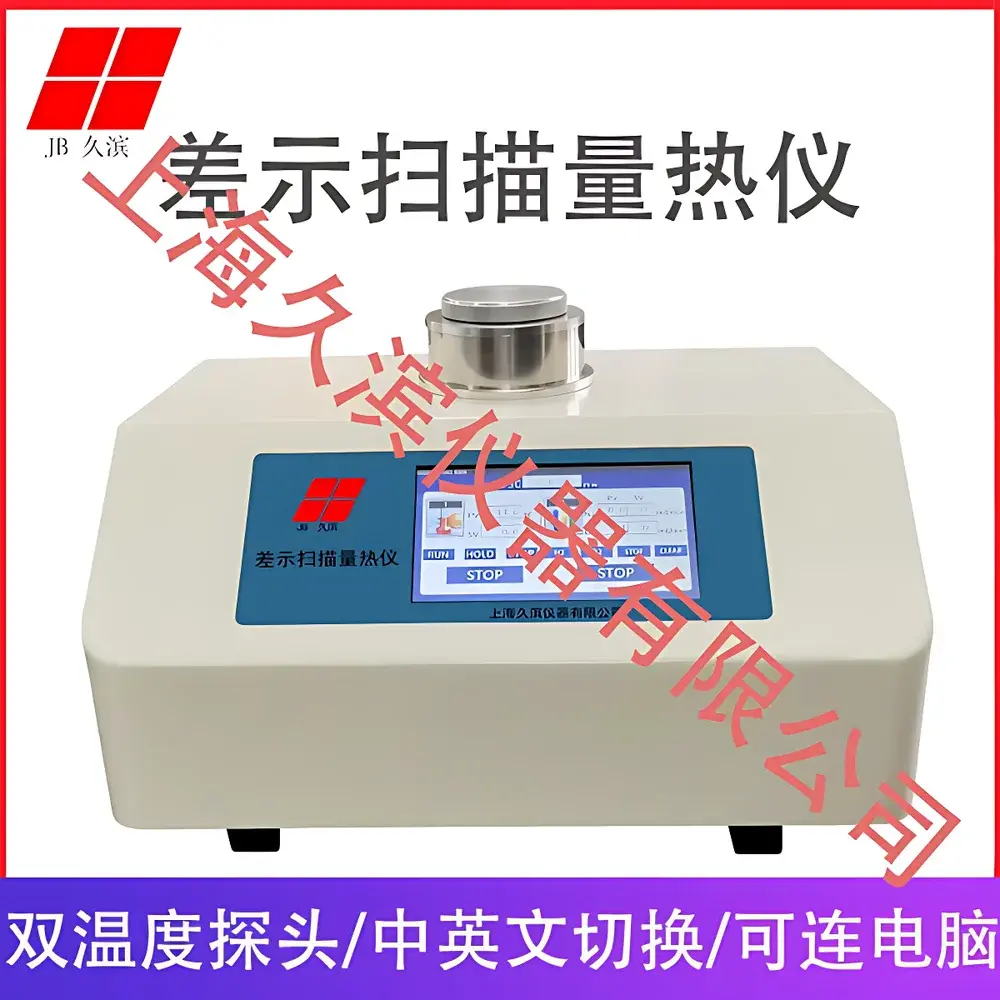
JB-DSC-200L Liquid Nitrogen-Cooled Differential Scanning Calorimeter
| Brand | Jiubin Instruments |
|---|---|
| Origin | Shanghai, China |
| Model | JB-DSC-200L |
| Temperature Range | −100 °C to 600 °C (with LN₂ cooling) |
| Temperature Accuracy | ±0.1 °C |
| Heating/Cooling Rate | 1–80 °C/min |
| Heat Flow Sensitivity | 0.1 μW |
| Compliance | ASTM E794, ISO 11357, USP <1163>, GB/T 29549 |
Overview
The JB-DSC-200L is a high-performance differential scanning calorimeter engineered for precise thermal transition analysis across demanding research and quality control environments. It operates on the heat-flux DSC principle, measuring the difference in heat flow between a sample and an inert reference as both are subjected to identical, programmable temperature profiles. Equipped with a liquid nitrogen (LN₂) cryogenic cooling system, the instrument achieves stable, reproducible sub-ambient operation down to −100 °C—enabling characterization of low-temperature transitions such as glass relaxation (Tg), cold crystallization, and secondary relaxations in polymers, pharmaceuticals, and advanced composites. Its robust furnace architecture, high-resolution thermocouple array, and active baseline compensation ensure exceptional signal-to-noise ratio and long-term thermal stability over extended runs.
Key Features
- Liquid nitrogen cooling system enabling continuous, controllable operation from −100 °C to 600 °C without mechanical compressor limitations or condensation artifacts
- Programmable heating/cooling rates from 1 to 80 °C/min, supporting both standard ASTM/ISO protocols and non-standard dynamic ramping for kinetic modeling
- High-sensitivity microcalorimetric sensor with resolution better than 0.1 μW, calibrated traceably to NIST-traceable standards
- Hermetically sealed sample chamber with optional purge gas control (N₂, He, Ar) to minimize oxidative degradation and moisture interference
- Modular crucible platform accommodating standard aluminum, gold-plated aluminum, and high-pressure stainless-steel pans (up to 10 bar)
- Integrated real-time mass compensation algorithm to correct for minor sample mass loss during volatile decomposition events
Sample Compatibility & Compliance
The JB-DSC-200L accommodates solid powders, thin films, granules, gels, and small-volume liquids (≤30 mg typical). It supports routine analysis of thermoplastics, thermosets, elastomers, APIs, excipients, battery electrode materials, shape-memory alloys, and phase-change materials. All thermal data acquisition and reporting workflows comply with ASTM E794 (melting point determination), ISO 11357 series (general DSC practice), and USP (thermal analysis in pharmaceutical development). The system architecture supports GLP/GMP-aligned audit trails when operated with validated software modules, and raw data files retain full metadata (operator ID, timestamp, calibration history, environmental logs) for regulatory submission readiness per FDA 21 CFR Part 11 requirements.
Software & Data Management
Control and analysis are performed via proprietary DSC-Studio v4.x software, compatible with Windows 10/11 (64-bit). The interface provides real-time visualization of heat flow, temperature, and modulation parameters; automated peak detection with customizable baselines; and multi-step analysis sequences (e.g., melt–quench–reheat, modulated DSC). Data export formats include ASCII (.txt), CSV, and universal .qdx (QD-compatible) for cross-platform interoperability. Software validation packages—including IQ/OQ documentation, electronic signature support, and change-controlled version management—are available upon request for regulated laboratories. Raw data integrity is preserved through SHA-256 hashing and immutable file timestamps.
Applications
- Determination of glass transition temperature (Tg), melting enthalpy (ΔHm), crystallinity, and purity in polymer science and packaging R&D
- Stability assessment of amorphous solid dispersions and polymorphic screening in preformulation studies
- Thermal safety evaluation of lithium-ion battery cathode/anode materials under rapid heating conditions
- Decomposition kinetics and activation energy calculation using Ozawa-Flynn-Wall and Kissinger methods
- Quality control of incoming raw materials and finished goods in automotive elastomers, aerospace composites, and medical device polymers
- Validation of thermal curing profiles for epoxy resins and UV-curable adhesives in industrial manufacturing
FAQ
Does the JB-DSC-200L support modulated DSC (MDSC)?
Yes—when equipped with the optional MDSC module, the system delivers reversing and non-reversing heat flow separation for enhanced resolution of overlapping transitions.
What is the recommended maintenance interval for the LN₂ cooling system?
A full vacuum integrity check and dewar inspection are advised every 12 months; LN₂ consumption rate monitoring should occur daily during operation.
Can the instrument be integrated into a LIMS environment?
Yes—via OPC UA or RESTful API interfaces, enabling bidirectional data exchange with major laboratory information management systems.
Is third-party calibration certification available?
Yes—NIST-traceable calibration certificates for temperature, enthalpy, and sensitivity are provided by accredited metrology labs upon request.
What sample pan types are included standard with delivery?
Each system ships with 50 pairs of standard 40 µL aluminum pans and lids, plus one set of gold-plated pans for high-precision applications.



