
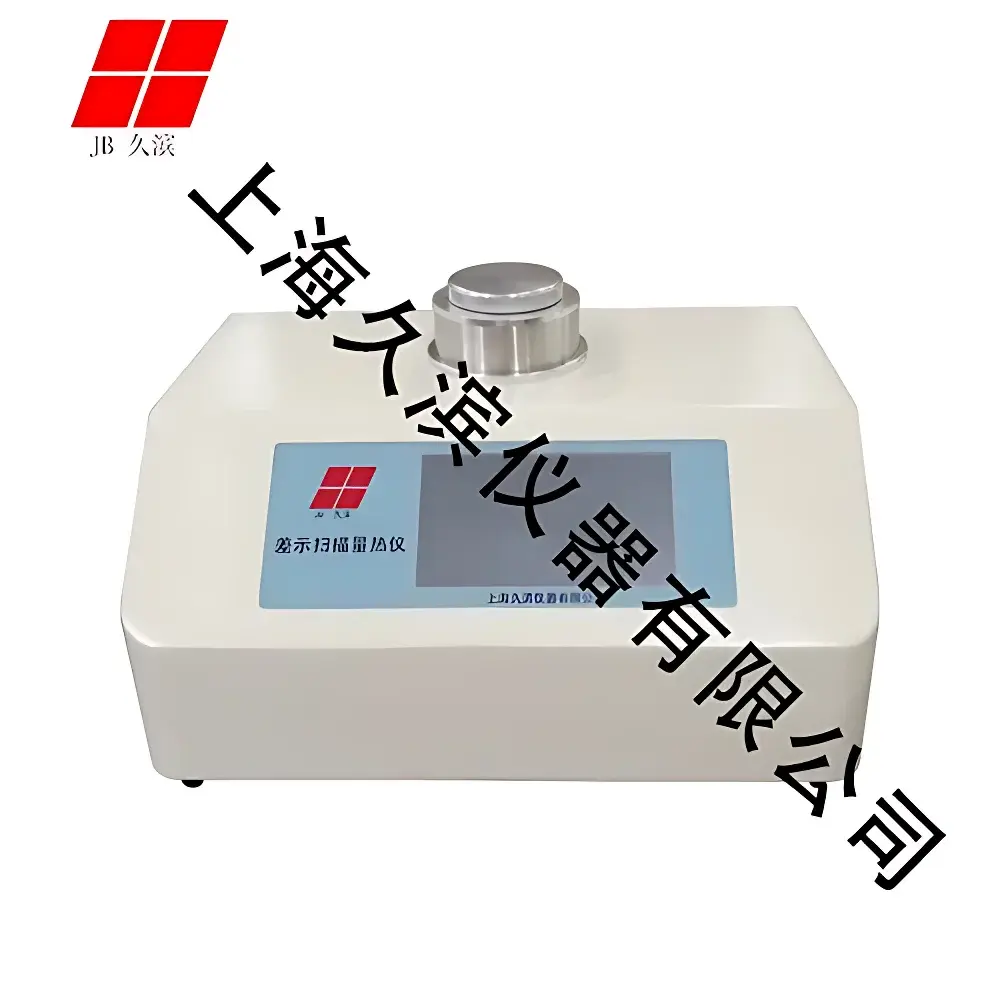
JB-DSC-750L Differential Scanning Calorimeter (DSC) by Jiubin Instruments
| Brand | Jiubin Instruments |
|---|---|
| Origin | Shanghai, China |
| Model | JB-DSC-750L |
| Temperature Range | −150 to 725 °C |
| Temperature Accuracy | ±0.1 °C |
| Heating/Cooling Rate | 0.1–50 K/min |
| DSC Sensitivity | 0.001 mW |
| DSC Dynamic Range | ±500 mW |
| Temperature Resolution | 0.01 °C |
| Atmosphere Control | Dual-gas mass flow controller (N₂/O₂) |
| Interface | USB 2.0 with auto-reconnect |
| Display | 7-inch 24-bit color LED touchscreen |
| Calibration | Pre-loaded standard reference materials (In, Sn, Zn, KCl), one-click temperature calibration |
Overview
The JB-DSC-750L Differential Scanning Calorimeter is a high-stability, laboratory-grade thermal analysis instrument engineered for precise quantification of heat flow differences between a sample and inert reference as a function of temperature or time. Based on the heat-flux DSC principle, it measures endothermic and exothermic transitions—including glass transition (Tg), melting (Tm), crystallization (Tc), solid-solid phase changes, and oxidative induction time (OIT)—with high reproducibility across demanding applications in polymer science, pharmaceutical development, composite material characterization, and advanced ceramics research. Its extended low-temperature capability (down to −150 °C using liquid nitrogen cooling) enables reliable detection of subtle Tg events in thermoset composites, carbon-fiber-reinforced resins, and high-performance elastomers—critical parameters for structural integrity assessment, process window definition, and regulatory documentation under ISO 11357 and ASTM E1356.
Key Features
- Integrated liquid nitrogen cooling system with proportional flow control, enabling linear, programmable cooling down to −150 °C without mechanical refrigeration;
- Dual platinum resistance temperature detectors (RTDs) embedded in the sensor assembly ensure ±0.1 °C temperature repeatability and minimize thermal lag;
- Compact, all-metal furnace architecture with mechanically secured sensor mounting—eliminating adhesive-based assemblies that introduce thermal drift or signal contamination;
- High-resolution 7-inch LED touchscreen interface displaying real-time DSC signal, sample/reference temperatures, dual-gas mass flow rates (N₂/O₂), and system status flags;
- USB 2.0 interface with hardware-level auto-reconnect protocol—ensuring uninterrupted data acquisition during transient host power or OS sleep cycles;
- Digital dual-channel mass flow controller with sub-second switching response and <15-second stabilization time for rapid atmosphere transitions;
- Onboard calibration suite with certified reference standards (indium, tin, zinc, potassium chloride) and one-click automated temperature/DSC sensitivity calibration;
- Fully programmable temperature profile engine supporting multi-segment ramp/hold/cycle sequences, including dynamic heating-cooling-reheating protocols for enthalpy recovery analysis.
Sample Compatibility & Compliance
The JB-DSC-750L accommodates standard 40 µL aluminum crucibles (hermetic or vented), platinum crucibles for high-temperature or corrosive samples, and custom pans for fiber, film, or powder geometries. It supports quantitative analysis of thermosetting matrix resins (epoxy, BMI, cyanate ester), fiber-reinforced laminates, prepregs, and hybrid nanocomposites—enabling direct measurement of Tg depression due to moisture uptake, post-cure evolution, or interfacial degradation. The instrument meets core requirements of ISO 11357-2 (DSC determination of Tg), ASTM D3418 (polymer transition temperatures), and USP <1151> (thermal analysis of pharmaceuticals). Data acquisition and reporting comply with GLP/GMP-aligned audit trail functionality when used with validated software configurations.
Software & Data Management
The included Windows-native analysis software (compatible with Windows 10/11, 64-bit) provides full ICH M7-compliant metadata tagging, user-defined report templates (PDF/Excel export), and raw data export in ASCII (.txt) and universal .q2 format. It supports baseline subtraction, peak integration with tangent/inflection-point methods, derivative (dH/dT) plotting, and multi-curve overlay for comparative kinetics. The scripting module allows users to define custom instruction sequences—e.g., “ramp to 50 °C at 10 K/min → hold 5 min → cool to −40 °C at 5 K/min → reheat to 200 °C”—and save them as reusable method files. All operations are timestamped and logged with operator ID, instrument serial number, and environmental conditions for traceability.
Applications
- Determination of glass transition temperature (Tg) in carbon-fiber/epoxy composites for aerospace qualification;
- Quantification of residual cure exotherm and degree of cure in thermoset prepregs;
- Thermal stability assessment of flame-retardant additives in polymeric matrices;
- Crystallinity evaluation of semi-crystalline thermoplastics (e.g., PEEK, PEI) before and after annealing;
- Oxidative induction time (OIT) testing per ASTM D3895 for antioxidant efficacy screening;
- Polymorph screening and thermal behavior mapping of active pharmaceutical ingredients (APIs);
- Phase separation analysis in polymer blends and block copolymers;
- Heat capacity (Cp) measurement via step-heating method for thermodynamic modeling.
FAQ
What is the lowest achievable temperature with liquid nitrogen cooling?
The JB-DSC-750L achieves a verified base temperature of −150 °C under standard operating conditions with optimized LN₂ flow and purge gas management.
Does the instrument support modulated DSC (MDSC®) or TOPEM® capabilities?
No—this is a conventional heat-flux DSC platform. MDSC requires proprietary sensor architecture and specialized firmware not present in the JB-DSC-750L design.
Can the software generate 21 CFR Part 11-compliant electronic records?
The base software does not include electronic signature or role-based access controls; however, it exports fully traceable raw data and metadata compatible with third-party LIMS or ELN systems configured for FDA compliance.
Is calibration traceable to NIST or other national metrology institutes?
Reference materials supplied are certified to ISO/IEC 17025-accredited laboratories; users may perform in-house calibration verification using NIST-traceable standards such as SRM 3451 (indium) or SRM 720 (tin).
What maintenance intervals are recommended for the liquid nitrogen delivery system?
The solenoid-controlled LN₂ valve and insulated transfer line require visual inspection every 6 months; no scheduled lubrication or recalibration is required under normal usage conditions.
Related Products



