
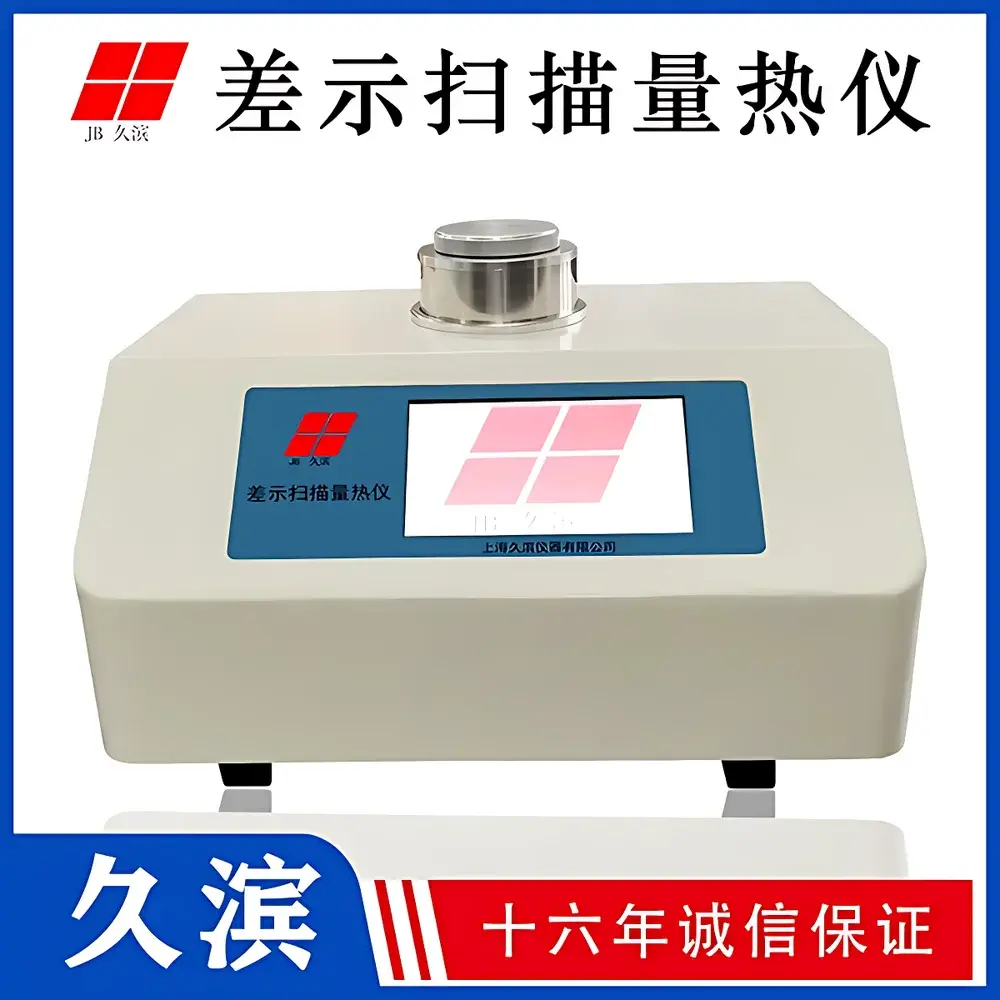
JB-DSC-800L Differential Scanning Calorimeter with Oxidation Induction Time (OIT) Analysis Capability
| Brand | Jiubin Instruments |
|---|---|
| Origin | Shanghai, China |
| Model | JB-DSC-800L |
| Instrument Type | DSC |
| Temperature Range | Ambient to 800 °C |
| Temperature Accuracy | ±0.1 °C |
| Heating/Cooling Rate | 0.1–100 °C/min |
| DSC Heat Flow Range | ±200 mW |
| Sample Capacity | Single-sample configuration |
| Detection Sensitivity | 0.1 μW |
Overview
The JB-DSC-800L is a high-stability differential scanning calorimeter engineered for precise thermal characterization of materials across academic, industrial, and regulatory laboratory environments. It operates on the principle of heat flux DSC, measuring the difference in heat flow between a sample and an inert reference as both are subjected to identical, controlled temperature programs. This enables quantitative determination of endothermic and exothermic transitions—including glass transitions (Tg), melting points (Tm), crystallization behavior, phase changes, and reaction enthalpies—with high baseline reproducibility and signal-to-noise ratio. A core application focus of the JB-DSC-800L is Oxidation Induction Time (OIT) analysis per ASTM D3895 and ISO 11357-6, where the instrument monitors the onset of oxidative degradation under isothermal oxygen atmosphere—critical for evaluating antioxidant efficacy in polyolefins, elastomers, and biomedical polymers.
Key Features
- Robust furnace design with dual-sensor heat flux detection ensures stable baseline performance across extended temperature ramps and isothermal holds.
- Wide operational temperature range (ambient to 800 °C) supports analysis of high-melting metals, ceramics, and advanced composites alongside conventional polymers and pharmaceuticals.
- Precise temperature control with ±0.1 °C accuracy and programmable heating/cooling rates from 0.1 to 100 °C/min enables method flexibility for kinetic studies, modulated DSC (MDSC®-compatible protocols), and multi-step thermal profiling.
- High-resolution heat flow measurement (0.1 μW sensitivity) and ±200 mW dynamic range accommodate both low-energy transitions (e.g., weak crystallization events) and high-enthalpy reactions (e.g., metal oxidation or polymer decomposition).
- Single-sample configuration optimized for routine quality control and R&D workflows—designed for rapid turnaround, minimal cross-contamination risk, and straightforward calibration using certified standards (e.g., indium, zinc, tin).
- Integrated gas control module supports automated switching between inert (N2, Ar) and reactive (O2) atmospheres—essential for OIT, oxidative stability index (OSI), and decomposition kinetics testing.
Sample Compatibility & Compliance
The JB-DSC-800L accommodates standard aluminum, gold-plated aluminum, and high-temperature alumina crucibles (up to 800 °C), supporting solid powders, films, granules, fibers, and small metallic specimens (≤30 mg typical mass). It complies with fundamental requirements of ASTM E794 (melting point), ASTM E1356 (glass transition), ASTM D3895 (OIT), ISO 11357 series (general DSC practice), and USP (thermal analysis in pharmaceutical development). While not pre-certified for FDA 21 CFR Part 11, its software architecture supports audit trail implementation, electronic signature integration, and secure user access controls—enabling alignment with GLP and GMP documentation standards when deployed within validated laboratory information management systems (LIMS).
Software & Data Management
The instrument is operated via dedicated Windows-based acquisition and analysis software supporting real-time data visualization, peak integration, baseline correction, and comparative overlay of multiple runs. Built-in OIT calculation routines automatically detect the inflection point of the exothermic oxidation onset under isothermal O2, reporting time-to-onset (min) with statistical confidence intervals across replicate measurements. Raw data export is available in ASCII (.txt) and universal .csv formats; metadata (method parameters, calibration logs, operator ID, timestamp) is embedded and exportable for traceability. The software permits creation of SOP-compliant test templates, batch processing of sequential samples, and generation of PDF reports conforming to internal QA documentation requirements.
Applications
- Quantitative OIT assessment of polyethylene (PE), polypropylene (PP), and ethylene-propylene-diene monomer (EPDM) compounds for automotive and cable insulation applications.
- Thermal stability screening of lithium-ion battery cathode/anode materials and solid electrolytes under air and inert conditions.
- Crystallinity evaluation and cold-crystallization kinetics in biodegradable polyesters (e.g., PLA, PCL) for medical device development.
- Polymorph screening and solid-state stability studies of active pharmaceutical ingredients (APIs) and excipients.
- Decomposition thermodynamics of flame-retardant additives and nanocomposite matrices.
- Quality control of incoming raw materials (e.g., resins, fillers, antioxidants) against historical reference profiles.
FAQ
What standards does the JB-DSC-800L support for OIT testing?
ASTM D3895, ISO 11357-6, and GB/T 19466.6 are fully supported through preconfigured methods and reporting templates.
Can the instrument perform modulated DSC (MDSC)?
Yes—its high-speed temperature control and signal processing enable implementation of quasi-isothermal and temperature-modulated protocols, though advanced MDSC requires optional harmonic analysis modules.
Is calibration traceable to NIST or other national standards?
Calibration is performed using NIST-traceable reference materials (indium, zinc, tin); full calibration certificates with uncertainty budgets are provided upon request.
What crucible types are compatible with the 800 °C upper limit?
Alumina crucibles rated for continuous use up to 1600 °C are recommended; gold-plated aluminum is suitable up to 500 °C, and standard aluminum up to 600 °C.
Does the system include validation documentation for regulated environments?
IQ/OQ documentation packages are available as optional add-ons; installation and operational qualification protocols align with ASTM E967 and ISO/IEC 17025 laboratory accreditation frameworks.



