
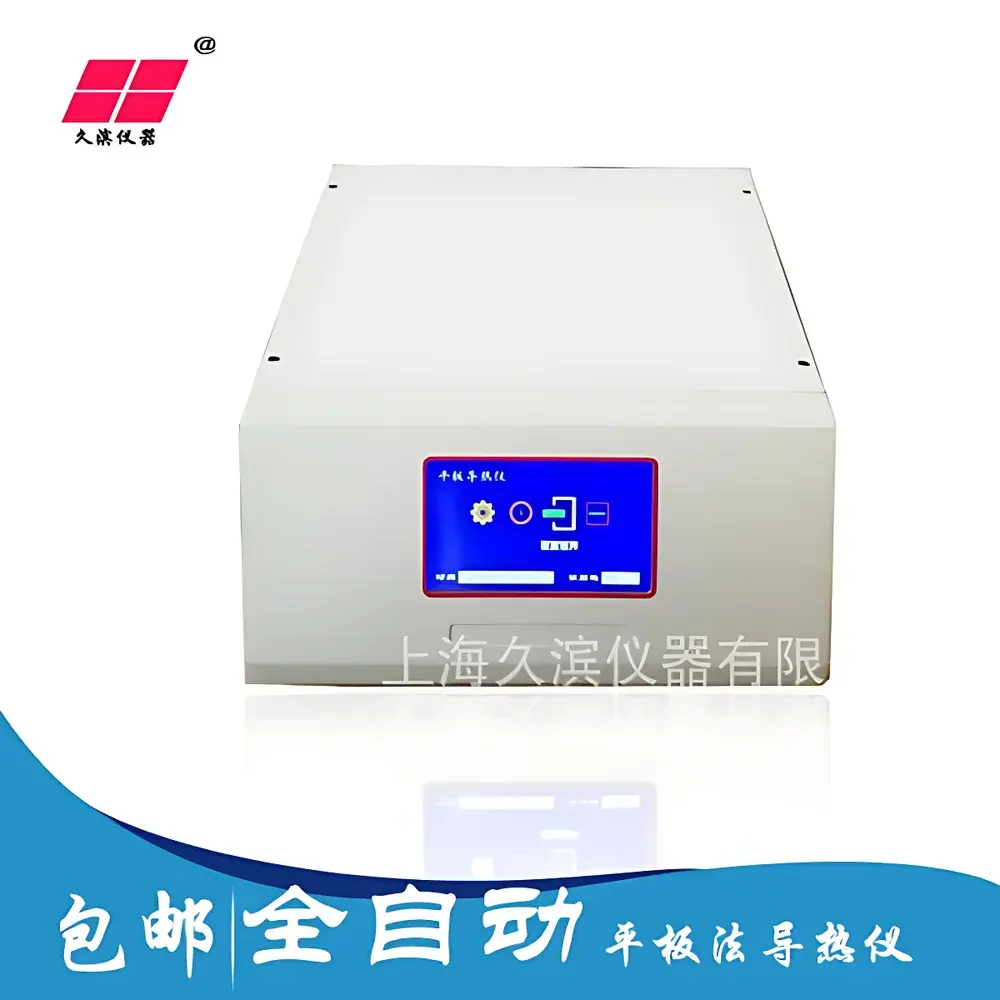
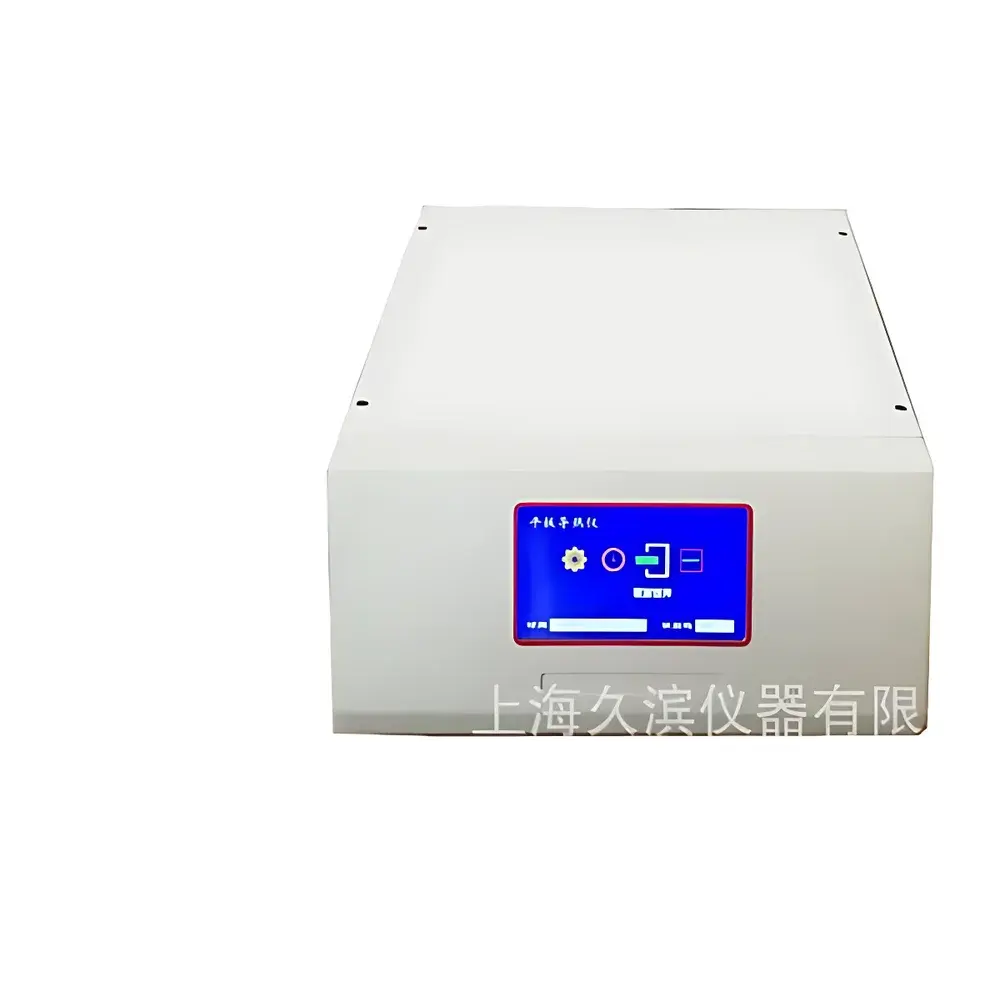
JB-P High-Temperature/Low-Temperature Guarded Hot Plate Thermal Conductivity Analyzer
| Brand | Jiubin Instruments |
|---|---|
| Origin | Shanghai, China |
| Model | JB-P |
| Measurement Principle | Guarded Hot Plate Method (ASTM C177, ISO 8302) |
| Temperature Range | -40 °C to +150 °C (with optional cryo/heating modules) |
| Thermal Conductivity Range | 0.010–5.000 W/(m·K) |
| Accuracy | ±3% of reading |
| Repeatability | ±3% |
| Dimensions (L×W×H) | 552 × 550 × 760 mm |
| Compliance | ASTM C177, ISO 8302, GB/T 10294 |
Overview
The JB-P High-Temperature/Low-Temperature Guarded Hot Plate Thermal Conductivity Analyzer is a precision benchtop instrument engineered for absolute measurement of thermal conductivity in solid and rigid cellular materials under controlled temperature conditions. Based on the steady-state guarded hot plate method—recognized as the primary reference technique by ASTM C177 and ISO 8302—the JB-P establishes a one-dimensional, uniform heat flux across a centrally mounted test specimen sandwiched between a heated upper plate and a cooled lower plate. A concentric guard ring, actively temperature-controlled to match the hot plate surface, eliminates lateral heat loss and ensures metrological traceability. The system supports bidirectional thermal conditioning from –40 °C to +150 °C, enabling characterization of insulation materials, polymers, composites, ceramics, and building products across service-relevant thermal environments. Its design adheres to fundamental principles of Fourier’s law and calorimetric equilibrium validation, delivering results suitable for material certification, R&D benchmarking, and quality control in compliance-driven sectors.
Key Features
- Guarded hot plate architecture with active temperature-controlled guard ring for minimized edge losses and enhanced measurement fidelity
- Integrated dual-zone climate chamber supporting precise, programmable sample conditioning from –40 °C to +150 °C
- High-stability platinum resistance thermometers (PRTs) calibrated to NIST-traceable standards for surface temperature monitoring (±0.1 °C resolution)
- Low-drift DC power supply with real-time wattmeter feedback for accurate heat input quantification
- Rigid, low-thermal-conductivity frame constructed from anodized aluminum and phenolic composite to minimize parasitic conduction paths
- Modular sample holder accommodating standard specimens up to 300 × 300 mm (thickness: 10–100 mm), with adjustable clamping force to ensure consistent interfacial contact pressure
Sample Compatibility & Compliance
The JB-P is validated for homogeneous, isotropic, non-phase-changing solids including rigid foam insulation (PUR, PIR, XPS), mineral wool, aerogels, structural composites, refractory bricks, and polymer sheets. It excludes liquids, powders, or highly anisotropic materials without prior cross-validation. All measurements comply with ASTM C177 (Standard Test Method for Steady-State Heat Flux Measurements and Thermal Transmission Properties by Means of the Guarded-Hot-Plate Apparatus) and ISO 8302 (Thermal insulation — Determination of steady-state thermal resistance and related properties — Guarded hot plate apparatus). The system supports documentation workflows aligned with ISO/IEC 17025 requirements, including calibration certificate traceability, uncertainty budget reporting (k = 2), and raw data archiving for GLP audits.
Software & Data Management
The proprietary JB-Control Suite (v3.2) provides full instrument orchestration via USB 2.0 or Ethernet interface. It enables automated temperature ramping, multi-point steady-state dwell control, real-time thermal gradient visualization, and automatic calculation of thermal conductivity (λ), thermal resistance (R), and apparent thermal diffusivity. All measurement sessions generate timestamped, digitally signed log files (.csv and .jbd format) containing raw sensor readings, power inputs, convergence metrics, and operator annotations. Audit trail functionality meets FDA 21 CFR Part 11 requirements for electronic records and signatures, including user access levels, change history logging, and immutable session export. Data exports are compatible with LIMS integration and third-party statistical analysis platforms (e.g., JMP, MATLAB).
Applications
- Validation of thermal performance claims for building envelope materials per EN 12667 and ASTM C518
- Development and qualification of aerospace-grade thermal barrier coatings and lightweight insulators
- QC release testing of molded polymer components in automotive and electronics thermal management systems
- Supporting ISO 5660 cone calorimeter correlation studies through baseline λ determination
- Academic research on temperature-dependent phonon transport mechanisms in novel dielectric solids
- Third-party certification testing for GREENGUARD, Passivhaus Institut, and CE marking submissions
FAQ
What standards does the JB-P comply with for thermal conductivity measurement?
ASTM C177, ISO 8302, and GB/T 10294 — all referencing the guarded hot plate method for absolute thermal conductivity determination.
Can the JB-P measure materials with high anisotropy, such as layered composites?
It is not recommended without supplementary directional calibration; the method assumes isotropic conduction and uniform thickness. Cross-plane-only measurements may be performed with strict specimen orientation control and uncertainty expansion.
Is external cryogenic equipment required for sub-zero operation?
No — the integrated Peltier-based cooling module achieves –40 °C without liquid nitrogen or external chillers. Optional recirculating chiller integration is available for extended stability at extreme low temperatures.
How is measurement uncertainty quantified in the JB-P system?
Uncertainty is calculated per GUM (JCGM 100:2008) using Type A (repeatability) and Type B (calibration, geometry, temperature gradient) components. Typical expanded uncertainty (k=2) is ≤4.2% for λ in the mid-range (0.1–2.0 W/(m·K)).
Does the software support automated report generation for regulatory submissions?
Yes — configurable templates generate PDF reports compliant with ISO/IEC 17025, including calibration status, environmental conditions, raw data plots, and signature fields for authorized personnel.



