
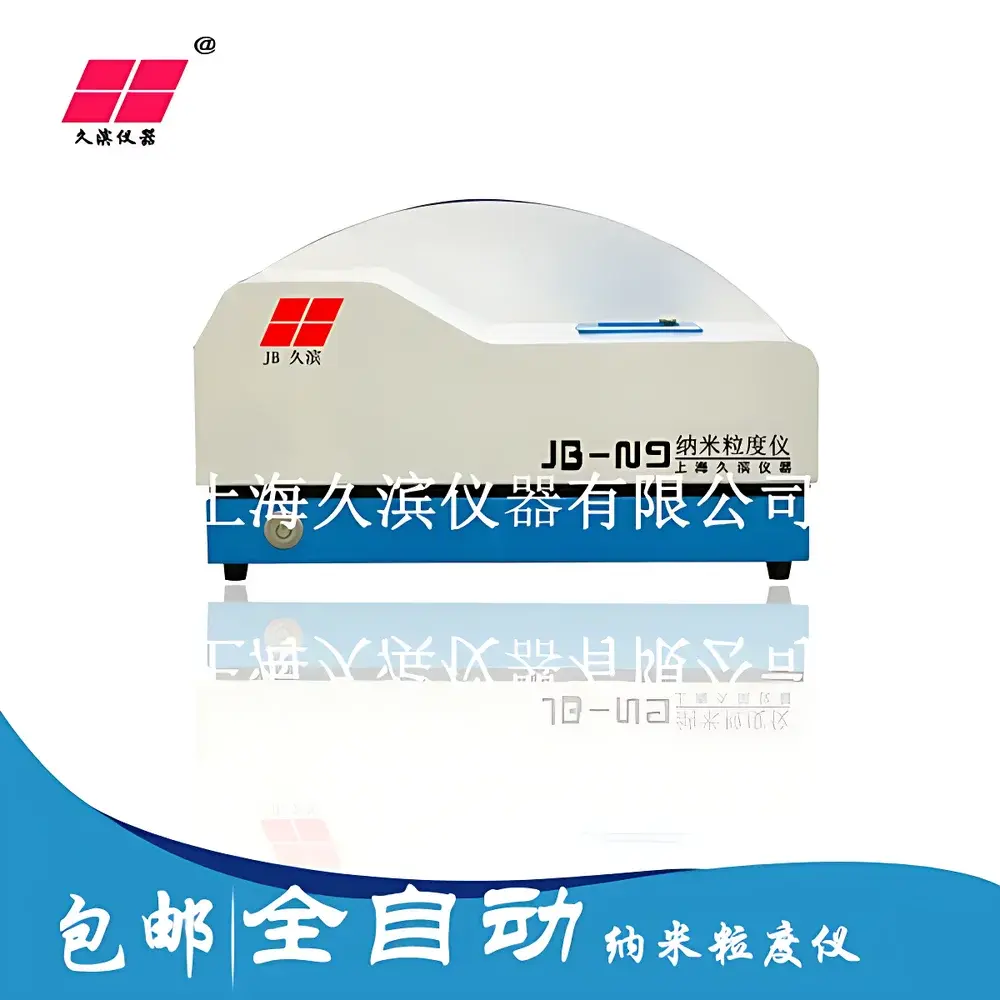
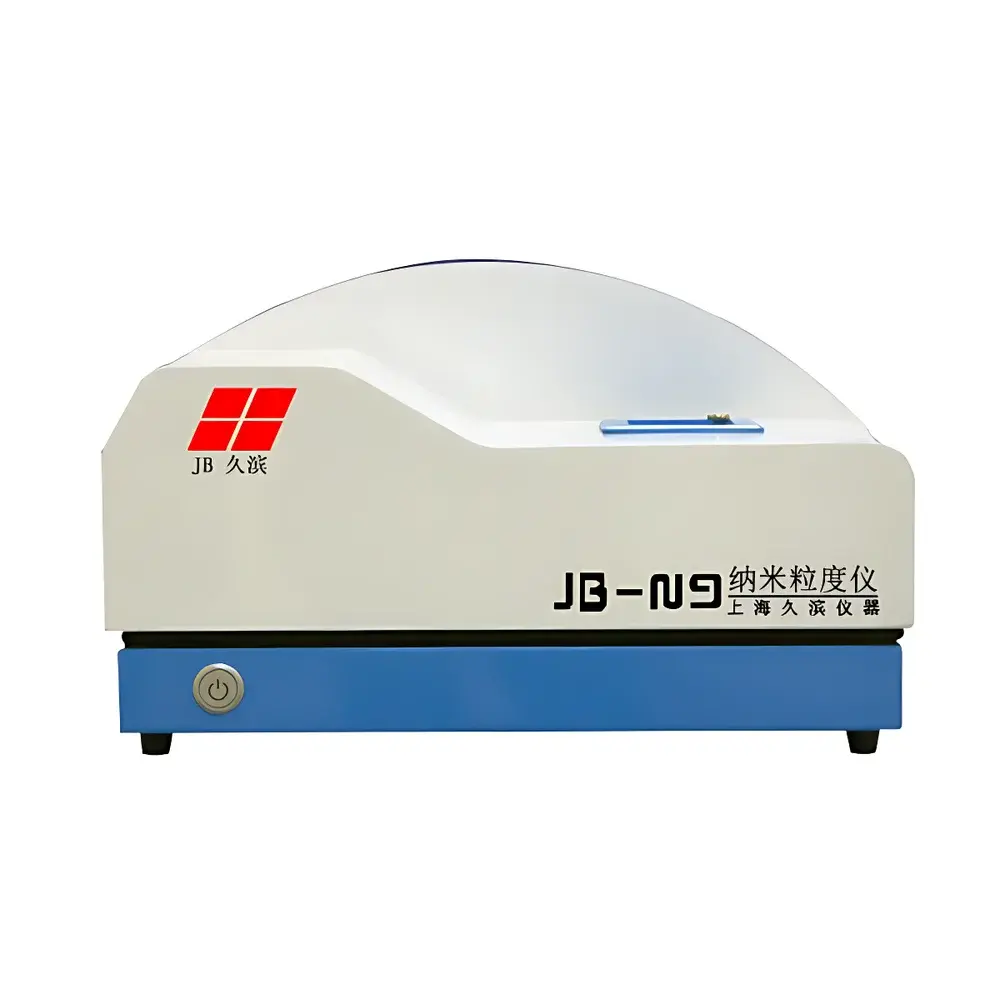
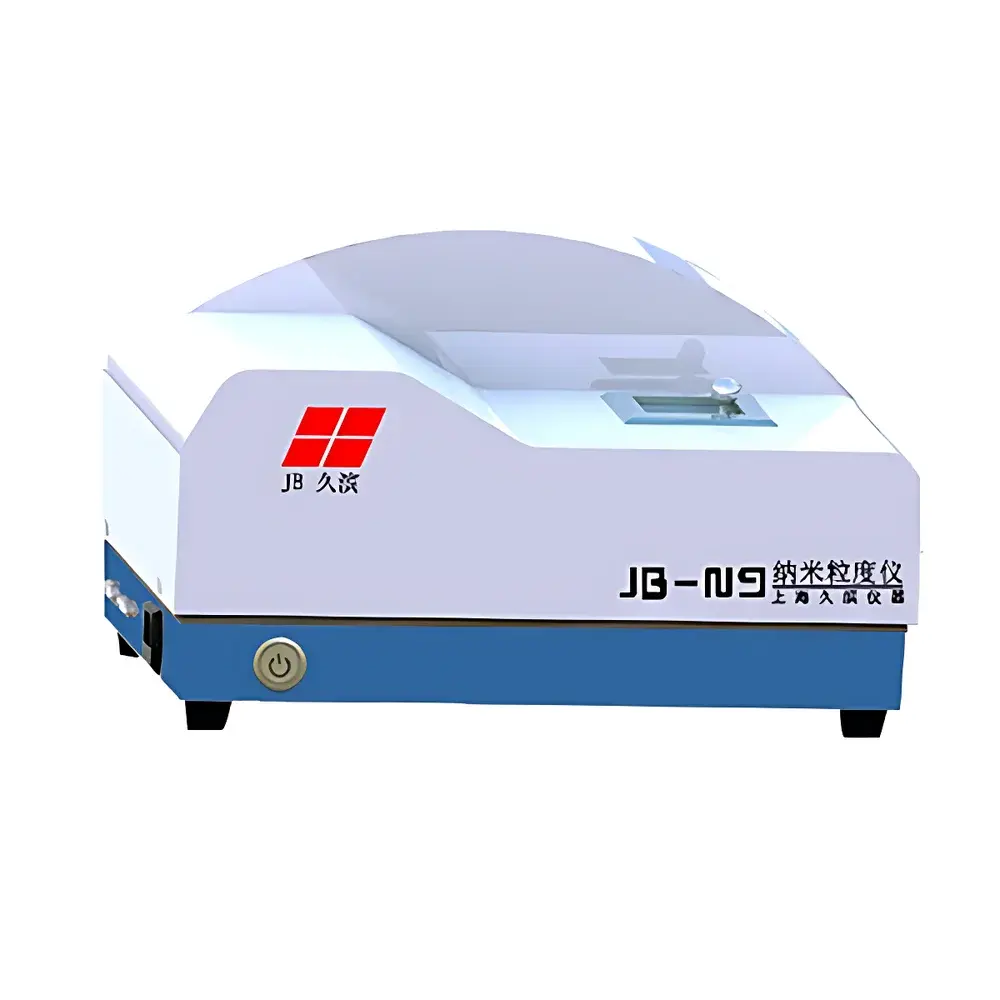
JB-N9 Nanoparticle Size Analyzer (Dynamic Light Scattering) by Jiubin Instruments
| Brand | Jiubin Instruments |
|---|---|
| Model | JB-N9 |
| Principle | Dynamic Light Scattering (DLS) / Photon Correlation Spectroscopy (PCS) |
| Measurement Range | 1–10,000 nm |
| Concentration Range | 0.1–100 mg/L |
| Accuracy | <1% (NIST-traceable standard samples) |
| Repeatability | <1% (NIST-traceable standard samples) |
| Laser Source | 532 nm LD-pumped solid-state laser with integrated temperature stabilization |
| Detector | Hamamatsu single-photon-counting photomultiplier tube (PMT) coupled via single-mode polarization-maintaining fiber |
| Scattering Angle | 90° |
| Correlator | Custom ASIC-based high-speed digital photon correlator |
| Sample Cell | 10 mm × 10 mm square quartz cuvette, 4 mL volume, Peltier-controlled (±0.1 °C) |
| Data Analysis | Cumulant method + regularized non-negative least-squares (NNLS) inversion |
| Output | Z-average diameter (d<sub>Z</sub>), polydispersity index (PDI), intensity-weighted size distribution histogram & tabular data |
| Temperature Control Range | 8–45 °C |
| Measurement Time | <60 s per run (excluding dispersion) |
| Dimensions | 390 × 255 × 240 mm |
| Power Supply | AC 100–260 V, 50/60 Hz, max. 80 W |
| Operating Environment | 15–40 °C, 20–70% RH, non-condensing |
| Compliance | GB/T 29022–2012, ISO 22412:2008 |
Overview
The JB-N9 Nanoparticle Size Analyzer is a laboratory-grade dynamic light scattering (DLS) instrument engineered for precise, reproducible hydrodynamic diameter measurement of colloidal nanoparticles and macromolecules in liquid suspension. Based on the physical principle of Brownian motion—where particle diffusion velocity inversely correlates with hydrodynamic size—the JB-N9 quantifies temporal fluctuations in scattered laser intensity (at 532 nm) using photon correlation spectroscopy (PCS). This enables calculation of the diffusion coefficient via the Stokes–Einstein equation, from which the Z-average diameter (dZ) and polydispersity index (PDI) are derived. Designed for routine QC and R&D applications in nanomaterials science, pharmaceutical formulation, polymer synthesis, and biologics characterization, the JB-N9 integrates a thermally stabilized solid-state laser, a Hamamatsu single-photon-counting PMT detector, and a custom ASIC-based digital correlator to ensure high signal-to-noise ratio and sub-second acquisition stability.
Key Features
- High-fidelity optical path: 90° fixed-angle detection geometry optimized for low-background, high-contrast scattering signal capture
- Integrated Peltier temperature control (8–45 °C, ±0.1 °C resolution) for thermal stability-critical measurements such as protein aggregation kinetics or temperature-dependent micelle formation
- Dual-algorithm data processing: Cumulant analysis for rapid Z-average and PDI reporting, plus regularized non-negative least-squares (NNLS) inversion for robust, model-free intensity-weighted size distribution reconstruction
- Automated parameter optimization: Intelligent software adjusts count rate, acquisition time, and correlation channel settings based on real-time signal quality—eliminating manual calibration for routine users
- Compliance-ready architecture: Audit trail logging, user access levels, and electronic signature support align with GLP/GMP documentation requirements per FDA 21 CFR Part 11 guidelines
- Compact benchtop footprint (390 × 255 × 240 mm) with low power consumption (≤80 W), suitable for shared instrumentation labs and cleanroom-adjacent environments
Sample Compatibility & Compliance
The JB-N9 accepts aqueous and organic dispersions within a concentration range of 0.1–100 mg/L, accommodating common nanomaterials including metal oxides (e.g., TiO₂, SiO₂), polymeric nanoparticles (PLGA, PEG-PLA), liposomes, protein aggregates, and viral vectors. Sample volume requirement is 4 mL in standardized 10 mm × 10 mm quartz cuvettes with integrated thermal coupling. All measurements conform to ISO 22412:2008 and GB/T 29022–2012 standards for DLS instrumentation validation and reporting. Instrument performance verification is supported by NIST-traceable polystyrene latex reference materials (e.g., NIST SRM 1963), enabling lab-specific uncertainty budgeting and inter-laboratory comparability.
Software & Data Management
The proprietary JB-N9 Control Suite runs on Windows OS and provides full local data ownership without cloud dependency. Raw autocorrelation functions, processed distributions, and metadata (temperature, laser power, count rate, correlation quality index) are stored in HDF5 format for long-term archival and third-party analysis compatibility. Reporting templates comply with ISO/IEC 17025 documentation standards, generating PDF test reports with embedded instrument ID, operator credentials, calibration status, and traceable reference material data. Export options include CSV (for Excel or Python pandas ingestion), SVG vector graphics for publication-quality figures, and XML for LIMS integration.
Applications
- Quality control of nanoparticle drug delivery systems (e.g., liposomal doxorubicin, mRNA-LNPs) during formulation development and batch release
- Stability assessment of colloidal suspensions under accelerated storage conditions (e.g., temperature cycling, pH variation)
- Monitoring self-assembly processes: surfactant micellization, block copolymer vesicle formation, and peptide fibrillation kinetics
- Verification of size reduction efficacy in top-down nanomilling or sonication protocols
- Supporting regulatory submissions requiring physicochemical characterization per ICH Q5A(R2) and USP <729>
FAQ
What sample preparation steps are required prior to DLS measurement?
Samples must be filtered (typically 0.1–0.45 µm syringe filters) to remove dust and large aggregates; sonication may be applied only if validated for the specific material to avoid structural damage.
Can the JB-N9 measure zeta potential?
No—zeta potential requires electrophoretic light scattering (ELS); the JB-N9 is dedicated to hydrodynamic size via DLS only.
Is the instrument compatible with non-aqueous solvents?
Yes, provided the solvent’s refractive index and viscosity are entered into the software for accurate Stokes–Einstein conversion; compatibility with chloroform, THF, and DMF has been verified.
How often does the system require recalibration?
Laser alignment and correlator timing are factory-set and stable; annual verification using NIST SRM 1963 is recommended for ISO 17025-accredited labs.
Does the software support multi-sample batch processing?
Yes—up to 96 samples can be queued with auto-loading, temperature ramping, and report generation enabled per sequence.



