
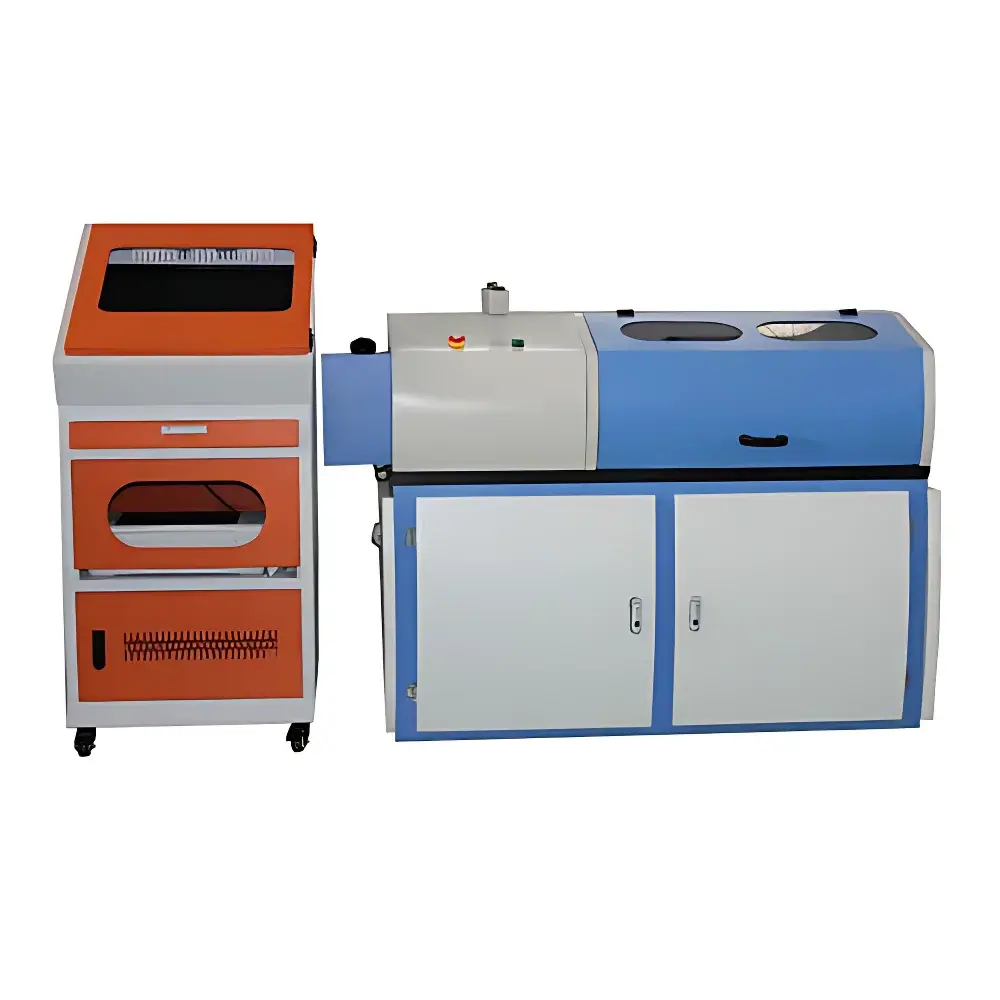
JB-NXD Microcomputer-Controlled Torsion Testing Machine by Jiubin Instruments
| Brand | Jiubin Instruments |
|---|---|
| Origin | Shanghai, China |
| Model | JB-NXD |
| Torque Capacity Options | 500 / 1000 / 2000 / 3000 / 5000 N·m |
| Torque Indication Error | ≤ ±1% |
| Torsion Angle Range | 0–9999.9° |
| Angle Resolution | 0.1° (standard), 0.0001° (high-resolution small-angle mode) |
| Gauge Length | ≥500 mm |
| Specimen Diameter Clamping Range | Ø0–30 mm |
| Torsion Speed | 0–540°/min, continuously variable |
| Speed Accuracy | Better than ±1% of indicated value |
| Power Supply | 220 V ±10%, 50 Hz |
Overview
The JB-NXD Microcomputer-Controlled Torsion Testing Machine is an electromechanical testing system engineered for precise static and quasi-static torsional characterization of metallic, polymeric, composite, and structural materials. It operates on the principle of controlled angular displacement under applied torque, enabling direct measurement of shear stress–strain behavior, yield torque, maximum torque, plastic deformation limits, and torsional stiffness. Designed in accordance with GB/T 10128–1998 (equivalent to ISO 7800:2012 and ASTM E143–22 for torsional rigidity), the system delivers traceable mechanical data essential for material specification validation, process development, and structural integrity assessment in R&D and quality assurance environments.
Key Features
- Modular torque capacity selection: Five standard configurations (500, 1000, 2000, 3000, and 5000 N·m) accommodate a broad spectrum of specimen geometries and strength classes—from thin-wire torsion to heavy-duty shafts and fasteners.
- High-fidelity dual-sensor architecture: A calibrated high-accuracy torque transducer (±1% full-scale error) coupled with a precision optical encoder (0.1° base resolution; enhanced 0.0001° resolution for low-angle compliance and elastic region analysis) ensures synchronized, noise-immune acquisition of torque and angular displacement.
- Fully bidirectional, closed-loop speed control: Continuous torsion rate adjustment from 0 to 540°/min with better than ±1% speed fidelity supports both slow-rate creep/torque-hold tests and rapid dynamic sweeps—critical for evaluating viscoelastic response or failure initiation thresholds.
- Integrated electromechanical drive system: Self-developed servo motor and controller provide smooth, repeatable motion profiles with minimal backlash and thermal drift, ensuring long-term stability during extended test sequences.
- Rigid, monolithic frame construction with ≥500 mm adjustable gauge length: Accommodates standardized specimens per GB/T 10128 and enables custom-length testing of rods, tubes, and assembled components up to Ø30 mm diameter.
Sample Compatibility & Compliance
The JB-NXD accommodates cylindrical, solid, and hollow specimens—including round bars, wires, bolts, springs, and miniature structural elements—within the Ø0–30 mm clamping range. Its mechanical design and control logic comply with national and international torsion testing standards, including GB/T 10128–1998 (Metallic Materials – Room Temperature Torsion Testing Method), ISO 7800:2012 (Metallic Materials – Determination of Torsional Strength), and ASTM E143–22 (Standard Test Method for Shear Modulus at Room Temperature). The system supports GLP-aligned documentation workflows through audit-trail-enabled software logging, meeting foundational requirements for ISO/IEC 17025-accredited laboratories and internal QA/QC protocols in metallurgy, aerospace component manufacturing, and academic materials science departments.
Software & Data Management
The proprietary data acquisition and control software runs on a preconfigured Lenovo industrial PC and provides real-time visualization of torque–angle curves, loading rate trends, peak torque capture, and hysteresis loop analysis. All raw and processed data are stored in timestamped, user-annotated project files compliant with CSV and XML export formats for third-party statistical analysis (e.g., MATLAB, JMP, Minitab). The software enforces user-level access controls, automatic calibration log recording, and electronic signature support—facilitating alignment with FDA 21 CFR Part 11 principles where electronic records serve as primary data sources. Raw sensor outputs are sampled at ≥1 kHz, enabling post-test reprocessing of transient events such as torque drop during ductile fracture or stick–slip phenomena in coated fasteners.
Applications
- Quantification of torsional yield strength, ultimate shear strength, and modulus of rigidity for alloy development and heat treatment verification.
- Mechanical qualification of threaded fasteners, drive shafts, and torsion springs in automotive and aerospace OEM supply chains.
- Interfacial bond strength evaluation in fiber-reinforced composites and adhesive-bonded joints via torsional peel or twist-to-failure protocols.
- Educational demonstration of Saint-Venant’s torsion theory, warping effects, and non-circular section behavior in university mechanics labs.
- Periodic verification of torque wrench calibration standards and reference artifacts in metrology institutes and technical supervision centers.
FAQ
What torque capacities are available for the JB-NXD series?
The JB-NXD is offered in five nominal torque ratings: 500 N·m, 1000 N·m, 2000 N·m, 3000 N·m, and 5000 N·m—each configured with matched load cells and mechanical reinforcement.
Does the system support automated test sequences and report generation?
Yes. The software includes programmable multi-step test templates (e.g., ramp-hold-ramp, cyclic torsion, stepwise torque control) and generates customizable PDF reports with embedded graphs, metadata, and pass/fail annotations against user-defined limits.
Is the JB-NXD compatible with external environmental chambers or extensometers?
The machine features standardized I/O ports (analog ±10 V, digital TTL) and RS-485/USB interfaces, enabling synchronization with temperature-controlled chambers and non-contact angle measurement systems for elevated-temperature or high-precision angular strain applications.
What documentation is provided for regulatory audits?
Each unit ships with a factory calibration certificate traceable to CNAS-accredited standards, full mechanical and electrical schematics, software validation summary, and installation qualification (IQ) documentation suitable for internal GMP/GLP audits.
Can the system be integrated into a laboratory information management system (LIMS)?
Via its open API and structured data export (CSV/XML), the JB-NXD supports scheduled data push to LIMS platforms using middleware or custom Python-based ingestion scripts—without requiring vendor-specific middleware licenses.



