
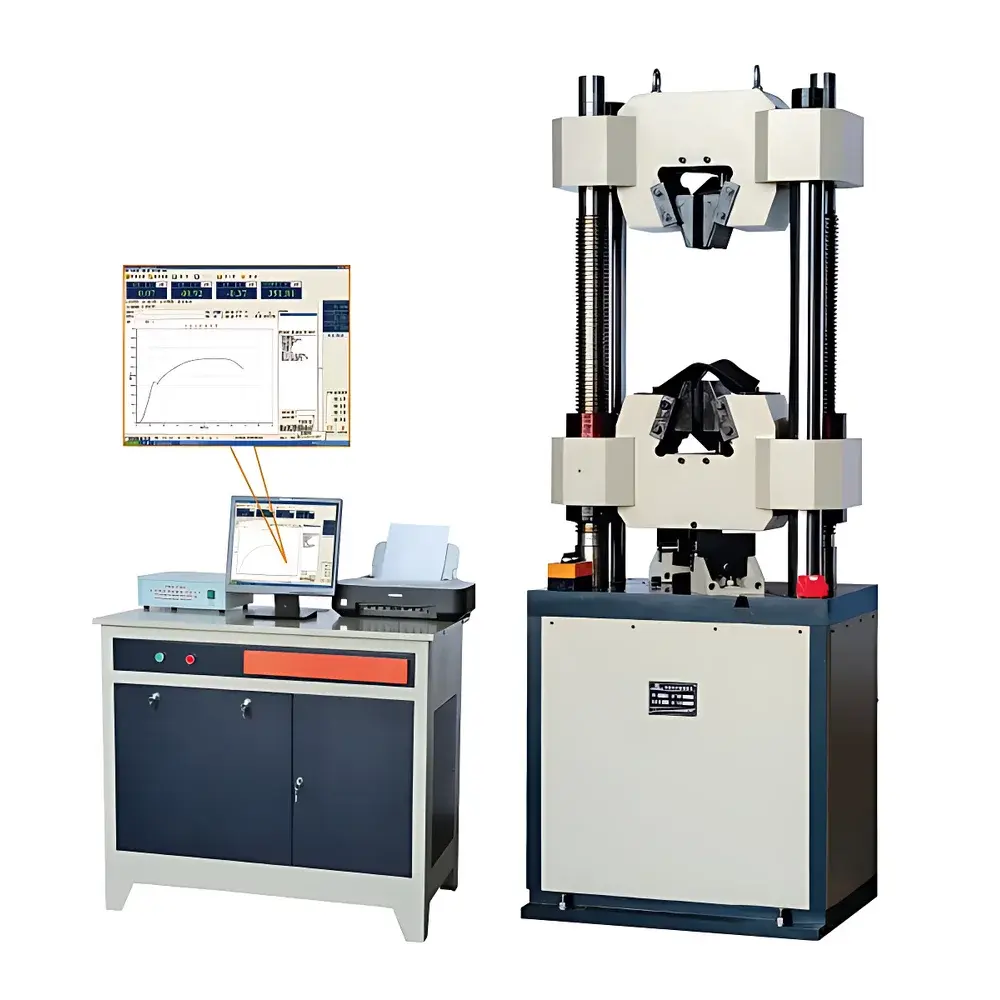
JB/WAW-100B Microcomputer-Controlled Electro-Hydraulic Servo Universal Testing Machine
| Brand | Jiubin Instruments |
|---|---|
| Origin | Shanghai, China |
| Model | JB/WAW-100B |
| Test Force Capacity | 100 kN |
| Force Measurement Range | 4–100% FS |
| Force Accuracy | ≤ ±1% of reading |
| Force Resolution | 0.01 kN |
| Displacement Resolution | 0.01 mm |
| Deformation Measurement Accuracy | 0.01 mm |
| Tensile Test Space | 550 mm |
| Compression Space | 380 mm |
| Piston Stroke | 150 mm |
| Round Specimen Gripping Range | Φ6–Φ26 mm |
| Flat Specimen Thickness Capacity | 0–15 mm |
| Flat Specimen Jaw Width | 70 mm |
| Compression Platen Diameter | φ160 mm |
| Bend Support Span | 450 mm |
| Bend Roller Width | 120 mm |
| Bend Roller Diameter | Φ30 mm |
| Piston Speed | 50 mm/min |
| Clamping Method | Manual |
| Host Dimensions (W×D×H) | 720×580×1950 mm |
| Load Frame Control Cabinet Dimensions (W×D×H) | 1000×700×1400 mm |
| Compliance | GB/T 228.1–2021 (Metallic Materials — Tensile Testing) |
Overview
The JB/WAW-100B Microcomputer-Controlled Electro-Hydraulic Servo Universal Testing Machine is a high-stability, load-frame-based mechanical testing system engineered for precision static mechanical characterization of metallic and non-metallic materials under tension, compression, bending, and shear loading conditions. Its electro-hydraulic servo architecture employs closed-loop hydraulic actuation—driven by a digitally controlled servo valve and high-fidelity pressure transducer—to deliver consistent force application across the full 100 kN capacity range. The load frame features a robust oil-cylinder-underneath configuration, optimizing vertical stiffness and minimizing deflection during high-load compression tests. Designed in accordance with GB/T 228.1–2021 (equivalent to ISO 6892-1:2019), the system ensures metrological traceability and repeatability required for quality control laboratories, R&D centers, and accredited testing facilities operating under GLP or ISO/IEC 17025 frameworks.
Key Features
- Full-range force control with dual-range load cell calibration (4–100% FS), delivering ≤ ±1% force indication error per GB/T 16825.1 and ASTM E4 compliance requirements.
- High-resolution displacement feedback via optical encoder (0.01 mm resolution) and optional extensometer integration (YYU-25/50, 25 mm gauge length, ±0.5% accuracy per ISO 9513).
- Modular software architecture supporting user-defined test procedures—including multi-step ramp-hold cycles, load-controlled and displacement-controlled modes—with programmable dwell times and conditional branching.
- Dual-level user permission management (Administrator / Tester) with audit-trail logging for all parameter modifications, test execution, and data export events—supporting internal QA workflows and FDA 21 CFR Part 11 readiness when paired with electronic signature modules.
- Open Excel-based reporting engine enabling fully customizable report templates; supports automated generation of stress–strain curves, modulus calculations (E, G), yield point determination (Rp0.2, Rm), and elongation metrics (A%, Z%).
- Standardized mechanical interface for rapid attachment/detachment of interchangeable fixtures: flat-specimen jaws (0–15 mm thickness, 70 mm width), round-specimen grips (Φ6–Φ26 mm), φ160 mm compression platen, and 450 mm-span three-point bending assembly with Φ30 mm support rollers.
Sample Compatibility & Compliance
The JB/WAW-100B accommodates standardized tensile specimens (e.g., ISO 6892-1 Type 2, ASTM E8/E21 rectangular bars), sheet metal coupons, castings, weldments, polymer rods, and composite laminates up to 15 mm thick or Φ26 mm diameter. Its 550 mm tensile travel and 380 mm compression height meet minimum requirements for ASTM E9 (compression testing of metallic materials) and ISO 15630-1 (reinforcing steels). All force, displacement, and strain measurement subsystems are calibrated per ISO 376:2011 (force calibration) and ISO 9513:2012 (extensometer verification). System validation documentation includes as-delivered calibration certificates traceable to NIM (National Institute of Metrology, China) standards.
Software & Data Management
The embedded Windows-based control software provides real-time acquisition at ≥100 Hz sampling rate, synchronized force–displacement–strain data streams with timestamped metadata (operator ID, environmental temperature/humidity tags if externally interfaced). Raw data exports in CSV and XML formats preserve full precision (16-bit ADC resolution); binary project files (.jbt) retain complete test configuration history. Audit logs record all critical actions—including method edits, calibration updates, and user logins—with immutable timestamps. Optional network deployment enables centralized data archiving to SQL Server or NAS environments, supporting ISO/IEC 17025 clause 7.5.2 (data protection and integrity).
Applications
This system serves routine mechanical property evaluation in metallurgical QC labs (yield strength, ultimate tensile strength, reduction of area), civil engineering material certification (rebar, structural steel plates), aerospace component qualification (Ti-6Al-4V fasteners, aluminum alloy extrusions), and academic materials science research (polymer viscoelasticity mapping, ceramic fracture toughness pre-characterization). Its manual grip actuation and fixed-speed piston (50 mm/min) make it especially suited for standardized compliance testing where procedural fidelity outweighs high-speed dynamic capability.
FAQ
Does the JB/WAW-100B comply with international testing standards such as ASTM or ISO?
Yes—it is configured and validated to meet the essential performance criteria of ASTM E4, E8, E9, and ISO 6892-1, ISO 15630-1, and ISO 376, with documentation provided for traceable calibration and method alignment.
Can third-party extensometers be integrated?
Yes—the system features standard analog voltage input (±10 V) and digital TTL trigger ports compatible with most commercial clip-on and non-contact extensometers meeting ISO 9513 Class 1 or better specifications.
Is remote operation or network monitoring supported?
Local Ethernet connectivity enables remote desktop access and file transfer; full SCADA-level integration requires optional OPC UA gateway licensing and IT infrastructure alignment.
What maintenance intervals are recommended for the hydraulic power unit?
Oil filtration and level verification every 500 operational hours; full hydraulic fluid replacement and servo valve inspection every 2,000 hours or annually—whichever occurs first—per manufacturer’s technical bulletin TB-JB-WAW-100B-MNT-2023.
Are calibration certificates supplied with shipment?
Yes—factory calibration certificates for load cell, displacement encoder, and system-level verification (tension/compression/bend) are included, each referencing NIM-traceable standards and valid for 12 months from date of issue.



