
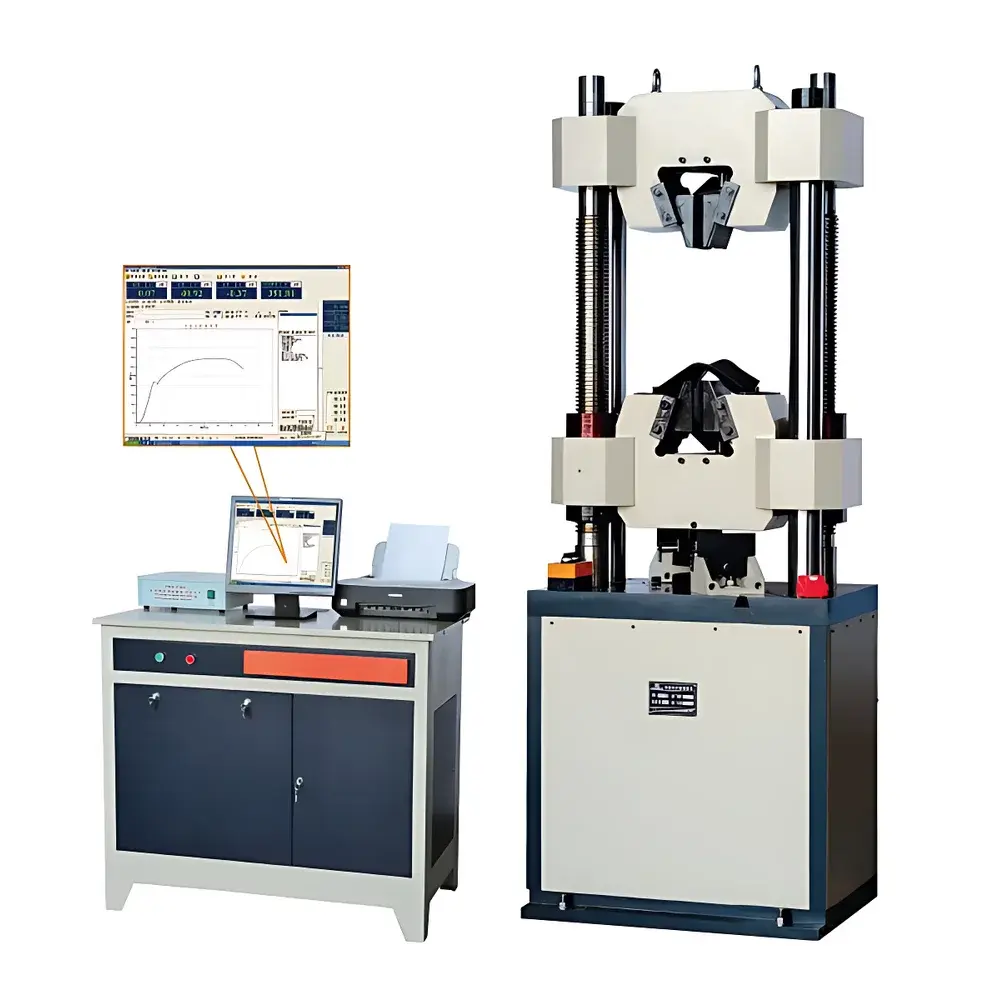
JB/WAW-300B Electromechanical-Hydraulic Servo Universal Testing Machine
| Brand | Jiubin Instruments |
|---|---|
| Origin | Shanghai, China |
| Model | JB/WAW-300B |
| Test Force Capacity | 300 kN |
| Force Measurement Range | 4–100% FS |
| Force Accuracy | ≤ ±1% of reading |
| Force Resolution | 0.01 kN |
| Displacement Resolution | 0.01 mm |
| Deformation Measurement Accuracy | 0.01 mm |
| Tensile Test Space | 550 mm |
| Compression Space | 380 mm |
| Piston Stroke | 150 mm |
| Round Specimen Grip Range | Φ6–Φ26 mm |
| Flat Specimen Thickness Capacity | 0–15 mm |
| Flat Specimen Jaw Width | 70 mm |
| Compression Platen Diameter | φ160 mm |
| Bend Support Span | 450 mm |
| Bend Roller Width | 120 mm |
| Bend Roller Diameter | Φ30 mm |
| Piston Speed | 50 mm/min |
| Gripping Method | Hydraulic |
| Overall Dimensions (W×D×H) | 720 × 580 × 1950 mm |
| Control Cabinet Dimensions (W×D×H) | 1000 × 700 × 1400 mm |
| Compliance | GB/T 228.1–2021 (formerly GB 228–2002) |
| Standard Accessories | Dual-range round specimen grips (Φ6–Φ13 & Φ13–Φ26), flat specimen grip (0–15 mm), compression platen (φ160 mm), 3-point bending fixture (450 mm span), YYU-25/50 extensometer (Beijing Iron and Steel Research Institute), servo oil source, digital electro-hydraulic servo valve, proprietary servo & electrical control systems, industrial-grade Lenovo PC, color inkjet printer |
Overview
The JB/WAW-300B Electromechanical-Hydraulic Servo Universal Testing Machine is a precision-engineered, load-frame-based mechanical testing system designed for static mechanical property evaluation of metallic and non-metallic materials under controlled quasi-static loading conditions. It operates on the principle of closed-loop electro-hydraulic servo control, where real-time feedback from high-stability pressure transducers, linear displacement transducers, and optional extensometers drives proportional flow modulation via a digitally regulated servo valve—ensuring accurate force, displacement, and strain regulation across full-scale test cycles. The machine features a robust, oil-cylinder-underneath structural configuration, delivering enhanced rigidity, minimized frame deflection, and optimal alignment stability during high-load tensile, compression, and flexural testing. Its architecture conforms to fundamental metrological requirements defined in ISO 7500-1:2018 (metallic materials — verification of static uniaxial testing machines) and supports full traceability to national standards referenced in GB/T 228.1–2021, the Chinese adoption of ISO 6892-1 for tensile testing at ambient temperature.
Key Features
- 300 kN nominal test capacity with verified force accuracy ≤ ±1% of reading over 4–100% full scale (FS), meeting Class 1 accuracy per ISO 7500-1.
- Hydraulic actuation with digital electro-hydraulic servo valve enabling precise, low-noise, and repeatable load ramping, dwell, and cycling profiles.
- Oil-cylinder-underneath host design ensures superior column alignment, reduced lateral deflection, and extended service life under cyclic and high-force operation.
- Integrated dual-channel measurement: high-resolution piston displacement (0.01 mm) and optional clip-on or contacting extensometry (YYU-25/50, 25 mm gauge length, ±0.5% accuracy per ISO 9513).
- Modular software architecture supporting user-defined test sequences, multi-step protocols (e.g., preload → hold → ramp → unload), and customizable pass/fail criteria.
- Two-tier role-based access control (administrator and tester), ensuring audit-ready operational separation in GLP- and GMP-aligned environments.
- Native Excel-based reporting engine with drag-and-drop field mapping, allowing fully configurable output templates compliant with internal QA documentation workflows.
Sample Compatibility & Compliance
The JB/WAW-300B accommodates standardized and custom specimens across major material categories: ductile and brittle metals (steel, aluminum, titanium alloys), polymers, composites, ceramics, and construction materials (concrete cores, mortar prisms). Its standard fixture suite includes interchangeable hydraulic wedge grips for round specimens (Φ6–Φ26 mm), flat specimen jaws (0–15 mm thickness, 70 mm width), a φ160 mm compression platen, and a three-point bending assembly (450 mm support span, Φ30 mm rollers, 120 mm roller width). All mechanical interfaces are manufactured to ISO 26203-2 tolerances for dimensional repeatability. The system satisfies mandatory requirements of GB/T 228.1–2021, and its measurement subsystems are calibrated per JJG 139–2014 (Chinese verification regulation for universal testing machines). Optional calibration certificates include NIST-traceable force calibration up to 300 kN and displacement verification per ISO 6914.
Software & Data Management
The embedded Windows-based control software provides real-time graphical monitoring of force–displacement, force–time, and stress–strain curves with synchronized data logging at ≥100 Hz. All raw acquisition channels—including load cell output, encoder position, extensometer signal, and hydraulic pressure—are timestamped and stored in binary-encoded .DAT files with metadata headers (operator ID, test ID, environmental notes, calibration expiry). Export functions support CSV, XML, and PDF formats; Excel integration allows direct formula-driven post-processing (e.g., yield strength calculation via 0.2% offset method, modulus determination via secant or tangent fit). Audit trails record all parameter modifications, test start/stop events, and user logins—fully compatible with FDA 21 CFR Part 11 requirements when deployed with electronic signature modules and encrypted database storage.
Applications
- Mechanical property certification of structural steel grades per GB/T 14977 and ASTM A370.
- Quality assurance of aerospace fasteners and castings under MIL-STD-810 and HB 5469.
- Research-grade tensile/compression characterization of advanced high-strength steels (AHSS), magnesium alloys, and fiber-reinforced thermoplastics.
- Construction materials validation including rebar elongation, concrete compressive strength, and asphalt mixture stiffness modulus.
- Educational use in university laboratories for hands-on instruction in solid mechanics, materials science, and experimental stress analysis.
- Third-party testing labs performing accredited services under CNAS-CL01 (ISO/IEC 17025) scope.
FAQ
What standards does the JB/WAW-300B comply with for tensile testing?
It fully supports GB/T 228.1–2021 (equivalent to ISO 6892-1) and includes built-in calculation routines for Rp0.2, Rm, A%, and Agt per that standard.
Is the system suitable for cyclic fatigue testing?
No—the JB/WAW-300B is configured for quasi-static loading only; it lacks the dynamic actuation bandwidth and waveform generation capability required for high-cycle fatigue or servo-hydraulic S-N curve testing.
Can third-party extensometers be integrated?
Yes—via analog voltage input (±10 V) and RS-422 serial interface; compatibility requires signal conditioning matching the instrument’s DAQ specifications.
What maintenance intervals are recommended for the hydraulic system?
Oil filtration and level checks every 500 operating hours; full hydraulic oil replacement and valve inspection every 2,000 hours or annually, whichever occurs first.
Does the software support automated report generation for batch testing?
Yes—batch mode enables sequential execution of identical test protocols across multiple specimens, with consolidated summary reports aggregating key metrics (e.g., mean Rm ± SD, coefficient of variation) across the set.



