
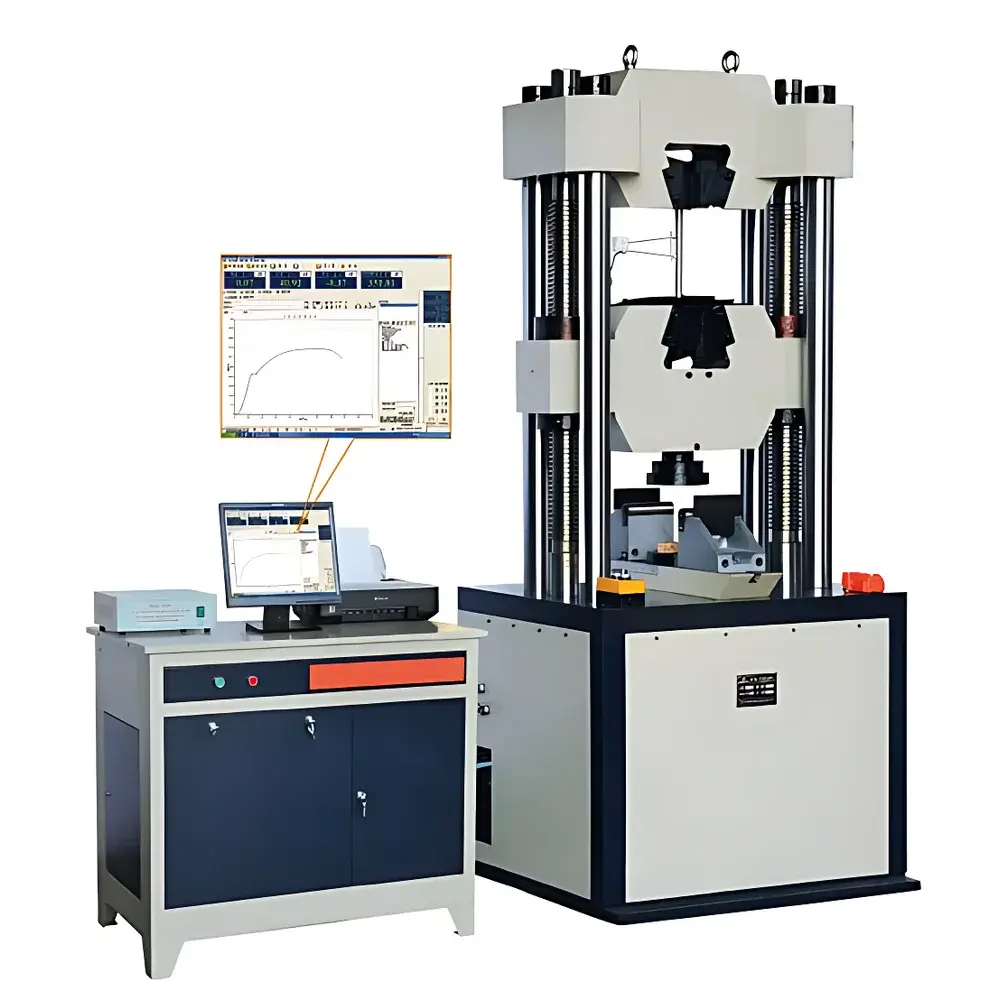
JB/WAW-600D Jinbin Electro-Hydraulic Servo Universal Testing Machine
| Brand | Jinbin |
|---|---|
| Origin | Shanghai, China |
| Model | JB/WAW-600D |
| Test Force Capacity | 600 kN |
| Force Measurement Range | 4–100% FS |
| Force Accuracy | ≤ ±1% of reading |
| Force Resolution | 0.01 kN |
| Displacement Resolution | 0.01 mm |
| Deformation Measurement Accuracy | 0.01 mm |
| Tensile Test Space | 650 mm |
| Compression Space | 380 mm |
| Piston Stroke | 150 mm |
| Round Specimen Grip Range | Φ13–Φ40 mm |
| Flat Specimen Thickness Capacity | 0–15 mm |
| Flat Specimen Max Width | 75 mm |
| Compression Platen Diameter | φ160 mm |
| Bend Support Span | 450 mm |
| Bend Roller Width | 120 mm |
| Bend Roller Diameter | Φ30 mm |
| Piston Speed | 50 mm/min |
| Clamping Method | Automatic Hydraulic Clamping |
| Host Dimensions (W×D×H) | 830×700×2100 mm |
| Load Frame Control Cabinet Dimensions (W×D×H) | 1000×700×1400 mm |
Overview
The JB/WAW-600D Jinbin Electro-Hydraulic Servo Universal Testing Machine is a high-stability, load-frame-based mechanical testing system engineered for precision static mechanical characterization of metallic and non-metallic materials under tension, compression, bending, and shear loading conditions. Utilizing a robust oil-cylinder-underneath frame architecture and closed-loop electro-hydraulic servo control, the system delivers high-force fidelity and long-term repeatability across multi-cycle test protocols. Its force transduction relies on a calibrated high-linearity pressure sensor (Zhenhai, Ningbo), coupled with digital servo valve actuation and real-time PID-regulated hydraulic flow control—enabling smooth, low-noise load application from 4% to 100% of full-scale capacity (600 kN). Designed in accordance with GB/T 228.1–2021 (equivalent in scope to ISO 6892-1 and ASTM E8/E21), the machine supports standardized quasi-static mechanical property extraction—including yield strength (Rp0.2), ultimate tensile strength (Rm), elongation at break (A%), reduction of area (Z%), compressive modulus, and flexural strength—under ambient laboratory conditions.
Key Features
- Oil-cylinder-underneath structural design ensures enhanced rigidity, minimized frame deflection, and improved alignment stability during high-load testing.
- Automatic hydraulic clamping system provides consistent gripping force across round (Φ13–Φ40 mm) and flat (0–15 mm thick × up to 75 mm wide) specimens, minimizing slippage and stress concentration artifacts.
- Integrated high-resolution displacement measurement via optical encoder (0.01 mm resolution) and extensometer-compatible interface (YYU-25/50, Beijing Iron and Steel Research Institute).
- Dual-channel analog signal conditioning with 24-bit ADC ensures accurate, low-drift acquisition of force, displacement, and strain signals.
- Modular software architecture supporting user-defined test procedures, editable standards libraries, and stepwise protocol sequencing—including ramp-hold-relax cycles and multi-stage loading profiles.
- Role-based access control with two-tiered permission levels (Administrator and Tester) for audit-compliant operation in regulated environments.
- Native Excel-based reporting engine enables full customization of output templates—columns, units, calculations, and formatting—without requiring third-party scripting or licensing.
Sample Compatibility & Compliance
The JB/WAW-600D accommodates standard and custom geometries per ISO 6892-1, ASTM E8/E21, ASTM C39, ASTM D790, and GB/T 228.1–2021. Round specimen grips cover Φ13–Φ40 mm diameters; flat grips accept thicknesses from 0 to 15 mm and widths up to 75 mm. Compression platen (φ160 mm) and three-point bend fixtures (450 mm support span, Φ30 mm rollers, 120 mm roller width) meet dimensional requirements for metallic, polymer, ceramic, and composite material evaluation. All mechanical components are manufactured to ISO 9001-certified processes. The system’s measurement uncertainty budget conforms to ISO/IEC 17025 principles when operated with traceably calibrated transducers and verified environmental conditions (23 ± 5 °C, <70% RH).
Software & Data Management
The embedded Windows-based control software features native support for GLP/GMP-aligned data integrity practices. All test executions generate immutable digital records including operator ID, timestamp, environmental metadata, raw channel data (force/displacement/strain), and processed results—all stored in encrypted binary + CSV dual format. Audit trail functionality logs all parameter modifications, user logins, report exports, and calibration events. Data export supports direct integration into LIMS platforms via ODBC and complies with FDA 21 CFR Part 11 requirements when deployed with electronic signature modules and time-stamped digital certificates. Batch printing allows concurrent output of multiple specimens with customizable sort order (e.g., by batch ID, material grade, or test date).
Applications
This system serves as a core mechanical characterization platform in metallurgical QA/QC labs (steel billets, aluminum extrusions, titanium alloys), civil engineering material testing (rebar, concrete cores, grout), aerospace component validation (fasteners, sheet stock), academic materials science research (polymer composites, additive-manufactured metals), and certification bodies performing third-party conformity assessments. Its 600 kN capacity and 50 mm/min piston speed enable both slow-strain-rate ductility assessment and rapid qualification tests under production throughput constraints.
FAQ
What international standards does the JB/WAW-600D comply with for tensile testing?
It fully supports GB/T 228.1–2021, which aligns technically with ISO 6892-1 and ASTM E8/E21 for metallic materials.
Is the system compatible with external extensometers?
Yes—the frame includes dedicated mounting interfaces and analog input channels for third-party or OEM extensometers, including the supplied YYU-25/50.
Can test methods be exported and shared across multiple JB/WAW-600D units?
Yes—test procedures, standards definitions, and step sequences are saved as portable XML files and can be imported/exported without version dependency.
Does the software provide traceable calibration management?
Yes—calibration certificates, due dates, and verification logs are maintained within the software’s instrument management module, with automated alerts prior to expiry.
What safety protections are built into the hydraulic control system?
The servo oil source includes overpressure relief valves, thermal cut-off sensors, low-oil-level detection, and emergency stop interlocks compliant with ISO 13850.



