
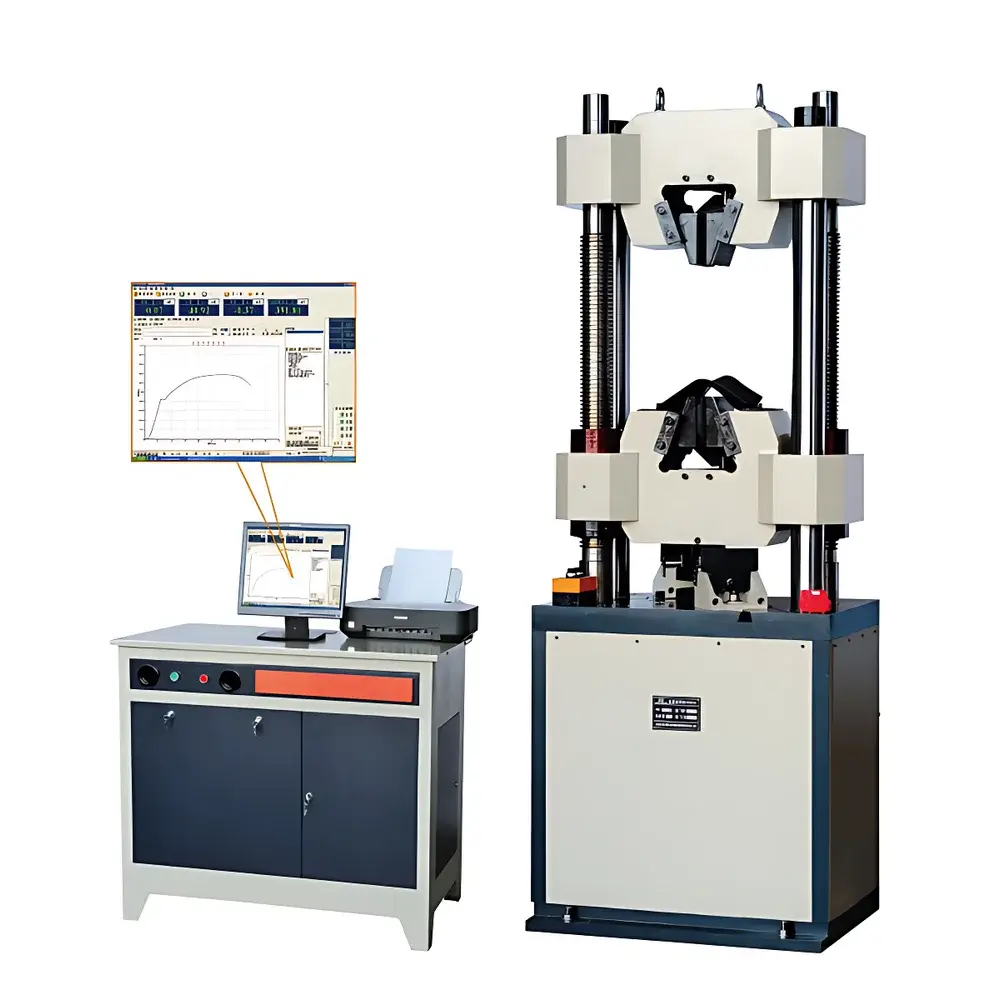
JB/WEW-600B Hydraulic Universal Testing Machine by Jiubin Instruments
| Brand | Jiubin Instruments |
|---|---|
| Origin | Shanghai, China |
| Model | JB/WEW-600B |
| Max. Test Force | 600 kN |
| Force Range | 30–600 kN |
| Force Accuracy | ±1% of reading |
| Force Resolution | 0.01 kN |
| Displacement Resolution | 0.01 mm |
| Deformation Measurement Accuracy | 0.01 mm |
| Tensile Space | 650 mm |
| Compression Space | 380 mm |
| Piston Stroke | 150 mm |
| Round Specimen Grip Range | Φ13–Φ40 mm |
| Flat Specimen Thickness Capacity | 0–15 mm |
| Flat Specimen Width | 75 mm |
| Compression Plate Diameter | φ160 mm |
| Bend Span (Max) | 450 mm |
| Bend Roller Width | 120 mm |
| Bend Roller Diameter | Φ30 mm |
| Piston Speed | 50 mm/min |
| Clamping Method | Automatic Hydraulic Clamping |
| Overall Dimensions (L×W×H) | 720×580×2100 mm |
| Control Console Dimensions | 1000×700×1400 mm |
| System Type | Oil-Actuated, Load Frame with Lower Cylinder |
Overview
The JB/WEW-600B Hydraulic Universal Testing Machine is a statically rated, oil-actuated universal testing system engineered for high-reliability mechanical property evaluation of metallic and non-metallic materials in accordance with ASTM E4, ASTM E8/E8M, ISO 6892-1, ISO 7500-1, GB/T 228.1, and EN 10002-1 standards. Its load frame features a robust lower-cylinder architecture with dual-column guidance, delivering stable axial loading under both tension and compression modes. The machine employs a high-stiffness hydraulic actuation system coupled with precision pressure transduction and closed-loop load control—enabling accurate force application across the full 30–600 kN operating range. Integrated displacement sensing via optical encoder and strain measurement via clip-on extensometer (YYU-25/50) support concurrent acquisition of force, displacement, and true strain data. Designed for laboratory, QA/QC, and third-party certification environments, the JB/WEW-600B meets structural integrity requirements for GLP-compliant material validation workflows.
Key Features
- Hydraulic actuation with automatic clamping—eliminates manual torque dependency and ensures consistent grip pressure across specimen geometries.
- Dual-range load cell (30–600 kN) calibrated to ISO 7500-1 Class 1 accuracy (±1% of reading), traceable to national metrology institutes.
- High-resolution digital feedback: 0.01 kN force resolution, 0.01 mm displacement and deformation resolution.
- Modular fixture system supporting tensile (round: Φ13–Φ40 mm; flat: 0–15 × 75 mm), compression (φ160 mm plate), and three-point bending (450 mm span, Φ30 mm rollers) configurations.
- Real-time closed-loop control with adjustable ramp rates, dwell periods, and break detection logic per test step.
- Two-tier user permission architecture (administrator & operator) compliant with internal audit and SOP enforcement requirements.
- Self-diagnostic firmware with real-time error logging, sensor status monitoring, and hardware fault isolation capability.
Sample Compatibility & Compliance
The JB/WEW-600B accommodates standardized specimens per ASTM E8, ISO 6892-1, and GB/T 228.1—including round bars, flat strips, castings, weldments, and polymer composites up to 15 mm thickness. Its 650 mm tensile height and 380 mm compression space allow full-stroke testing of long-section or high-aspect-ratio samples. All mechanical components conform to ISO 12100 safety principles; hydraulic circuit includes pressure relief valves, thermal cutoffs, and emergency stop interlocks meeting IEC 60204-1. Software supports audit trail generation and electronic signature capture per FDA 21 CFR Part 11 Annex 11 guidelines when deployed in regulated manufacturing settings.
Software & Data Management
The bundled universal testing software operates on Windows OS and provides native support for six real-time plotting modes: Force vs. Displacement, Force vs. Strain, Stress vs. Displacement, Stress vs. Strain, Force vs. Time, and Displacement vs. Time. Data export is natively compatible with Microsoft Excel (.xlsx), enabling direct integration into statistical process control (SPC) platforms. Users may define custom test templates, modify ASTM/ISO-compliant calculation routines (e.g., Rp0.2, Rm, A5, E), and generate multi-specimen comparative reports with sortable fields. All raw data files are stored in timestamped binary format with SHA-256 checksums; revision history and user action logs are retained for minimum 12 months as required under GLP documentation protocols.
Applications
This system serves as a primary mechanical characterization platform in metallurgical laboratories, aerospace component suppliers, construction materials certification bodies, and academic research groups. Typical use cases include yield strength verification of structural steel grades (Q345, S355), ductility assessment of aluminum extrusions (6061-T6), compressive modulus determination of concrete cores, flexural strength evaluation of fiber-reinforced polymers (FRP), and quality conformance testing of fasteners per ISO 898-1. It also supports routine calibration of secondary reference standards used in accredited calibration labs (ISO/IEC 17025).
FAQ
What standards does the JB/WEW-600B comply with for force calibration?
It conforms to ISO 7500-1 Class 1 requirements, with factory calibration traceable to CNAS-accredited reference standards.
Can the system perform cyclic or low-cycle fatigue tests?
No—this is a quasi-static testing machine optimized for monotonic loading; it lacks servo-hydraulic actuation or waveform generation capability required for dynamic fatigue testing.
Is third-party certification support available for IQ/OQ/PQ documentation?
Yes—Jiubin Instruments provides vendor-supplied qualification protocols and witnessed execution support for installation, operational, and performance qualification aligned with GMP Annex 15.
What is the maximum specimen length supported in tension mode?
With standard grips installed, the usable tensile gauge length is 650 mm; extended travel options require custom crosshead configuration.
Does the software meet FDA 21 CFR Part 11 requirements out-of-the-box?
Basic electronic signature and audit trail functions are enabled; full Part 11 compliance requires site-specific configuration review and validation documentation performed by the end user or qualified consultant.



