
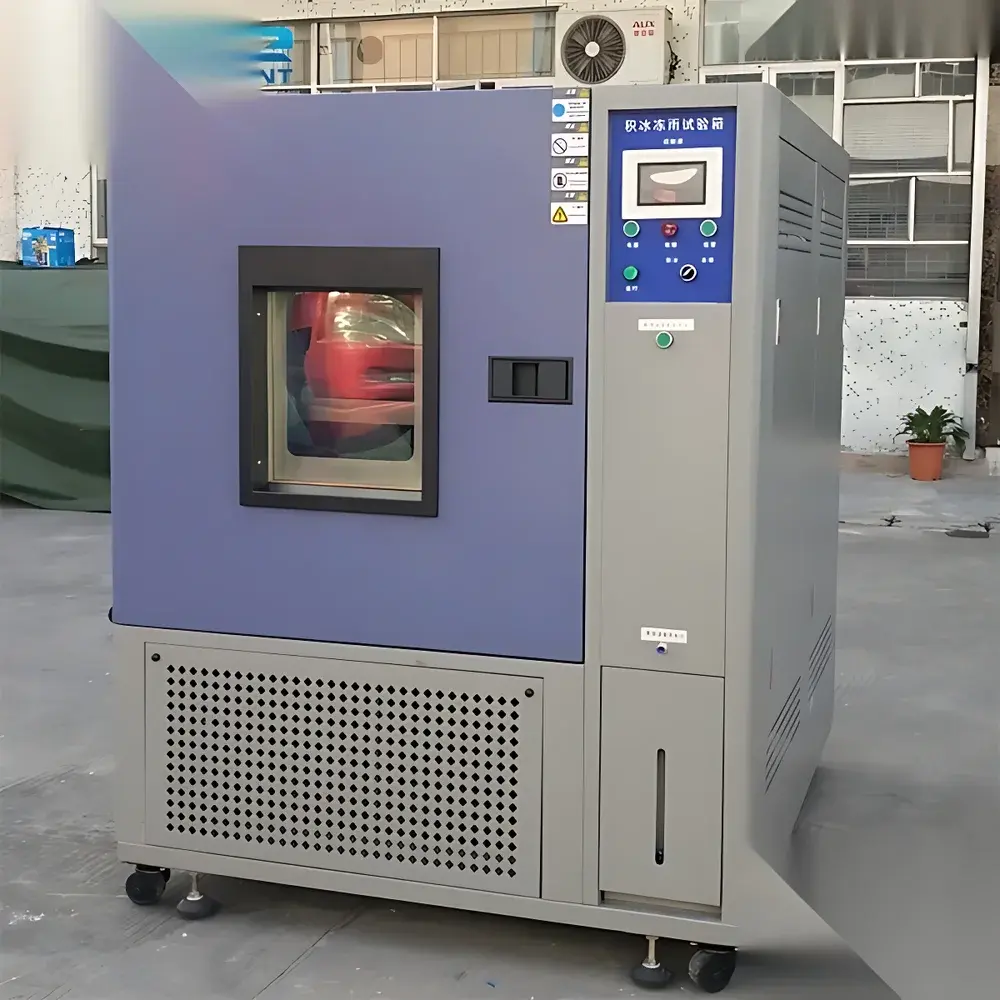
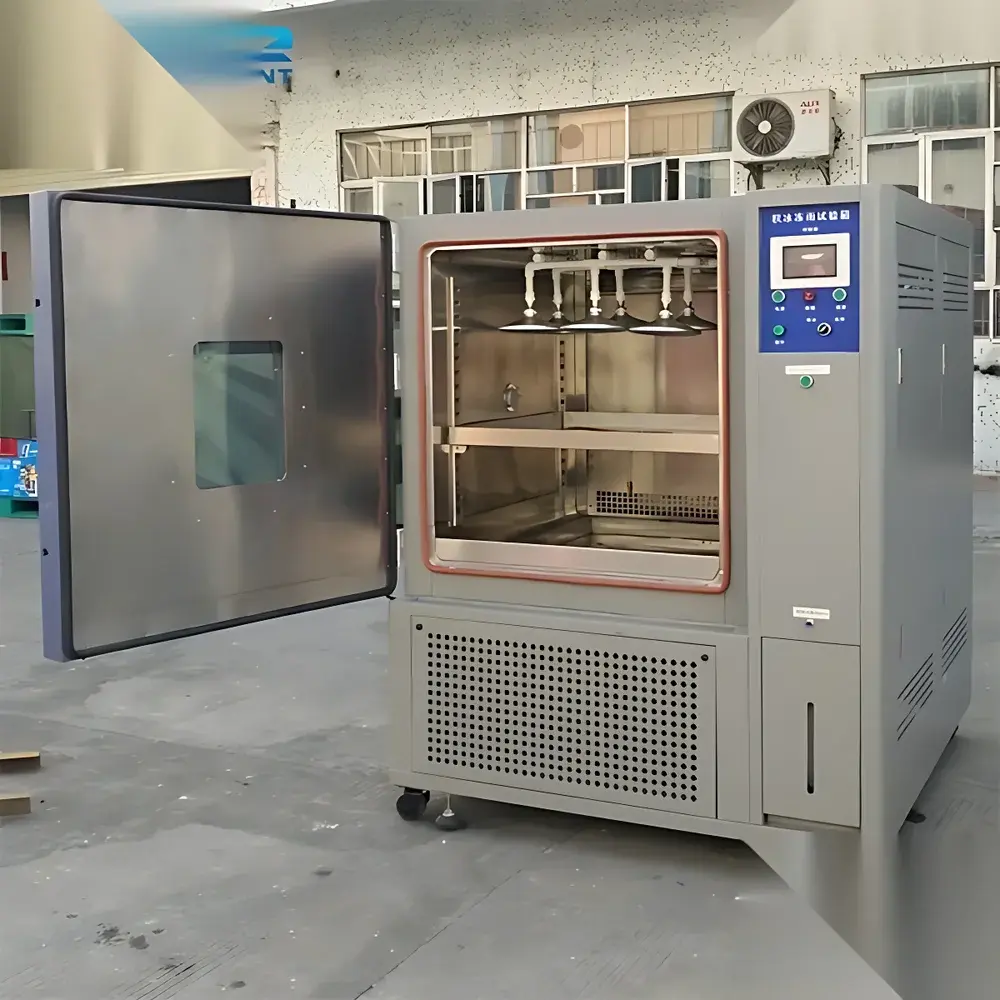
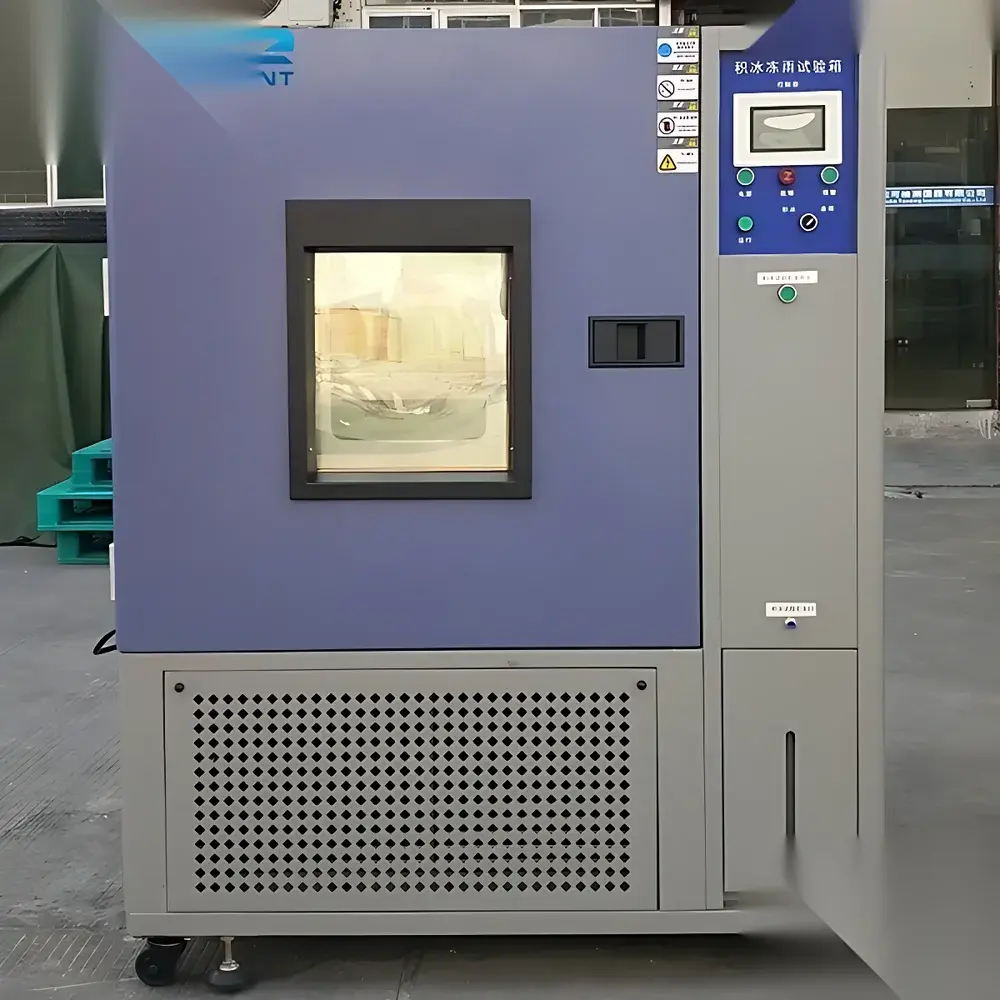
OK-JBDY Series Icing and Freezing Rain Environmental Test Chamber
| Brand | OK |
|---|---|
| Origin | Imported |
| Manufacturer Type | Authorized Distributor |
| Temperature Range | -20 °C to 80 °C (customizable) |
| Temperature Uniformity | ±2.0 °C |
| Temperature Fluctuation | ±0.5 °C |
| Rainfall Intensity | 25 mm/h |
| Nozzle Orifice Diameter | φ0.4 mm |
| Raindrop Diameter | 1.0–1.5 mm |
| Ice Accumulation Thickness Options | 6 mm, 13 mm, 37 mm, 75 mm |
| Ice Density Range | 0.2–0.9 g/cm³ |
| Water Temperature Control | 0–5 °C |
| Internal Chamber Materials | SUS#304 Stainless Steel |
| External Cabinet | Galvanized Steel with Powder Coating or Optional SUS304 |
| Refrigeration System | Hermetic Scroll Compressor (French/Tecumseh) |
| Controller | 5.7″ TFT Color LCD Touchscreen (Bilingual English/Chinese) |
| Power Supply | AC 220 V ±5%, 50 Hz ±0.5 Hz, Single-Phase Three-Wire |
Overview
The OK-JBDY Series Icing and Freezing Rain Environmental Test Chamber is a purpose-built climatic simulation system engineered for rigorous laboratory evaluation of equipment performance under atmospheric icing and freezing rain conditions. It operates on the principle of controlled nucleation and accretion—precisely regulating supercooled liquid water delivery, substrate temperature, ambient humidity, and airflow dynamics to replicate realistic ice formation mechanisms observed in natural environments. Designed in strict compliance with GJB 150.22A–2009 (“Environmental Test Methods for Military Equipment – Part 22: Icing and Freezing Rain Testing”), the chamber enables standardized assessment of functional integrity, structural load tolerance, sensor obscuration, aerodynamic interference, and de-icing system efficacy. Its modular architecture supports customization of internal volume (150 L to 1000 L), extended low-temperature operation (down to –20 °C), and programmable ice thickness profiles—making it suitable for aerospace components, unmanned aerial systems (UAS), wind turbine blades, power transmission hardware, maritime electronics, and automotive ADAS sensors.
Key Features
- Precision-controlled supercooled water delivery system with calibrated nozzles (φ0.4 mm orifice) generating uniform raindrops (1.0–1.5 mm diameter) at a reproducible intensity of 25 mm/h.
- Multi-zone thermal management: independent control of chamber air temperature (–20 °C to 80 °C), water supply temperature (0–5 °C), and test specimen surface temperature to ensure thermodynamic consistency during ice accretion.
- High-fidelity ice morphology simulation: selectable accumulation thicknesses (6 mm, 13 mm, 37 mm, 75 mm) and adjustable ice density (0.2–0.9 g/cm³) to emulate glaze ice, rime ice, or mixed-phase deposits per MIL-STD-810H and RTCA DO-160G Appendix O requirements.
- Robust chamber construction: seamless SUS#304 stainless steel interior for corrosion resistance and cleanability; external cabinet available in powder-coated galvanized steel or optional full SUS304 for marine-grade durability.
- Intelligent controller with 5.7″ TFT touchscreen interface supporting dual-language (English/Chinese) operation, real-time data logging, alarm history, and user-defined test profiles compliant with GLP audit trails.
Sample Compatibility & Compliance
The OK-JBDY chamber accommodates test specimens up to 1000 × 1000 × 1000 mm (OK-JBDY-1000 model), with configurable internal mounting structures, cable feedthroughs (φ50 mm), and load-bearing shelves. It meets the physical and operational requirements of GJB 150.22A–2009 and serves as a validated platform for pre-compliance testing aligned with international standards including RTCA DO-160G Section 22 (Icing), SAE ARP4754A, IEC 60068-2-30 (damp heat cyclic), and ISO 16750-4 (road vehicles — environmental conditions). All configurations support traceable calibration per ISO/IEC 17025 requirements and are compatible with third-party validation protocols for regulatory submissions.
Software & Data Management
The embedded controller provides real-time monitoring of temperature, water flow rate, chamber humidity, and elapsed test time, with automatic data export via USB or RS485. Optional PC-based software enables remote supervision, multi-chamber synchronization, statistical process control (SPC) charting, and generation of PDF test reports containing timestamped parameter logs, operator annotations, and pass/fail determinations per predefined acceptance criteria. Audit trail functionality records all configuration changes, user logins, and alarm events—supporting FDA 21 CFR Part 11 compliance when configured with electronic signature modules.
Applications
- Aerospace: Validation of pitot-static systems, engine inlets, wing leading edges, and rotorcraft components under simulated flight icing conditions.
- Renewable Energy: Functional testing of wind turbine blade coatings, anemometers, and pitch control actuators exposed to coastal rime or continental glaze events.
- Defense & Naval Systems: Evaluation of radar domes, EO/IR turrets, and communication antennas subjected to sea-spray icing per MIL-STD-810H Method 521.4.
- Automotive & Rail: Assessment of LiDAR field-of-view degradation, camera lens obscuration, and brake system reliability under freezing precipitation scenarios.
- Research Institutions: Controlled study of ice adhesion strength, anti-icing coating durability, and thermal de-icing cycle efficiency using standardized substrates.
FAQ
Does the chamber support automated cycling between freezing rain and dry cold soak phases?
Yes—programmable sequences allow timed transitions between precipitation, hold, and drying stages, enabling multi-phase test protocols per GJB 150.22A Annex B.
Can the system be integrated into a facility’s central BMS or SCADA network?
Standard RS485 Modbus RTU output is provided; optional Ethernet/IP or Profibus-DP gateways are available for industrial automation integration.
Is calibration documentation included with shipment?
All units ship with NIST-traceable calibration certificates for temperature sensors and flow meters, valid for 12 months from date of manufacture.
What maintenance intervals are recommended for the refrigeration and water delivery subsystems?
Compressor oil analysis every 24 months; nozzle inspection and ultrasonic cleaning every 500 operational hours; water filtration cartridge replacement every 3 months under continuous use.
Are custom test fixtures or specimen mounting solutions available?
OK Engineering offers OEM-design support for application-specific racks, thermal mass simulators, and airflow baffles—subject to mechanical drawings and structural load specifications.



