
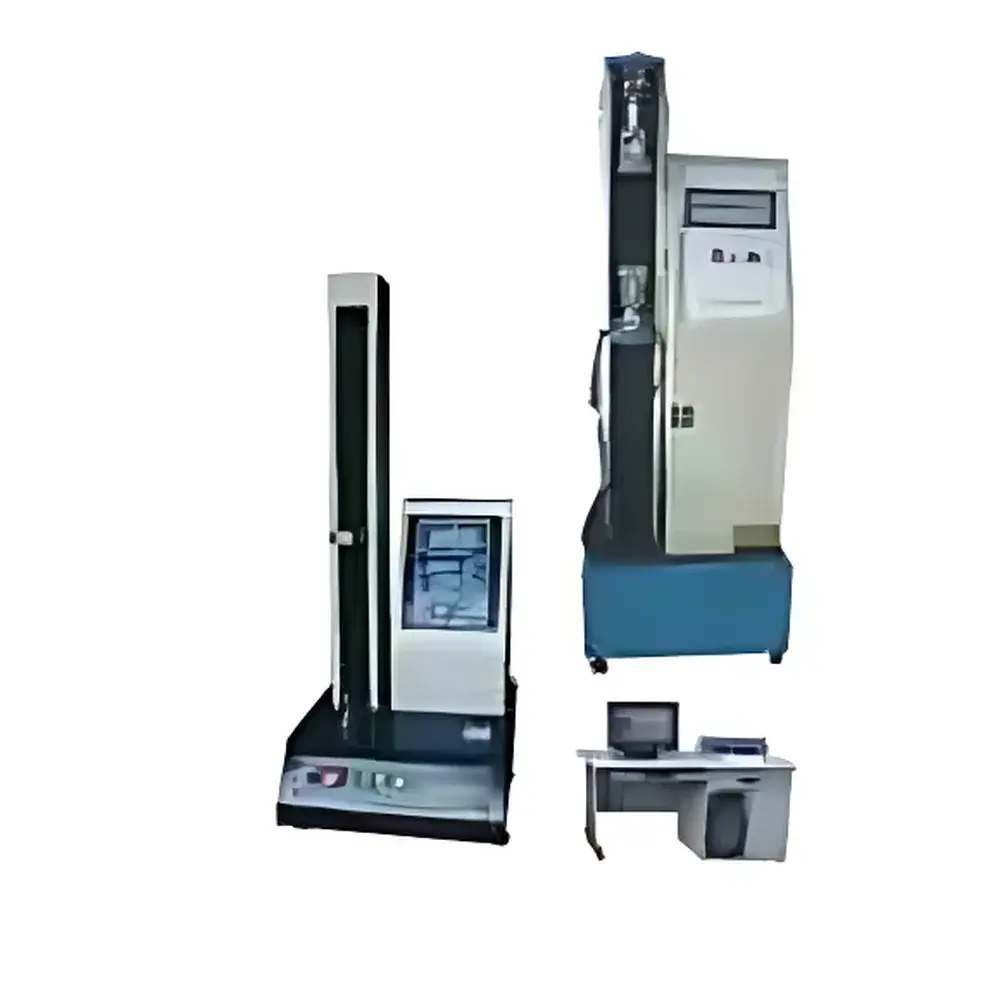
JByq JB-118A Universal Tensile Testing Machine
| Brand | JByq |
|---|---|
| Origin | Taiwan |
| Model | JB-118A |
| Load Capacity | 0–5 kN (user-selectable) |
| Force Sensor | High-precision load cell (USA-made) |
| Force Accuracy | ±0.5% of full scale |
| Effective Test Width | 380 mm |
| Max. Traverse Distance | 1000 mm |
| Drive System | Servo motor (Japan-made) + AC motor (Taiwan-made) |
| Mechanical Transmission | Precision ball screw (Taiwan-made) + High-strength backlash-free screw (Korea-made) |
| Test Speed Range | 0.001–500 mm/min (infinitely variable) |
| Displacement Accuracy | ±0.005% of reading |
| Resolution | 1/200,000 |
| Safety Features | Upper/lower mechanical limits, emergency stop button |
| Display | Dual-mode — PC-based GUI + embedded microcomputer display |
| Unit Options | g, kg, N, kN, lbf |
| Power Supply | 220 V, 50 Hz |
| Net Weight | 1180 kg |
| Dimensions (W×D×H) | 1280 × 950 × 1800 mm |
Overview
The JByq JB-118A Universal Tensile Testing Machine is an electromechanically integrated materials testing system engineered for precision mechanical property evaluation under static and quasi-static loading conditions. It operates on the fundamental principle of controlled uniaxial force application—measuring load via a calibrated high-accuracy load cell while simultaneously tracking displacement through a closed-loop servo-controlled actuator and high-resolution encoder feedback. Designed for compliance with ASTM E4, ASTM D638, ISO 6892-1, ISO 527, and GB/T 228.1 standards, the JB-118A delivers repeatable, traceable data for tensile, compression, flexure, peel, shear, and tear testing across metallic, polymeric, elastomeric, textile, composite, and thin-film specimens. Its rigid C-frame architecture, reinforced with dual-source high-precision transmission components, ensures minimal frame deflection (<0.02% FS) and long-term dimensional stability—critical for GMP-aligned quality control laboratories and ISO/IEC 17025-accredited test facilities.
Key Features
- Modular dual-drive architecture: Combines a Japan-sourced servo motor for high-torque low-speed precision with a Taiwan-sourced AC motor for rapid positioning—enabling seamless transition between fine-load resolution and high-speed return strokes.
- Multi-source mechanical integrity: Incorporates Taiwan-manufactured precision ground ball screws and Korea-supplied backlash-free lead screws to eliminate axial play and ensure <0.005% displacement linearity over full stroke.
- Dual-display operational interface: Embedded microcomputer panel provides real-time load/displacement readouts with local parameter configuration; simultaneously synchronizes with Windows-based PC software for advanced curve analysis, report generation, and audit trail logging.
- Configurable safety hierarchy: Hardware-level upper/lower mechanical limit switches operate independently of software control, backed by a certified emergency stop circuit meeting IEC 60204-1 requirements.
- High-fidelity signal acquisition: 200,000-count A/D resolution coupled with USA-manufactured S-type load cells guarantees force measurement repeatability within ±0.5% of full scale across the entire 0–5 kN range.
- Flexible speed profiling: Infinitely variable speed control from 0.001 mm/min (creep-sensitive polymer testing) to 500 mm/min (high-rate impact simulation), programmable in both constant-rate and multi-step ramp modes.
Sample Compatibility & Compliance
The JB-118A accommodates specimens ranging from sub-millimeter wire strands to 380 mm wide sheet materials, supporting standardized grips (flat, wedge, pneumatic, pin-and-slot) and optional extensometers (contact and non-contact). It complies with regulatory frameworks governing material verification in regulated industries: test method validation aligns with FDA 21 CFR Part 11 electronic record requirements when paired with compliant software; raw data export supports GLP/GMP audit readiness; and mechanical certification documentation satisfies ISO 17025 clause 6.4.2 for equipment qualification. All force transducers are NIST-traceable and factory-calibrated per ISO 376 Annex B procedures.
Software & Data Management
The bundled Windows-native testing software enables full lifecycle test management—from method creation (predefined templates for ASTM D882, ISO 1184, EN 1392) to automated pass/fail decision logic based on user-defined thresholds. Each test generates a timestamped, digitally signed XML data package containing raw channel data (load, displacement, time), derived metrics (modulus, yield point, elongation at break), and metadata (operator ID, calibration certificate ID, environmental conditions). Audit trails record all parameter modifications, file exports, and user logins with immutable timestamps—fully compatible with 21 CFR Part 11 electronic signature workflows. Export formats include CSV, PDF, Excel, and industry-standard MDF v3.1 for LIMS integration.
Applications
- Metals & Alloys: Yield strength, ultimate tensile strength, reduction in area, and Young’s modulus per ASTM E8/E21.
- Polymers & Elastomers: Stress–strain behavior, creep compliance, tear resistance (ASTM D624), and peel adhesion (ASTM D903).
- Textiles & Nonwovens: Breaking strength, elongation, and seam slippage per ISO 13934-1 and ASTM D5035.
- Electrical Components: Terminal crimp pull-off, insulation jacket tensile integrity, and PCB flexural fatigue (IPC-TM-650 2.4.1).
- Medical Devices: Suture tensile strength (ISO 10555-1), catheter shaft stiffness (ISO 80369-7), and packaging seal peel performance (ASTM F88).
FAQ
What calibration standards does the JB-118A support?
It accepts NIST-traceable deadweight calibration kits and is compatible with third-party accredited calibration services per ISO/IEC 17025.
Can the system be integrated into an existing LIMS or MES environment?
Yes—via OPC UA or TCP/IP socket interface; raw data streams conform to ASTM E1382-18 structured output protocols.
Is the software compliant with FDA 21 CFR Part 11 for electronic records?
When deployed with role-based access control, digital signatures, and audit trail archiving enabled, it meets all technical and procedural requirements for Part 11 compliance.
What is the recommended maintenance interval for mechanical components?
Ball screw lubrication and preload verification are scheduled every 500 operational hours; annual load cell recalibration is advised per ISO 376.
Does the machine support multi-specimen sequential testing without operator intervention?
Yes—through programmable batch test sequences with auto-grip repositioning and conditional branching logic based on prior test outcomes.



