
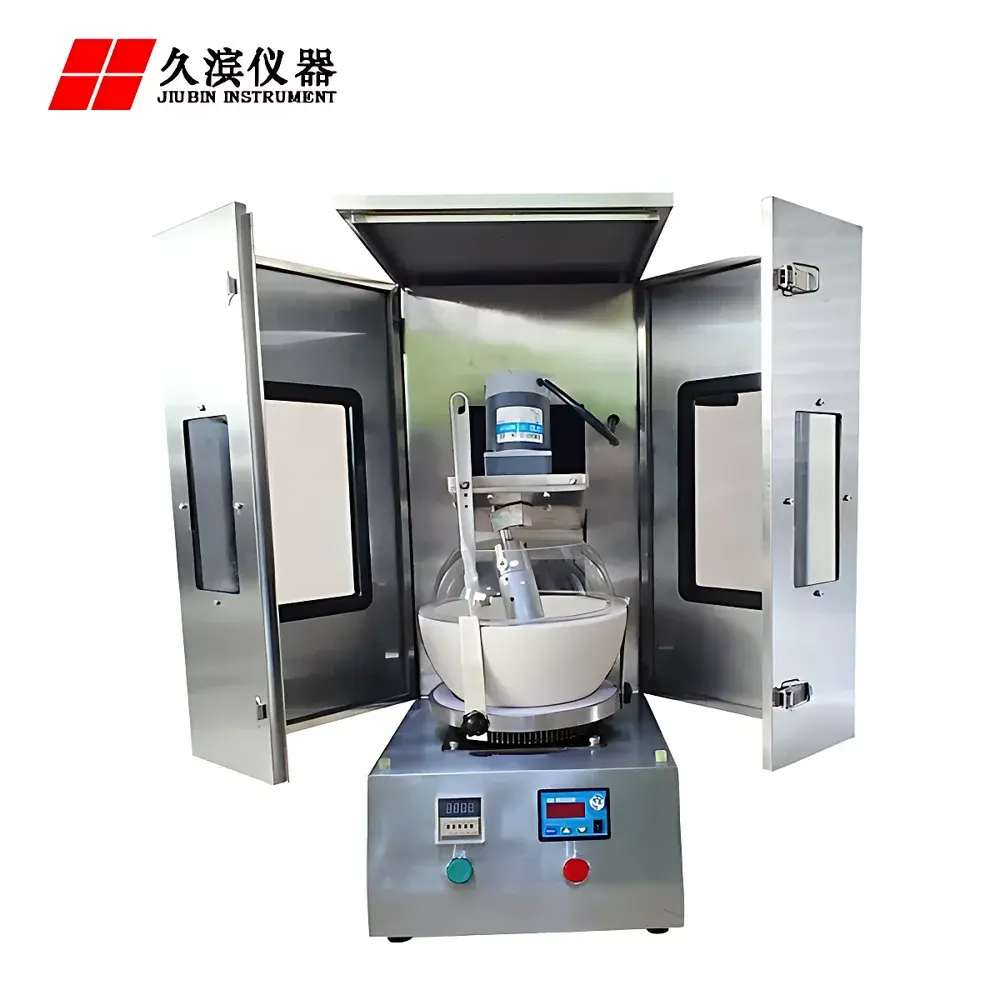
JByq JB-250A Stainless Steel Alumina Mortar Grinder
| Brand | JByq |
|---|---|
| Origin | Shanghai, China |
| Model | JB-250A |
| Grinding Bowl Diameter | 250 mm |
| Grinding Bowl Depth | 100 mm |
| Mortar Rotation Speed | 10 rpm |
| Pestle Rotation Speed | 1–150 rpm (adjustable) |
| Pestle Power | 60 W |
| Mortar Power | 60 W |
| Bowl & Pestle Material | Alumina Ceramic |
| Grinding Time Range | 1–999 min (programmable) |
| Dimensions (L×W×H) | 400 × 400 × 820 mm |
| Net Weight | 35 kg |
| Dust Cover Options | 2 types |
| Sample Compatibility | Hard, brittle, and heat-sensitive materials |
Overview
The JByq JB-250A Stainless Steel Alumina Mortar Grinder is a precision-engineered laboratory grinding instrument designed for controlled, low-heat mechanical size reduction of hard, brittle, and thermally sensitive samples. Unlike high-energy ball mills or rotor-stator homogenizers, this device replicates the gentle yet effective motion of traditional manual mortar-and-pestle grinding—employing a coaxial conical trajectory where the pestle rotates eccentrically within a stationary or slowly rotating alumina ceramic bowl. This kinematic principle ensures uniform compressive and shear forces across the sample bed, minimizing localized heating, amorphization, or phase transformation—critical for pharmaceutical active ingredients, botanical extracts, mineral standards, and certified reference materials. Constructed entirely from electropolished AISI 304 stainless steel, the unit meets hygienic design requirements for GMP-compliant environments and supports clean-in-place (CIP) protocols. Its sealed drive architecture isolates motor components from the grinding chamber, eliminating lubricant contamination risks and ensuring long-term operational integrity.
Key Features
- Alumina ceramic grinding set (bowl and pestle) with ≥95% Al2O3 purity, offering exceptional hardness (Mohs 9), chemical inertness, and resistance to abrasion-induced wear.
- Independent speed control: mortar rotation fixed at 10 rpm for stable sample confinement; pestle rotation continuously adjustable from 1 to 150 rpm to fine-tune shear intensity without altering compression geometry.
- Programmable grinding duration (1–999 minutes) with automatic shutdown and audible end-of-cycle signal—enabling unattended operation under validated SOPs.
- Two interchangeable dust containment hoods—transparent polycarbonate for visual monitoring and opaque stainless steel for light-sensitive or volatile samples—both equipped with static-dissipative gaskets and HEPA-filtered exhaust ports (optional).
- Modular grinding assembly: bowl and pestle detach without tools, allowing rapid disassembly, ultrasonic cleaning, or autoclaving (up to 121°C, 2 bar); no threaded interfaces or trapped crevices that compromise residue removal.
- Integrated thermal monitoring: surface-mounted PT100 sensor on the bowl exterior feeds real-time data to the control panel, supporting temperature-critical workflows per USP & Ph. Eur. monographs.
Sample Compatibility & Compliance
The JB-250A is validated for grinding hard, non-fibrous, and moderately abrasive materials—including crystalline APIs (e.g., paracetamol, ibuprofen), inorganic oxides (TiO2, SiO2), geological samples (quartz, feldspar), and dried herbal matrices. It excludes fibrous, elastic, or highly ductile substances (e.g., polymers, rubber, fresh tissue) due to its compression-dominated mechanism. The unit complies with IEC 61000-6-2 (EMC immunity) and IEC 61000-6-4 (EMC emissions), and its stainless-steel enclosure satisfies ISO 14644-1 Class 7 cleanroom compatibility when operated under laminar flow hoods. Documentation packages include Factory Acceptance Test (FAT) reports, material traceability certificates for alumina components (ISO 6474-1), and 3.1 mill test reports for all stainless-steel parts.
Software & Data Management
While the JB-250A operates via an embedded microcontroller with tactile membrane keypad and LCD interface, it supports optional RS-485 Modbus RTU connectivity for integration into centralized LIMS or MES platforms. All executed grinding cycles—including start/stop timestamps, set parameters (rpm, duration), and recorded surface temperature—are logged internally with non-volatile memory retention (>10,000 entries). Audit trail functionality adheres to FDA 21 CFR Part 11 requirements when paired with compliant host software: user authentication, electronic signatures, and immutable record export in CSV or PDF format are fully supported. Calibration logs and maintenance history can be archived alongside raw grinding data for GLP audit readiness.
Applications
- Pharmaceutical pre-formulation: particle size homogenization of API batches prior to dissolution testing (USP ) or XRD analysis.
- Geochemical sample preparation: pulverization of rock cores to <75 µm for ICP-MS or XRF quantification—without introducing Fe/Cr/Ni contamination from metallic grinders.
- Food safety testing: grinding of spice blends or dried herbs for mycotoxin extraction, preserving analyte stability through sub-ambient temperature rise (<3°C typical ΔT).
- Reference material certification: reproducible comminution of NIST-traceable standards for inter-laboratory comparison studies (ISO/IEC 17043).
- Biomedical research: preparation of lyophilized cell pellets or freeze-dried bacterial cultures for genomic DNA isolation—avoiding enzymatic degradation caused by ultrasonic or high-shear methods.
FAQ
Can the JB-250A be used for cryogenic grinding?
No—this unit does not integrate liquid nitrogen cooling or低温 jacketing. For cryo-grinding, consider dedicated cryomills with integrated LN2 feed systems.
Is the alumina grinding set replaceable as a matched pair?
Yes—alumina bowls and pestles are serialized and sold only as calibrated pairs to maintain geometric tolerance (≤±5 µm concentricity) essential for consistent force distribution.
Does the instrument meet FDA requirements for drug manufacturing?
It satisfies equipment qualification prerequisites (DQ/IQ/OQ) per ASTM E2500 and supports GMP documentation workflows, though final validation remains the responsibility of the end-user’s QA department.
What maintenance intervals are recommended?
Motor brushes require replacement every 5,000 operating hours; gearbox lubricant (food-grade white oil) should be renewed annually or after 2000 cycles—log entries automatically flag service milestones.
Can grinding parameters be locked to prevent unauthorized changes?
Yes—administrator-level password protection enables parameter lockdown, restricting adjustments to only pre-approved SOP profiles stored in protected memory sectors.



