
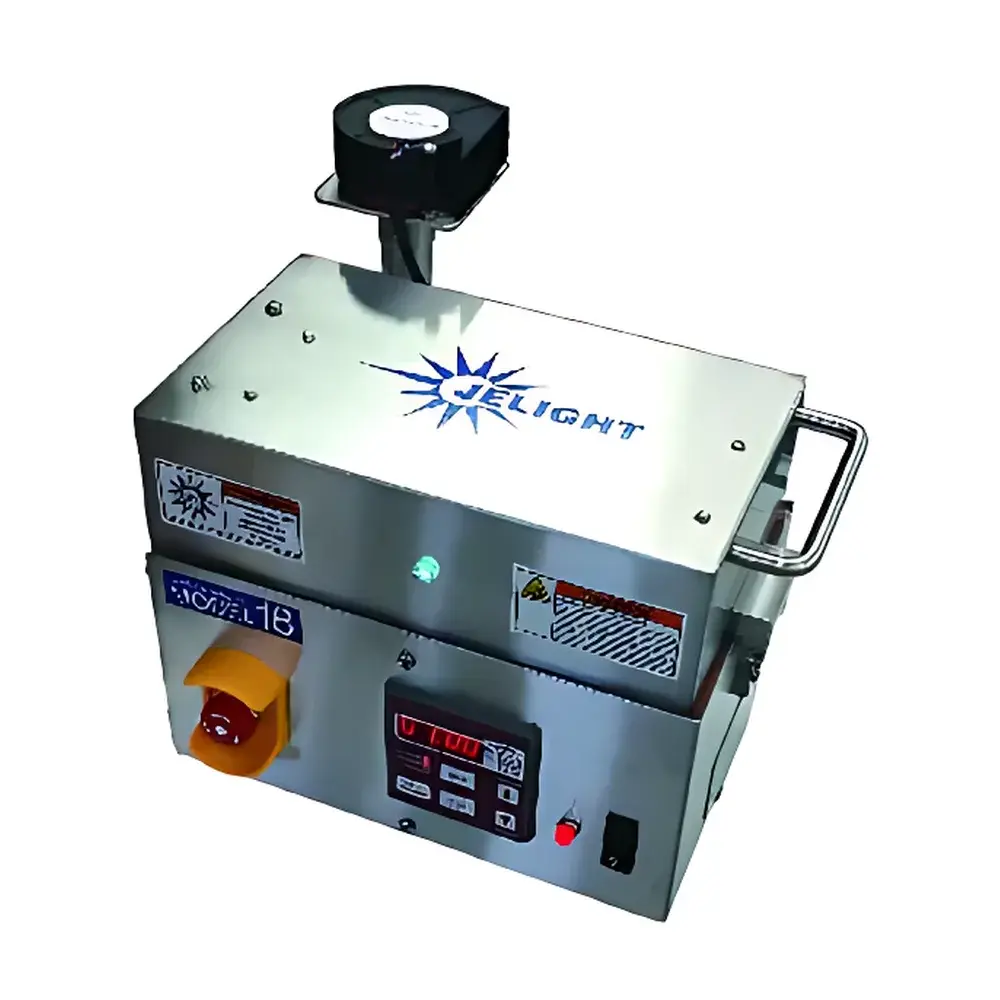
Jelight Model 18 UV-Ozone Cleaner
| Brand | Jelight |
|---|---|
| Origin | USA |
| Model | Model 18 |
| UV Lamp Type | Suprasil® Quartz |
| Ozone Generation Capacity | >6000 ppm |
| Ozone Flow Rate | Adjustable up to 5 L/min (via calibrated flowmeter) |
| Ozone Inlet/Outlet Port | 1/4" NPT |
| Optional Ozone Monitor | Model 465L (detection limit: 3 ppb, microprocessor-controlled, temperature & pressure compensated) |
| Safety | Interlocked door, automatic UV shutoff, audible alarm on cycle completion |
| Construction | All-metal enclosure, ESD-safe design |
Overview
The Jelight Model 18 UV-Ozone Cleaner is an engineered surface preparation system designed for precision removal of trace organic contaminants from substrates used in semiconductor fabrication, microelectronics packaging, optical component manufacturing, and advanced materials research. It operates on the synergistic principle of vacuum-ultraviolet (VUV) photolysis (184.9 nm and 253.7 nm emission lines from low-pressure mercury lamps housed in high-purity Suprasil® quartz) combined with in situ ozone generation and decomposition. VUV photons directly cleave C–H, C–C, and C–O bonds in hydrocarbon films, while simultaneously dissociating molecular oxygen (O₂) to atomic oxygen (O), which reacts with ambient O₂ to form ozone (O₃). The resulting reactive oxygen species—including atomic oxygen, ozone, and singlet oxygen—oxidize adsorbed organics into volatile byproducts (CO₂, H₂O, CO) that are evacuated via the integrated exhaust path. This dry, solvent-free process leaves no residue, avoids particle redeposition, and preserves nanoscale topography—critical for wafer-level lithography, thin-film adhesion promotion, and oxide regrowth applications.
Key Features
- High-efficiency Suprasil® quartz UV lamp assembly emitting at 184.9 nm (ozone-generating) and 253.7 nm (direct photo-oxidation), optimized for maximum photon flux and spectral stability over lamp lifetime
- Integrated ozone generator delivering >6000 ppm ozone concentration, with precision-adjustable mass flow control (0–5 L/min) via calibrated needle valve and digital flowmeter
- Active lamp cooling system maintaining optimal quartz envelope temperature, extending lamp service life and ensuring consistent UV output intensity
- Interlocked stainless-steel chamber door with fail-safe circuitry: UV irradiation terminates instantly upon door opening, preventing operator exposure to VUV radiation
- Digital timer with programmable cycle duration (1–999 minutes), automatic shutdown, and audible end-of-cycle alarm
- ESD-safe all-metal chassis with grounded powder-coated finish, compatible with Class 100 cleanroom environments
- Modular port configuration: standard 1/4″ NPT inlet/outlet for integration with ozone monitors (e.g., Model 465L), vacuum pumps, or inert gas purging systems
Sample Compatibility & Compliance
The Model 18 accommodates substrates up to 6″ (152 mm) diameter, including silicon wafers, quartz masks, fused silica optics, sapphire substrates, GaAs wafers, ITO-coated glass, and flexible polymer films (e.g., polyimide, PET). Its non-contact, dry cleaning mechanism is compatible with temperature-sensitive materials (operating chamber remains near ambient during standard cycles). The system supports compliance with industry-standard surface cleanliness verification protocols, including water contact angle reduction (to <5°), XPS-detectable carbon reduction (<0.5 at.%), and FTIR-confirmed elimination of aliphatic C–H stretches. While not certified to a single regulatory standard, its operational parameters align with ASTM F2217 (Standard Practice for Cleaning and Preparing Surfaces for Adhesive Bonding), ISO 14644-1 (cleanroom particulate control), and SEMI F21 (specifications for semiconductor equipment safety)—making it suitable for GLP/GMP-adjacent R&D and pilot-line processing.
Software & Data Management
The Model 18 operates as a stand-alone instrument with embedded microcontroller logic; no external PC or proprietary software is required for basic operation. Cycle parameters (time, flow rate setting) are retained in non-volatile memory across power cycles. For traceability in regulated environments, optional integration with the Jelight Model 465L ozone monitor provides real-time ozone concentration logging (3 ppb resolution), temperature/pressure-compensated data streams, and configurable alarm thresholds (1/3/6-channel monitoring available). Output signals (4–20 mA or RS-232) can be routed to SCADA systems or LIMS platforms. Audit trail functionality—including operator ID, start/stop timestamps, and ozone exposure dose (ppm·min)—is enabled when paired with compliant third-party data acquisition software meeting FDA 21 CFR Part 11 requirements.
Applications
- Pretreatment of Si, GaAs, and sapphire wafers prior to ALD, PVD, or CVD to eliminate adventitious carbon and enhance nucleation uniformity
- Removal of residual photoresist, DUV resist scum, and blue tape adhesive residues from reticles and photomasks without substrate erosion
- Surface activation of Teflon®, Viton®, and polyimide prior to metallization or bonding—increasing surface energy from ~18 mN/m to >72 mN/m
- Cleaning of optical components (lenses, mirrors, laser windows) where solvent wiping risks micro-scratches or coating damage
- Pre-oxidation surface conditioning of Si wafers to promote native oxide regrowth with improved stoichiometry and reduced interface trap density (Dit)
- Decontamination of MEMS devices, microfluidic chips, and biosensor surfaces prior to functionalization
FAQ
What is the typical cleaning time required for complete organic removal from a silicon wafer?
Cycle duration depends on contaminant type and thickness; standard removal of monolayer hydrocarbons requires 5–15 minutes. Heavily contaminated or cross-linked resists may require 20–45 minutes. Process optimization is recommended using XPS or contact angle validation.
Can the Model 18 operate under nitrogen purge instead of ambient air?
Yes—the ozone generation module can be bypassed, and the chamber purged with inert gas to enable pure 253.7 nm UV cleaning (photo-desorption only), though organic removal efficiency decreases significantly without ozone-assisted oxidation.
Is lamp replacement a user-serviceable procedure?
Yes—Suprasil® lamps are field-replaceable with standard tools; Jelight provides torque specifications and alignment guidelines. Average lamp lifetime exceeds 1,500 hours at rated power.
Does the system meet CE or UL safety certification requirements?
The Model 18 complies with UL 61010-1 (Safety Requirements for Electrical Equipment for Measurement, Control, and Laboratory Use) and carries UL recognition marks. CE marking is available upon request for EU-distributed units meeting EN 61000-6-3 (EMC) and EN 61000-6-4 standards.
How is ozone safely exhausted from the system?
An integrated ozone destruct blower (optional accessory) thermally decomposes residual ozone to O₂ before venting. Alternatively, exhaust must be ducted to an external ozone scrubber or fume hood meeting local occupational exposure limits (OSHA PEL: 0.1 ppm TWA).



