
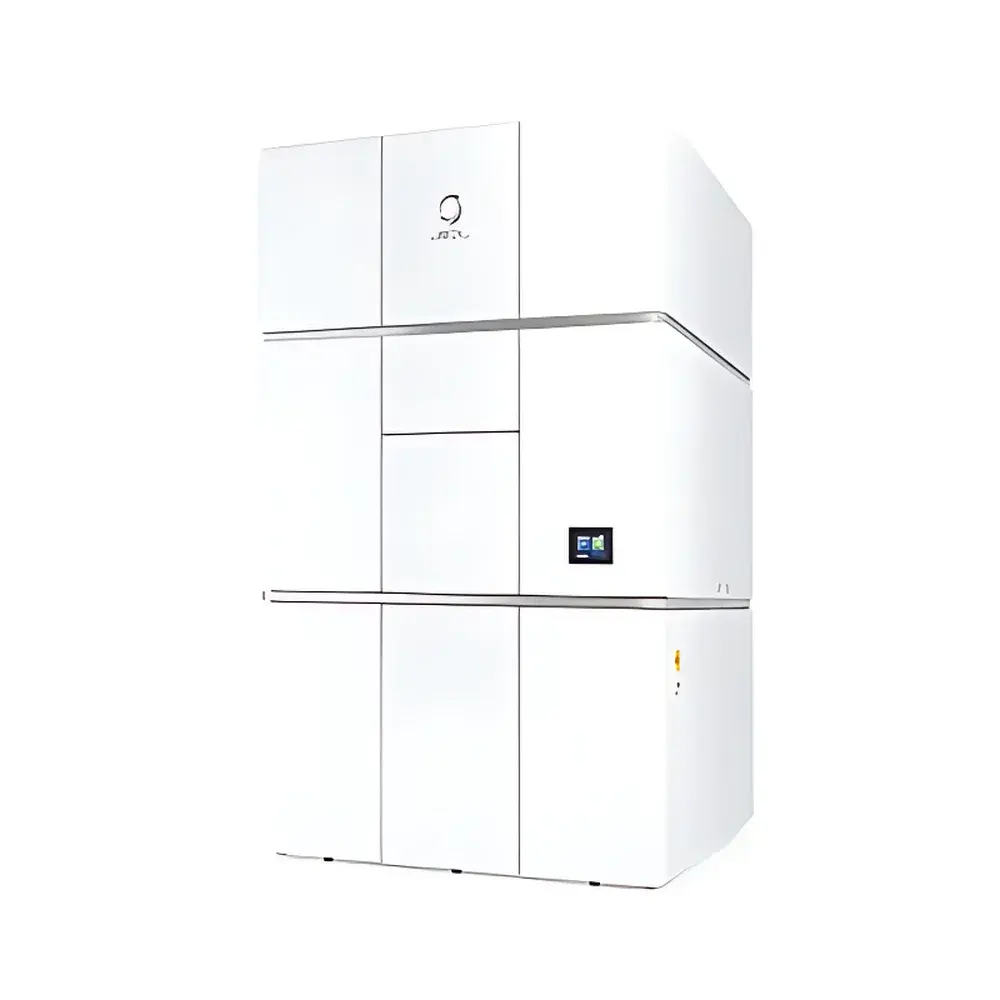
JEOL CRYOARM-300II (JEM-3300) Cryo-Transmission Electron Microscope
| Brand | JEOL |
|---|---|
| Origin | Japan |
| Manufacturer Type | Authorized Distributor |
| Origin Category | Imported |
| Model | JEM-3300 |
| Price Range | USD 6.2–6.9 million (est.) |
| Acceleration Voltage | Up to 300 kV |
| Magnification Range | 2,000× – 1,000,000× |
| Electron Source | Cold Field Emission Gun (CFEG) |
| Energy Filter | Integrated Omega-Type Electron Energy Filter |
| Automation | Automated Sample Loading System, JADAS Software Suite, Phase Plate Compatibility, Köhler Illumination Optics |
Overview
The JEOL CRYOARM-300II (JEM-3300) is a high-end cryogenic transmission electron microscope engineered for atomic-resolution structural biology and materials science applications. Operating at a nominal acceleration voltage of 300 kV, it leverages cold field emission gun (CFEG) technology to deliver exceptional beam coherence, stability, and brightness—critical parameters for high signal-to-noise ratio imaging of radiation-sensitive biological specimens under cryogenic conditions. The instrument integrates a fully aligned Omega-type electron energy filter to enable zero-loss imaging, energy-filtered TEM (EFTEM), and electron energy loss spectroscopy (EELS) with sub-eV energy resolution. Designed in accordance with ISO 14644-1 Class 5 cleanroom-compatible mechanical architecture, the CRYOARM-300II maintains thermal and mechanical stability within ±0.1 °C and <0.5 nm/h drift during extended acquisition sessions—essential for high-resolution single-particle analysis (SPA) and cryo-electron tomography (cryo-ET).
Key Features
- Cold field emission electron source with active suppression of gun flicker and long-term current stability (drift <0.5% over 8 h)
- Integrated Omega-type energy filter enabling precise zero-loss peak selection, background subtraction, and elemental mapping via EELS
- Automated cryo-sample loading system with dual-stage anti-contamination cold trap (≤−185 °C) and real-time vacuum integrity monitoring
- JADAS (JEOL Automated Data Acquisition System): a modular software platform supporting unattended grid screening, automated tilt-series acquisition, and on-the-fly motion correction
- Phase plate compatibility (Zernike or Volta phase plate interfaces available) for enhanced contrast in low-dose imaging of unstained biomolecules
- Köhler illumination optics with adjustable condenser aperture alignment and beam tilt compensation for uniform illumination across the field of view
- High-stability objective lens design incorporating active electromagnetic shielding and temperature-regulated pole piece housing
Sample Compatibility & Compliance
The CRYOARM-300II accommodates standard 3.05 mm cryo-EM grids (Quantifoil, UltrAuFoil, graphene oxide) mounted on Gatan 626/914 cryo-holders or compatible alternatives. Specimen temperature is maintained below −180 °C throughout imaging using liquid nitrogen cooling with redundant sensor feedback control. The system meets ISO/IEC 17025 requirements for calibration traceability of magnification, defocus, and energy dispersion. All operational logs—including beam parameters, stage positions, exposure metadata, and user authentication—are timestamped and stored in audit-trail-compliant format, satisfying GLP and FDA 21 CFR Part 11 data integrity requirements when deployed in regulated biopharmaceutical environments.
Software & Data Management
JADAS provides native integration with industry-standard processing pipelines including RELION, cryoSPARC, and cisTEM via standardized MRC2 and TIFF export protocols. Real-time GPU-accelerated motion correction (using FPGA-based frame alignment) and dose-fractionation metadata tagging are embedded at acquisition level. Raw image stacks are stored in hierarchical data format (HDF5) with embedded JSON sidecar files containing full experimental provenance (e.g., defocus gradient, astigmatism values, energy slit width). Remote access and multi-user session management are supported through TLS-encrypted HTTPS interface compliant with institutional IT security policies.
Applications
- Atomic-resolution determination of macromolecular complexes (e.g., membrane proteins, ribosomes, viral capsids) via single-particle cryo-EM
- In situ structural analysis of cellular ultrastructure using cryo-focused ion beam (cryo-FIB) milled lamellae
- Quantitative nanoscale compositional mapping of battery cathode materials, catalyst nanoparticles, and 2D heterostructures via EFTEM/EELS
- Time-resolved studies of radiation-induced structural transitions using controlled electron dose ramping protocols
- Correlative light and electron microscopy (CLEM) workflows enabled by integrated coordinate referencing and fiducial marker detection modules
FAQ
What is the typical point resolution achievable under optimal cryo-EM conditions?
Under standard low-dose imaging conditions with Volta phase plate and JADAS-optimized acquisition, the CRYOARM-300II routinely achieves ≤2.8 Å global resolution for well-behaved samples such as apoferritin or β-galactosidase.
Is the system compatible with third-party phase plates?
Yes—the column includes standardized mechanical and electrical interfaces for Zernike, Volta, and beam-shift-based phase plate systems from multiple vendors.
Does JEOL provide validation documentation for regulatory submissions?
JEOL supplies IQ/OQ documentation packages, system suitability test protocols, and electronic record retention reports aligned with ICH M10 and USP guidelines.
Can the Omega filter be used for elemental quantification?
Yes—the energy filter supports dual-EELS acquisition with calibrated dispersion (0.1 eV/channel) and quantitative cross-section libraries for elements Z ≥ 3 (Li and above).
What maintenance intervals are recommended for the CFEG source?
JEOL recommends flash cycles every 200 hours of beam-on time and full emitter replacement every 1,500–2,000 hours, depending on vacuum history and contamination load.




