
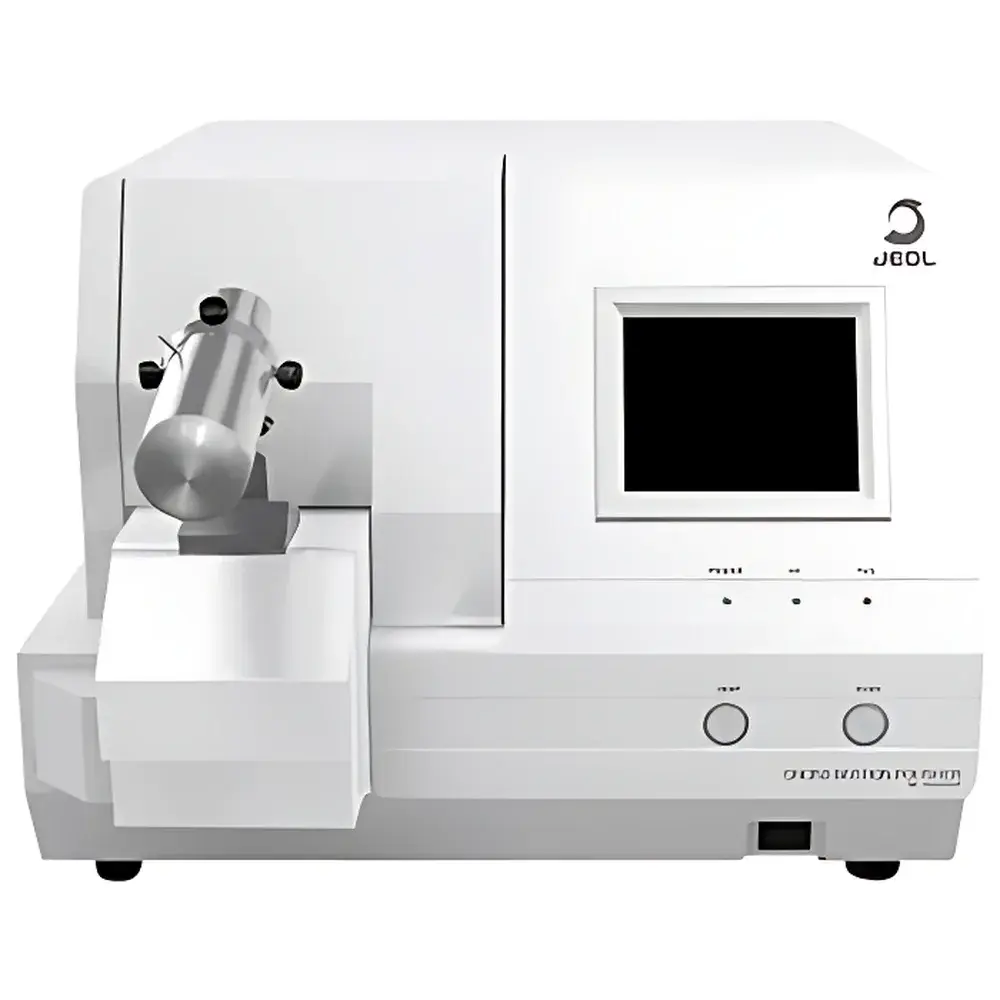
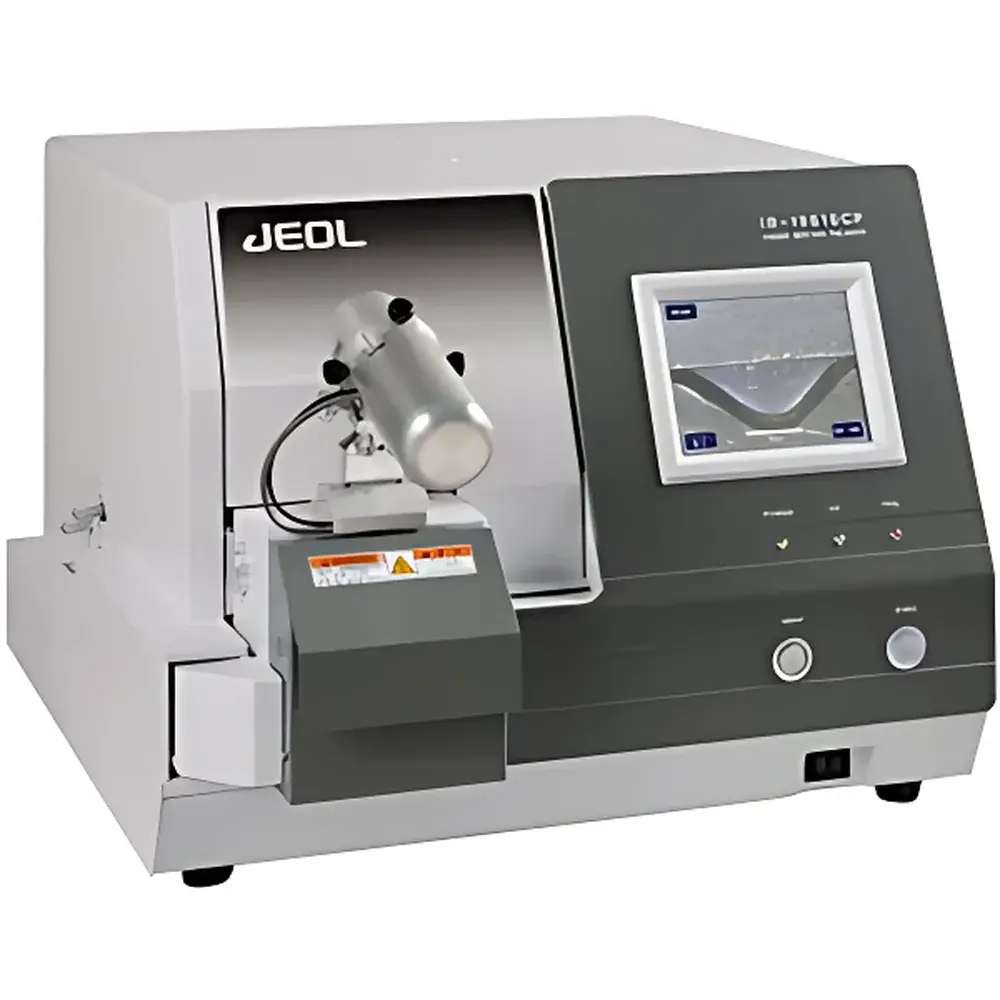
JEOL IB-19530CP Argon Ion Cross-Section Polisher
| Brand | JEOL |
|---|---|
| Origin | Japan |
| Model | IB-19530CP |
| Price | USD 150,000 |
| Equipment Type | Ion Beam Sample Preparation System for Electron Microscopy |
Overview
The JEOL IB-19530CP Argon Ion Cross-Section Polisher is an advanced, high-precision ion beam milling system engineered specifically for the preparation of artifact-free cross-sectional specimens for electron microscopy analysis. Developed by JEOL Ltd. (Japan Electron Optics Laboratory), this instrument implements broad-beam argon ion sputtering under high-vacuum conditions to remove material via physical etching—without thermal input, mechanical stress, or chemical interaction. Unlike conventional mechanical sectioning or focused ion beam (FIB) techniques, the IB-19530CP delivers large-area, ultra-smooth, low-damage cross-sections ideal for scanning electron microscopy (SEM), energy-dispersive X-ray spectroscopy (EDS), electron backscatter diffraction (EBSD), wavelength-dispersive X-ray spectroscopy (WDS), and Auger electron spectroscopy (AES). Introduced in January 2017 as the successor to earlier CP platforms, the IB-19530CP integrates real-time process monitoring, automated angle control, and enhanced beam uniformity—enabling reproducible, operator-independent sample preparation across heterogeneous, multi-phase, and brittle/ductile composite materials.
Key Features
- High-stability dual-argon-ion-source configuration with independently adjustable beam energy (0.1–8.0 keV) and current density for optimized sputter rate and surface quality
- Real-time in-situ monitoring via integrated CCD camera and LED illumination, enabling visual feedback during polishing without breaking vacuum
- Precision tilting stage with ±10° fine adjustment range and motorized rotation for controlled incidence angle optimization (typically 1–10° relative to sample surface)
- Ultra-high-vacuum chamber (base pressure ≤ 5 × 10⁻⁵ Pa) with cryo-trapped pumping system to minimize hydrocarbon contamination and ensure clean sputtering environments
- Programmable polishing sequences with time-, current-, and voltage-based termination logic to support unattended operation and batch processing
- Compact footprint and modular design compliant with standard SEM lab infrastructure; compatible with JEOL, Thermo Fisher, Zeiss, and Hitachi SEM/FIB platforms
Sample Compatibility & Compliance
The IB-19530CP accommodates a wide range of solid-state materials including metallic alloys, ceramics, semiconductor wafers, polymer composites, geological thin sections, battery electrode laminates, and multilayer thin-film stacks. Its non-contact, low-energy ion milling approach eliminates mechanical deformation, smearing, or preferential phase removal—critical for preserving interfacial integrity in graded or nanostructured systems. The system meets ISO 14644-1 Class 5 cleanroom compatibility requirements when operated within appropriate environmental enclosures. All electrical subsystems conform to IEC 61000-6-3 (EMC emission) and IEC 61000-6-2 (immunity) standards. Software logging supports audit trails aligned with GLP and GMP documentation frameworks, and optional timestamped image capture satisfies basic traceability needs per FDA 21 CFR Part 11 Annex 11 principles.
Software & Data Management
The IB-19530CP operates via JEOL’s proprietary CrossPolish™ Control Suite—a Windows-based application offering intuitive workflow sequencing, live camera overlay, parameter history logging, and export of CSV-formatted operational metadata (beam voltage, current, duration, tilt angle, vacuum status). All user actions—including method loading, stage movement, and beam activation—are recorded with timestamps and operator ID. Exported data files are compatible with common laboratory information management systems (LIMS) and can be ingested into digital specimen archives. No cloud connectivity or remote access functionality is embedded; all data remains on-device unless manually exported via USB or network share—ensuring full data sovereignty and alignment with institutional cybersecurity policies.
Applications
- Preparation of damage-free cross-sections for failure analysis of solder joints, wire bonds, and package interconnects in microelectronics
- Interface characterization in solid-state batteries (anode/cathode/electrolyte layers) without lithium redistribution artifacts
- Grain boundary and phase distribution analysis in additively manufactured metal components via EBSD
- Layer thickness quantification and compositional profiling in optical coatings and photovoltaic stacks using EDS line scans
- Microstructural evaluation of geological samples containing soft clay matrices and hard silicate inclusions
- Quality assurance of medical device coatings (e.g., drug-eluting stents) where surface topography directly influences biological response
FAQ
What vacuum level is required for stable operation of the IB-19530CP?
The system requires a base pressure of ≤ 5 × 10⁻⁵ Pa, achieved using a combination of turbomolecular and cryogenic pumping; typical pump-down time from atmosphere is < 45 minutes.
Can the IB-19530CP prepare cross-sections of hydrated or beam-sensitive organic samples?
No—argon ion polishing is incompatible with volatile, low-Tg, or hydrated materials; such samples require cryo-FIB or ultramicrotomy prior to CP treatment.
Is the IB-19530CP compatible with automated SEM integration or scripting APIs?
It does not feature native SEM synchronization or API-driven control; however, its exported metadata files can be correlated post-acquisition with SEM acquisition logs.
What maintenance intervals are recommended for the ion sources and vacuum gauges?
Ion source lifetime is rated at ≥ 1,000 operating hours under nominal conditions; vacuum gauge calibration is recommended annually per JEOL Service Bulletin IB-CP-2022-03.
Does JEOL provide application-specific method templates for common material systems?
Yes—JEOL supplies validated SOP packages for aluminum alloys, SiC-reinforced composites, LiCoO₂ cathodes, and dental ceramic zirconia, available through authorized service portals upon installation validation.




