
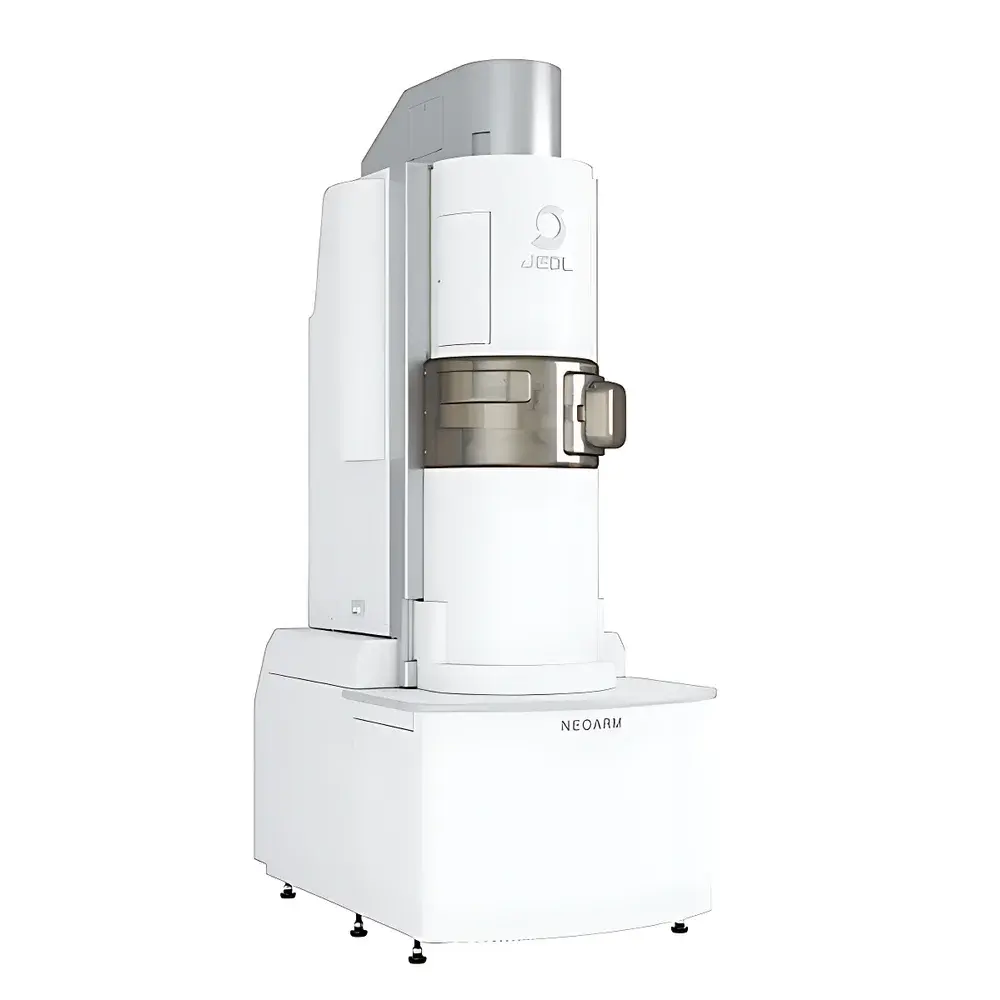
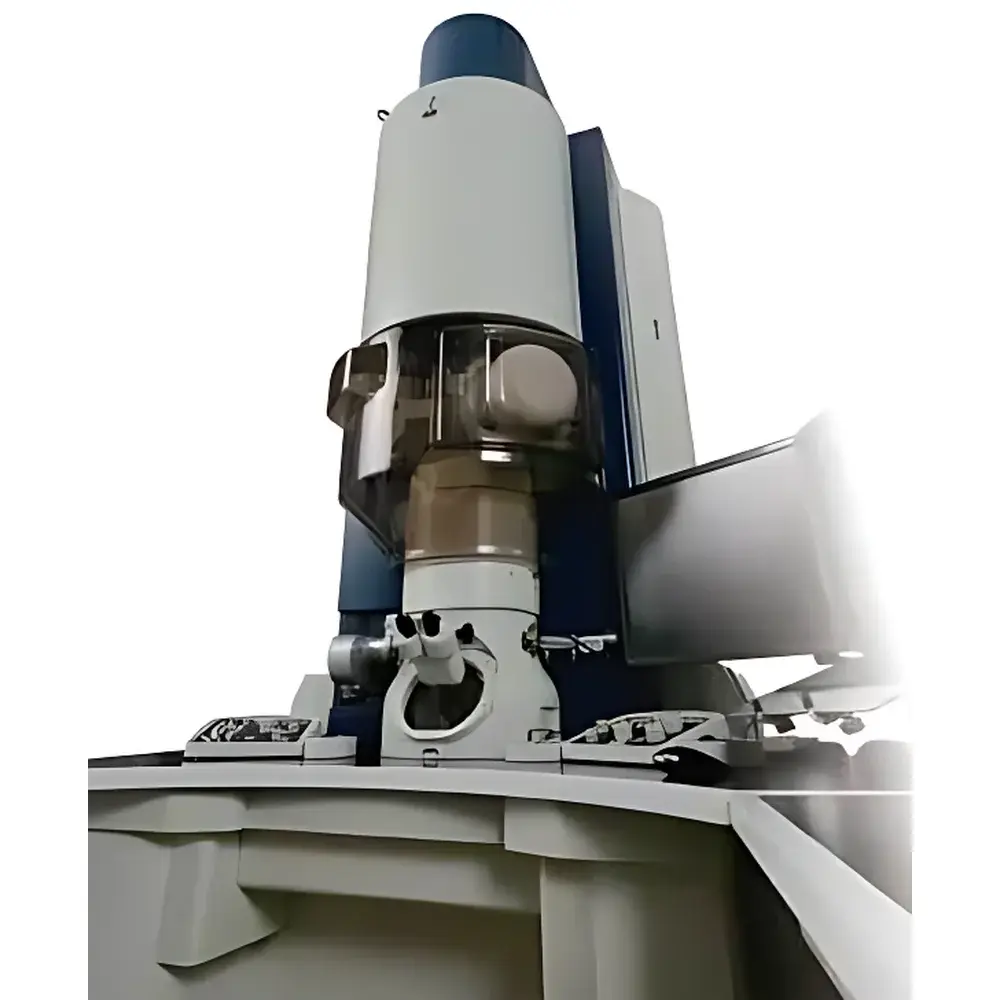
JEOL JEM-ARM200F(C)-NEO ARM Cold Field-Emission Aberration-Corrected Analytical Transmission Electron Microscope
| Brand | JEOL |
|---|---|
| Origin | Japan |
| Model | JEM-ARM200F(C)-NEO ARM |
| Acceleration Voltages | 30 kV, 80 kV, 200 kV |
| Magnification Range | 50× to 2,000,000× |
| Point Resolution | 0.078 nm (at 200 kV) |
| Energy Resolution | ≤0.3 eV (with monochromated cold FEG) |
| Configuration | Dual spherical aberration correctors (objective and condenser), integrated STEM/TEM/EELS/EDS platform |
Overview
The JEOL JEM-ARM200F(C)-NEO ARM is a high-end, cold field-emission (CFEG) transmission electron microscope engineered for atomic-resolution imaging and quantitative analytical spectroscopy. Built upon JEOL’s proprietary cold field-emission electron gun technology—developed to overcome historical limitations in beam stability, brightness, and coherence—the system integrates dual spherical aberration correctors (in both the objective and condenser lens systems) to eliminate primary geometric distortions that constrain resolution in conventional TEMs. Operating at selectable acceleration voltages of 30 kV, 80 kV, and 200 kV, the instrument delivers a verified point resolution of 0.078 nm under standard 200 kV conditions, with sub-angstrom performance sustained across low-voltage regimes. Its monochromated cold FEG enables an energy resolution of ≤0.3 eV in electron energy-loss spectroscopy (EELS), facilitating precise core-loss edge analysis, light-element mapping (e.g., Li, B, C, N, O), and fine-structure quantification (ELNES/XANES). The platform supports simultaneous acquisition of high-angle annular dark-field (HAADF)-STEM, bright-field (BF)-TEM, selected-area electron diffraction (SAED), energy-dispersive X-ray spectroscopy (EDS), and spectrum imaging—all within a single, vibration- and electromagnetic-noise-isolated column architecture.
Key Features
- Dual spherical aberration correction (objective + condenser) enabling consistent sub-Å imaging across accelerating voltages
- Cold field-emission electron source with ultra-high brightness (>1 × 10⁹ A/cm²·sr) and long-term emission stability (drift <0.5 nm/min at 200 kV)
- Integrated monochromator delivering ≤0.3 eV energy spread for high-fidelity EELS and bandgap analysis
- Automated aberration tuning via NEO ARM software suite—reducing operator dependency and calibration time by >60% compared to manual correction workflows
- Multi-mode detector architecture: 4-quadrant segmented STEM detector, direct electron detection camera (optional), silicon drift EDS detector (100 mm² active area), and Gatan Quantum GIF spectrometer
- High-stability mechanical design compliant with ISO 14644-1 Class 5 cleanroom integration requirements and compatible with active floor damping systems
Sample Compatibility & Compliance
The JEM-ARM200F(C)-NEO ARM accommodates standard 3 mm TEM grids (including holey carbon, ultrathin carbon, and graphene-based supports), as well as specialized holders for in situ heating (up to 1000 °C), biasing, and environmental gas cells (pressure up to 20 mbar). All hardware and control firmware conform to IEC 61000-6-2/6-4 EMC standards and meet CE marking requirements for laboratory instrumentation. Data acquisition and instrument control comply with GLP and GMP-aligned audit trail protocols; optional FDA 21 CFR Part 11-compliant software modules support electronic signatures, user access tiers, and immutable metadata logging for regulated environments. The system satisfies ASTM E1992-20 (Standard Guide for Electron Microscopy Specimen Preparation) and ISO/IEC 17025:2017 criteria for analytical instrument qualification.
Software & Data Management
Control and analysis are unified through JEOL’s NEO ARM software platform—a Windows-based, modular application supporting real-time aberration optimization, automated tilt-series acquisition, and correlative workflow synchronization with external tools (e.g., DigitalMicrograph, HyperSpy, and Python-based ML pipelines). Raw data is stored in standardized TIFF/HDF5 formats with embedded metadata (voltage, aperture settings, exposure time, stage coordinates, calibration parameters). The system includes built-in tools for drift correction, Fourier filtering, atom column fitting (using maximum-likelihood algorithms), and EELS background subtraction (power-law + multiple-least-squares). Export options include MRC, EMDB-compatible headers, and CSV-formatted spectral datasets for third-party quantification. Networked deployment allows centralized license management and remote diagnostics via secure TLS 1.2–encrypted channels.
Applications
This instrument serves advanced research domains requiring atomic-scale structural and chemical characterization: catalysis (single-atom catalyst coordination environments), battery materials (solid-electrolyte interphase evolution, Li-ion migration pathways), quantum materials (moiré superlattices in twisted van der Waals heterostructures), metallurgy (segregation behavior at grain boundaries and dislocation cores), and semiconductor defect engineering (dopant distribution in FinFET nodes). Its low-kV capability (30 kV operation) enables damage-sensitive imaging of organic frameworks, 2D materials, and beam-labile biological hybrids without significant knock-on displacement. Cross-disciplinary use cases include validation of DFT-predicted surface reconstructions and quantitative strain mapping via geometric phase analysis (GPA) of HRTEM lattice fringes.
FAQ
What distinguishes the cold field-emission source in the JEM-ARM200F(C)-NEO ARM from thermionic or Schottky sources?
It provides superior spatial coherence and brightness—critical for high-resolution EELS and ptychographic reconstruction—while maintaining lower energy spread than Schottky emitters and higher stability than early-generation cold FEGs.
Is automated spherical aberration correction fully software-driven?
Yes. NEO ARM software executes iterative image-based correction routines using probe-forming optics feedback, eliminating manual stigmator and corrector coil adjustments.
Can the system operate under GMP/GLP-regulated quality systems?
With optional 21 CFR Part 11 add-ons, it supports role-based access control, electronic signatures, and full audit-trail generation for IQ/OQ/PQ documentation.
What is the typical installation footprint and infrastructure requirement?
Minimum floor space: 5.5 m × 4.0 m (including service corridor); requires dedicated 208 V/30 A power, helium cooling loop, and acoustic/vibration isolation per JEOL Technical Bulletin TB-ARM200F-03.
Does JEOL provide application support for EELS quantification and spectrum imaging?
Yes—JEOL Applications Scientists offer on-site method development, including ELNES fingerprinting, thickness mapping, and multi-variate statistical analysis (PCA, MCR-ALS) training.



