
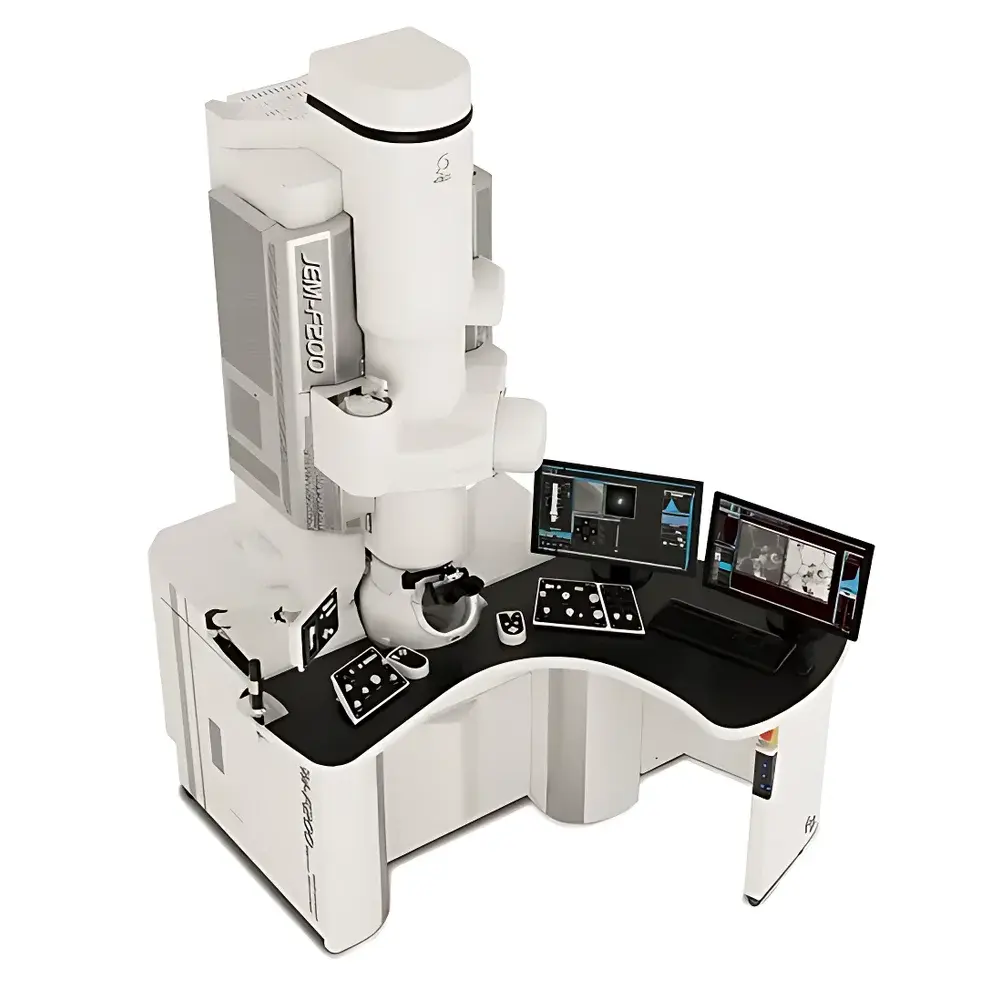
JEOL JEM-F200 Automated Sample-Loading Field-Emission Transmission Electron Microscope
| Brand | JEOL |
|---|---|
| Origin | Japan |
| Model | JEM-F200 |
| Price | USD $2,000,000 |
| Acceleration Voltage | Up to 200 kV |
| Magnification Range | 50× – 2,000,000× |
Overview
The JEOL JEM-F200 is a high-performance field-emission transmission electron microscope (FE-TEM) engineered for atomic-resolution imaging, analytical spectroscopy, and automated materials characterization in advanced research laboratories and industrial R&D facilities. Introduced globally in 2016, the JEM-F200 integrates decades of JEOL’s expertise in electron optics, cold field-emission source design, and ultra-stable mechanical architecture into a single platform optimized for reproducibility, ease of operation, and multi-modal data acquisition. Its core operating principle relies on coherent electron beam generation from a cold field-emission gun (CFEG), accelerated at up to 200 kV, and focused through a precisely aligned optical column to achieve sub-Ångström resolution in both conventional TEM and scanning TEM (STEM) modes. The instrument is designed to meet the rigorous demands of structural biology, nanomaterials science, semiconductor metrology, and catalysis research—where spatial resolution, signal-to-noise ratio, and quantitative elemental/chemical mapping are critical.
Key Features
- Cold Field-Emission Gun (CFEG) Technology: Incorporates JEOL’s mature CFEG platform—originally developed for aberration-corrected systems—delivering high brightness, exceptional energy stability (<0.3 eV energy spread), and long-term emission consistency without flash heating, enabling high-resolution HRTEM and low-dose imaging.
- Four-Stage Condenser Lens System: A proprietary quadruple condenser configuration allows independent control of probe current and convergence angle—essential for optimizing STEM probe formation, EELS collection efficiency, and spatial resolution in analytical STEM.
- Piezo-Driven Nanopositioning Stage: Standard integrated piezoelectric sample stage provides sub-10 pm positional repeatability and real-time drift compensation, supporting atomic-scale navigation, lattice-resolved tomography, and in situ experiment synchronization.
- Automated Specimen Insertion System (SPECPORTER): Fully motorized specimen exchange mechanism enables hands-free, vacuum-safe insertion and removal of double-tilt or cryo holders—reducing operator exposure, minimizing contamination risk, and improving throughput in high-volume analytical workflows.
- Dual Ultra-High-Resolution Energy-Dispersive X-ray Spectrometers (EDS): Supports simultaneous installation of two high-solid-angle SDD detectors with <127 eV Mn-Kα resolution, enabling atomic-column-resolved EDS mapping, quantification with ZAF matrix correction, and correlative EELS–EDS analysis.
- Power-Efficient Operation Mode: Intelligent power management reduces standby power consumption by up to 80% versus prior-generation FE-TEMs, aligning with ISO 50001-compliant laboratory sustainability initiatives without compromising thermal or mechanical stability.
Sample Compatibility & Compliance
The JEM-F200 accommodates standard 3 mm TEM grids—including carbon-film, lace-carbon, graphene oxide, and ultrathin silicon nitride windows—as well as specialized holders for in situ heating (up to 1000°C), biasing, liquid cell, and cryogenic observation (down to 80 K). All vacuum components conform to ISO 27427 (electron microscopy vacuum standards), while the control software architecture supports audit trails, user-level access controls, and electronic signature functionality compliant with FDA 21 CFR Part 11 and GLP/GMP documentation requirements. Routine calibration procedures follow ASTM E1115 (standard practice for TEM resolution measurement) and ISO 16700 (analytical electron microscopy—quantitative EDS analysis).
Software & Data Management
Operation is managed via JEOL’s Windows-based TEM-Center™ software suite, featuring modular GUIs for acquisition, real-time processing, and metadata-rich archiving. The system supports DICOM-EM export, TIFF/DM3/EMD file formats, and direct integration with third-party platforms including DigitalMicrograph™ (Gatan), Velox™ (Thermo Fisher), and HyperSpy for open-source spectral processing. All image and spectrum datasets are automatically tagged with acquisition parameters (kV, dose, dwell time, tilt angle, detector geometry), instrument log files, and user authentication records—ensuring full traceability for regulatory submissions and peer-reviewed publication.
Applications
- Atomic-resolution imaging of crystal defects, grain boundaries, and interfacial structures in battery cathode materials and 2D heterostructures
- Quantitative EDS and EELS mapping of dopant distribution in advanced logic transistors (FinFET, GAA)
- In situ thermal and electrical stimulation of nanowire growth and phase transformation kinetics
- Cryo-TEM structural analysis of membrane proteins and viral capsids at near-native conditions
- Correlative TEM–EDS–EELS characterization of catalyst nanoparticles under operando conditions
FAQ
What is the maximum achievable point resolution under standard operating conditions?
The JEM-F200 achieves ≤0.19 nm information limit resolution in HRTEM mode at 200 kV with standard objective lens configuration; optional Cs corrector upgrade extends this to ≤0.12 nm.
Is the instrument compatible with third-party tomography stages and detectors?
Yes—mechanical and electrical interfaces comply with JEOL’s Open-Platform Specification (JOPS), supporting integration of FEI/Thermo Fisher tomography stages and Oxford Instruments EDS systems via standardized RS-232/USB/Ethernet protocols.
Does the system support automated acquisition workflows for high-throughput screening?
Yes—TEM-Center™ includes scripting modules (Python API) and batch acquisition templates for automated particle picking, tilt-series collection, and multi-region EDS mapping across grid arrays.
What vacuum level is maintained in the gun and column during operation?
Cold FEG chamber: ≤5 × 10⁻⁹ Pa; main column: ≤1 × 10⁻⁵ Pa—maintained via differential pumping with turbomolecular and ion pumps, monitored continuously with Bayard-Alpert and cold cathode gauges.
Can the JEM-F200 be upgraded to include spherical aberration correction?
Yes—retrofit kits for Cs correctors (e.g., CEOS or Nion-compatible designs) are available through JEOL’s Engineering Services division, subject to mechanical and electrical compatibility assessment.





