
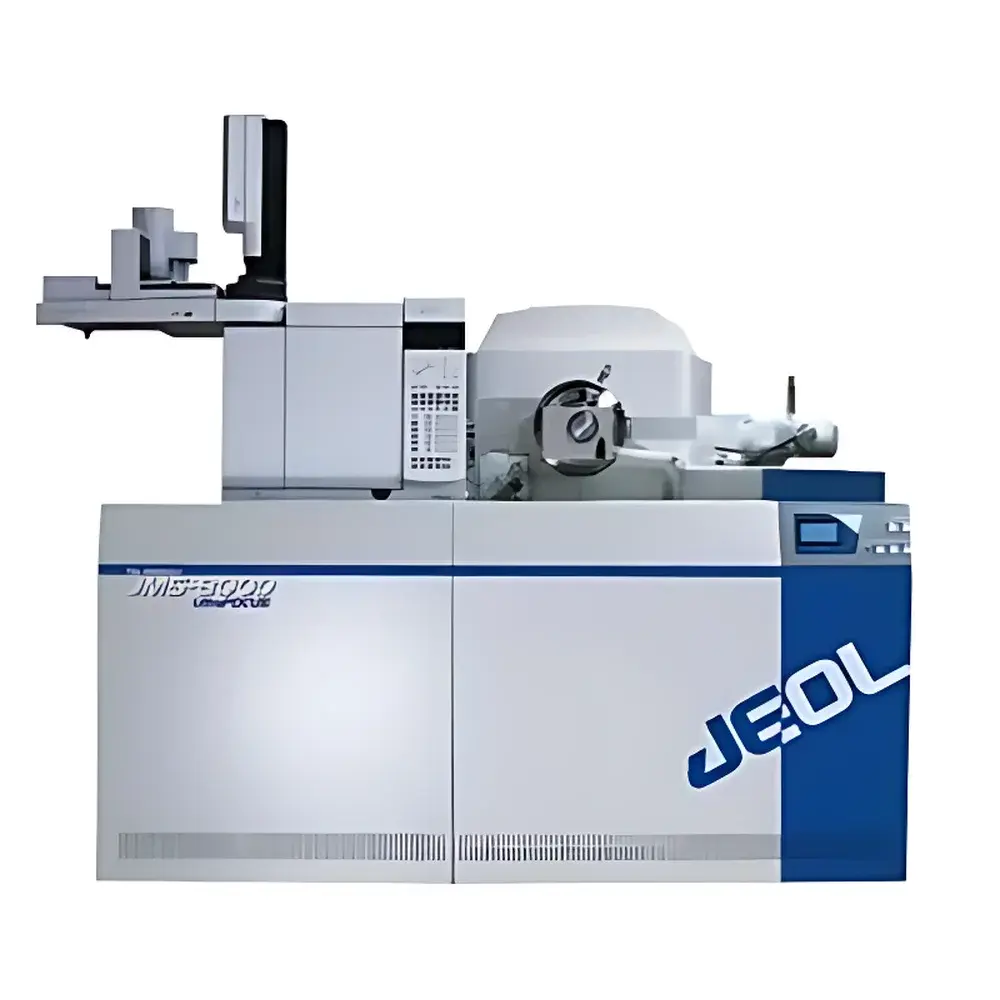
JEOL JMS-800D High-Resolution Magnetic Sector Mass Spectrometer
| Brand | JEOL |
|---|---|
| Origin | Japan |
| Instrument Type | Magnetic Sector Mass Spectrometer |
| Application Focus | Dioxin (PCDD/Fs) Analysis |
| GC Compatibility | Dual-Column Interface |
| Detector | Photomultiplier Tube (PMT) |
| Software | Diok Suite (EPA Method 1613 Compliant) |
| Vacuum Integrity | Column Exchange Without Ion Source Venting |
| Regulatory Alignment | Designed for EPA 1613, EU 2017/771, and ISO 18073 Compliance |
Overview
The JEOL JMS-800D is a high-resolution magnetic sector mass spectrometer engineered specifically for ultra-trace analysis of polychlorinated dibenzo-p-dioxins (PCDDs) and dibenzofurans (PCDFs) in environmental, food, and biological matrices. Operating on double-focusing magnetic sector principles—combining electrostatic and magnetic analyzers—the instrument delivers mass-resolving power exceeding 10,000 (10% valley definition), enabling baseline separation of isobaric congeners critical for congener-specific quantification. Its design prioritizes long-term signal stability, low chemical noise, and robust vacuum architecture—essential attributes for regulatory-grade dioxin reporting where detection limits routinely fall below 0.1 fg on-column. Unlike quadrupole or time-of-flight systems, the JMS-800D’s sector geometry ensures consistent mass accuracy (< 1 ppm RMS error) and exceptional isotopic fidelity across extended acquisition windows, directly supporting compliance with stringent international dioxin monitoring frameworks.
Key Features
- Dual-column gas chromatography interface: Enables simultaneous connection of two capillary GC columns to the ion source without compromising vacuum integrity; column switching or replacement is performed under full high-vacuum conditions, eliminating downtime and source contamination risks.
- Photomultiplier tube (PMT) detector: Replaces conventional electron multipliers to deliver superior signal-to-noise ratio, reduced gain drift over multi-day analyses, and enhanced resistance to saturation during high-abundance ion events—critical for accurate isotope dilution mass spectrometry (IDMS) workflows.
- High-stability magnetic field control: Utilizes temperature-regulated electromagnet with closed-loop flux stabilization, minimizing mass drift during prolonged thermal desorption-GC/MS runs typical in EPA 1613 sample batches.
- Ion source accessibility: Optimized for routine maintenance and cleaning; features rapid-disconnect ion optics and bake-out compatible ceramic insulators to sustain ultra-high vacuum (UHV) performance (< 5 × 10⁻⁸ Torr base pressure).
- Method-embedded hardware calibration: Integrated perfluorotributylamine (PFTBA) and cesium iodide (CsI) calibration sources support automated mass axis validation before each analytical sequence, satisfying GLP audit requirements for traceability.
Sample Compatibility & Compliance
The JMS-800D is validated for solid-phase extraction (SPE), gel permeation chromatography (GPC), and multi-layer silica column cleanup workflows aligned with EPA 1613 revision B and EU Commission Regulation (EU) 2017/771. It accommodates complex extracts from soil, sediment, fish tissue, milk fat, and human serum—matrices requiring rigorous interference removal prior to high-resolution MS detection. All operational parameters—including dwell times, peak width settings, and isotope ratio acceptance windows—are preconfigured in the Diok software to enforce strict adherence to congener identification criteria (e.g., retention time windows ± 0.20 min, isotope ratio tolerances ± 10%). The system supports ¹³C-labeled internal standard addition at sample preparation stage, enabling precise IDMS quantification traceable to NIST SRM 1946 (Lake Michigan Fish Tissue).
Software & Data Management
Diok software provides end-to-end method execution, spectral deconvolution, congener-specific integration, and automated toxic equivalency factor (TEF) weighting per WHO 2005 scheme. It enforces electronic signatures, full audit trails, and version-controlled method templates compliant with FDA 21 CFR Part 11 and ISO/IEC 17025 data integrity requirements. Raw data files (.jms) are stored in vendor-neutral HDF5 format with embedded metadata (instrument configuration, calibration history, operator ID, timestamped QC checks). Batch processing supports parallel analysis of up to 96 samples with auto-report generation in PDF and Excel formats—including summary tables of TEQ concentrations, recovery rates, and method detection limits (MDLs) calculated per CLP guidelines.
Applications
- Regulatory dioxin surveillance in municipal waste incinerator emissions and fly ash
- Compliance testing of animal feed and dairy products under EU Directive 2002/32/EC
- Human biomonitoring studies measuring PCDD/F body burden in adipose tissue and breast milk
- Forensic source apportionment using congener pattern matching and principal component analysis (PCA)
- Validation of novel cleanup protocols for high-fat food matrices (e.g., infant formula, edible oils)
FAQ
What regulatory methods is the JMS-800D validated for?
The system is fully configured for EPA Method 1613, EU Regulation (EU) 2017/771, and ISO 18073:2020, with Diok software preloaded with certified congener libraries and reporting templates.
Can the JMS-800D be used for non-dioxin applications?
While optimized for PCDD/F analysis, its magnetic sector platform supports high-accuracy isotope ratio measurements for other persistent organic pollutants (POPs), including PCBs, PBDEs, and chlorinated pesticides—subject to method development and validation per ISO 17025.
Is remote diagnostics supported?
Yes—JEOL’s SecureLink remote access protocol enables encrypted, auditable technician support with session logging, meeting GLP/GMP remote maintenance documentation standards.
What vacuum pumping configuration does the JMS-800D employ?
A hybrid system comprising turbomolecular pumps (2,000 L/s total speed) backed by dry scroll forepumps ensures stable UHV operation during extended GC temperature programs and minimizes oil backstreaming contamination.
How is detector longevity managed?
The PMT detector operates at reduced gain settings compared to EM detectors, extending service life beyond 5 years under typical EPA 1613 workload (200–300 samples/month); JEOL provides annual gain calibration and quantum efficiency verification services.





