
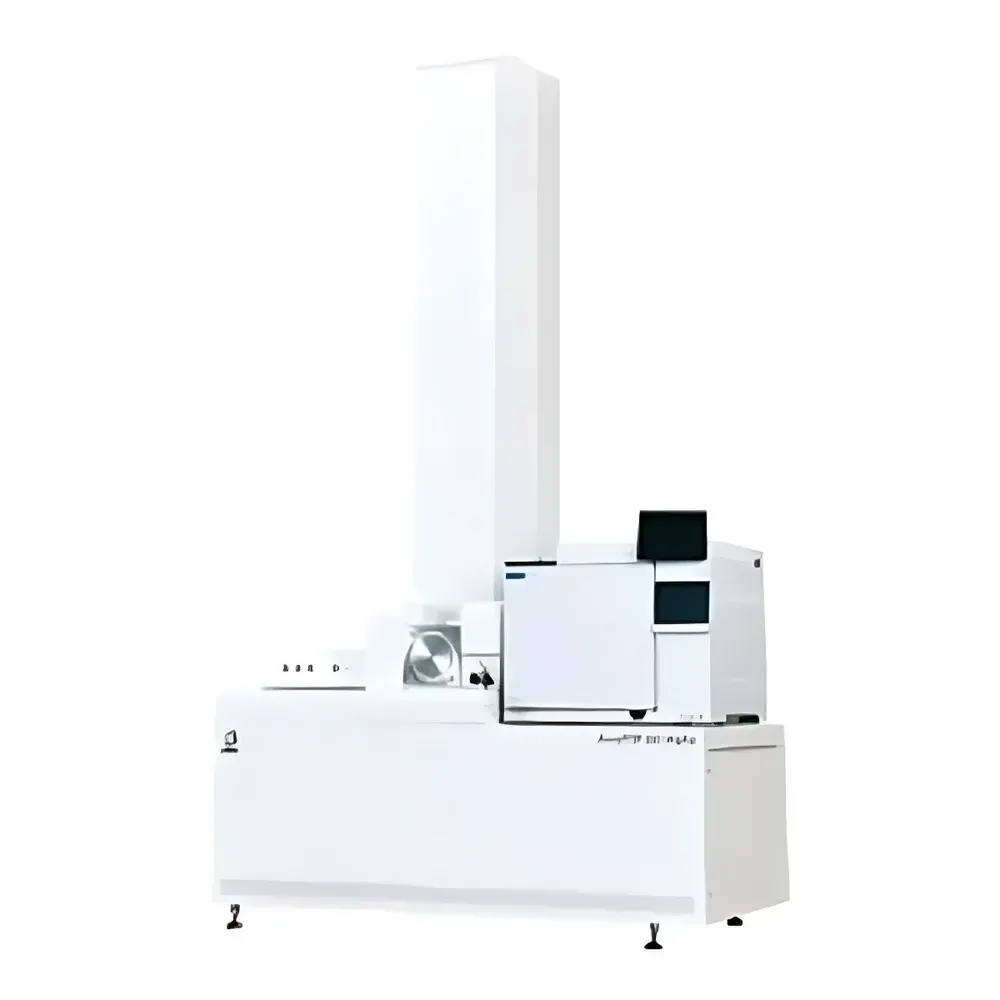
JEOL JMS-T2000GC AccuTOF™ GC-Alpha Time-of-Flight Gas Chromatography Mass Spectrometer
| Brand | JEOL |
|---|---|
| Origin | Japan |
| Model | JMS-T2000GC |
| Type | Time-of-Flight (TOF) GC-MS System |
| Ionization Modes | Electron Ionization (EI), Chemical Ionization (CI), Field Ionization (FI), and Optional Atmospheric Pressure Chemical Ionization (APCI) |
| Mass Accuracy | < 1 ppm (external calibration), < 0.5 ppm (internal lock mass) |
| Mass Resolution | > 10,000 (FWHM, m/z 500) |
| Acquisition Rate | Up to 50 spectra/sec |
| Mass Range | m/z 10–4,000 |
| Detector | Microchannel Plate (MCP) with Delayed Extraction |
| Vacuum System | Dual-stage differential pumping with turbomolecular pumps |
| GC Interface | Direct capillary column coupling with heated transfer line (up to 350 °C) |
| Software | MassCenter™ v5.x with automated deconvolution, library search (NIST, Wiley, JEOL MS Library), and quantitative workflow support |
Overview
The JEOL JMS-T2000GC AccuTOF™ GC-Alpha is a high-performance time-of-flight gas chromatography mass spectrometer engineered for uncompromising mass accuracy, high spectral acquisition speed, and robust quantitative and qualitative analysis of complex organic mixtures. Unlike quadrupole or ion trap systems, the AccuTOF™ platform employs orthogonal acceleration time-of-flight (oa-TOF) mass analysis, enabling simultaneous detection of all ions within a defined mass range without scanning. This architecture delivers true full-spectrum sensitivity, sub-ppm mass accuracy with internal lock-mass correction, and isotopic fidelity essential for elemental composition determination. Designed for laboratories requiring regulatory-grade data integrity—such as environmental testing labs, pharmaceutical QC/QA units, forensic chemistry departments, and academic metabolomics facilities—the system integrates seamlessly with standard GC platforms and supports rigorous analytical workflows compliant with ISO/IEC 17025, USP <1225>, and FDA 21 CFR Part 11 requirements.
Key Features
- Orthogonal acceleration TOF analyzer with delayed extraction for enhanced mass resolution (>10,000 FWHM at m/z 500) and mass accuracy (<0.5 ppm with internal reference)
- Multi-mode ionization capability: standard EI and CI sources, plus optional FI and APCI interfaces—enabling soft and hard ionization strategies for labile and non-volatile compounds
- High-speed acquisition up to 50 full-spectrum scans per second, preserving chromatographic peak shape even for narrow GC peaks (≤0.5 s width)
- Dual-stage vacuum architecture with two independent turbomolecular pumps ensures stable high-vacuum conditions (<5 × 10⁻⁷ Pa) during extended unattended operation
- Heated, low-dead-volume GC interface with programmable transfer line temperature (up to 350 °C) minimizes thermal degradation and adsorption of polar analytes
- Microchannel plate detector with digital signal processing provides linear dynamic range exceeding 4 orders of magnitude
Sample Compatibility & Compliance
The JMS-T2000GC accommodates a broad spectrum of volatile and semi-volatile organic compounds—including pesticides, PAHs, PCBs, flavor/aroma volatiles, residual solvents, and small-molecule metabolites—without derivatization in most cases. Its high mass resolution and accurate mass measurement allow confident distinction between isobaric species (e.g., C7H7+ vs. C6H3N+) and reliable formula assignment at natural abundance levels. The system meets key international compliance benchmarks: it supports audit-trail-enabled data acquisition under GLP/GMP environments, generates raw data files compliant with mzML 1.1 format, and includes electronic signature functionality aligned with FDA 21 CFR Part 11 Annex 11 expectations. Routine performance verification follows ASTM E2983-21 (Standard Practice for Mass Spectral Data Acquisition and Processing) and ISO 17025:2017 clause 7.7 on measurement traceability.
Software & Data Management
MassCenter™ v5.x serves as the unified control, acquisition, and interpretation platform. It features real-time background subtraction, automated peak deconvolution using the proprietary “AccuDeconv” algorithm, and integrated spectral library searching against NIST, Wiley, and JEOL’s proprietary high-resolution MS library. Quantitative modules support internal standard calibration curves, matrix-matched calibration, and isotope dilution mass spectrometry (IDMS) workflows. All raw and processed data are stored in a structured, vendor-neutral SQLite-based project database with configurable backup policies and role-based access control. Audit trails record user actions, parameter changes, and instrument status events with timestamps and operator IDs—fully exportable for regulatory submission.
Applications
- Non-targeted screening of environmental contaminants in water, soil, and air samples
- Residual solvent analysis in pharmaceutical active ingredients per ICH Q3C guidelines
- Flavor profiling and authenticity verification in food and beverage matrices
- Metabolite identification in biological fluids (urine, plasma) for preclinical toxicology studies
- Forensic toxicology screening for novel psychoactive substances (NPS) and designer drugs
- Impurity profiling of synthetic intermediates and final APIs under ICH Q5A and Q3B frameworks
FAQ
What distinguishes AccuTOF™ GC-Alpha from quadrupole GC-MS systems?
Unlike scanning mass analyzers, the oa-TOF architecture captures complete mass spectra at every retention time point—preserving sensitivity across the full mass range and enabling retrospective data mining without re-injection.
Can the system perform quantitative analysis with regulatory acceptance?
Yes—when configured with appropriate calibration standards, internal standards, and validated methods, it supports GLP-compliant quantitation meeting EPA Method 8270, ISO 17025, and pharmaceutical validation guidelines.
Is high-resolution mass data compatible with third-party software?
Raw data exports in mzML format ensure interoperability with open-source tools (e.g., OpenMS, MZmine) and commercial platforms (e.g., Compound Discoverer, Sieve).
How is mass calibration maintained over long-term operation?
Internal lock-mass correction uses a continuously infused reference compound (e.g., cesium iodide cluster ions), providing real-time recalibration without interrupting sample analysis.
What GC oven and inlet configurations are supported?
The system interfaces with all major GC manufacturers (Agilent, Thermo, Shimadzu, PerkinElmer) via industry-standard analog/digital signals and direct column coupling; split/splitless, PTV, and cold-on-column inlets are fully supported.




