
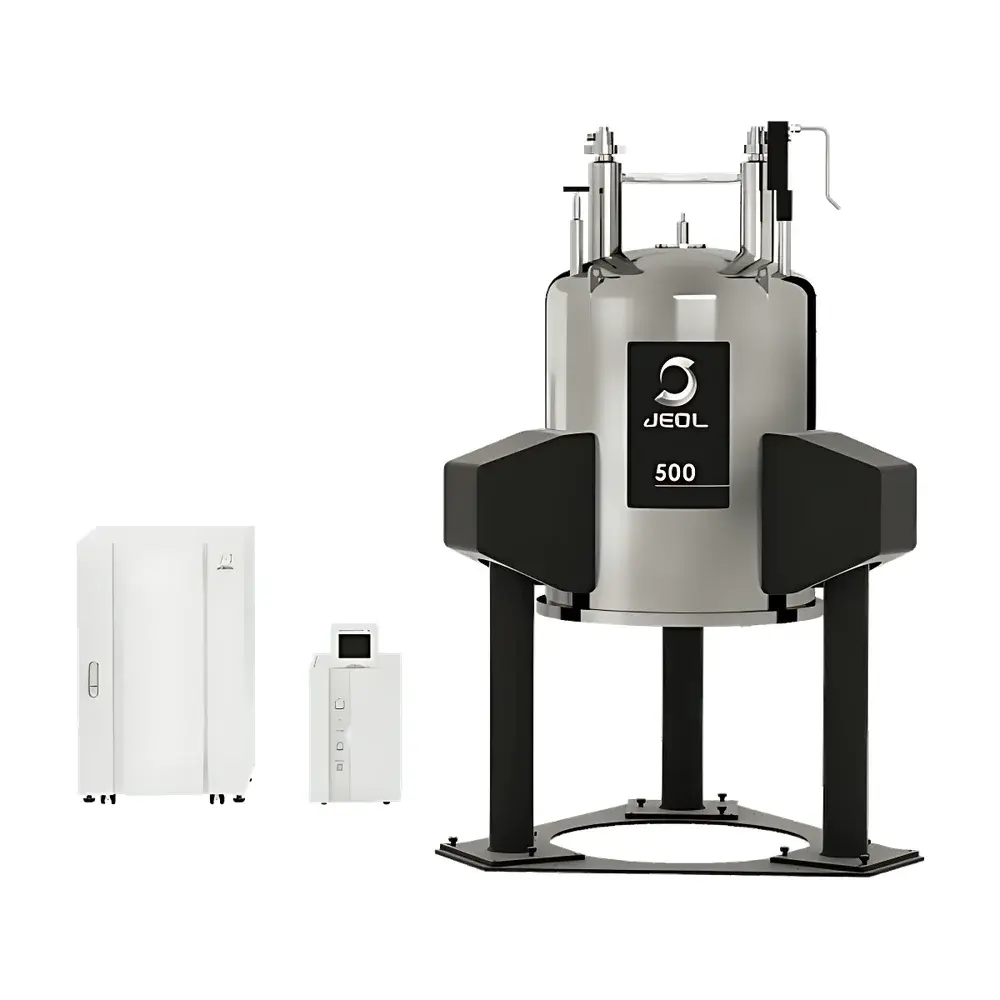
JEOL JNM-ECZL Luminous High-Field Nuclear Magnetic Resonance Spectrometer
| Brand | JEOL |
|---|---|
| Origin | Japan |
| Model | JNM-ECZL Series |
| Sample Type | Solid-Liquid Dual-Mode |
| Instrument Category | High-Field NMR Spectrometer |
| System Architecture | Integrated Smart Transceiver System (STS) |
| Multi-Resonance Capability | Standard Configuration |
| Design Principle | Compact High-Field Platform with Digital RF Control |
Overview
The JEOL JNM-ECZL Luminous is a high-field nuclear magnetic resonance (NMR) spectrometer engineered for advanced chemical structure elucidation, dynamic process monitoring, and quantitative molecular analysis in both solution and solid-state phases. Built upon JEOL’s proprietary Smart Transceiver System (STS), the platform integrates high-speed digital radiofrequency (RF) synthesis, real-time pulse shaping, and ultra-stable field regulation to deliver consistent spectral fidelity across diverse experimental conditions. Unlike conventional high-field systems requiring dedicated infrastructure, the ECZ Luminous achieves field strengths compatible with modern high-resolution NMR applications—typically 400 MHz and above (¹H reference)—within a footprint comparable to mid-field benchtop instruments. Its architecture supports both continuous-wave (CW) and pulsed NMR methodologies, with inherent compatibility for heteronuclear decoupling, cross-polarization (CP), magic-angle spinning (MAS), and multi-dimensional correlation experiments (e.g., COSY, HSQC, HMBC). The system operates under cryogen-free or conventional superconducting magnet configurations depending on field strength specification, with active shielding and shimming optimized for long-term field homogeneity (< 0.1 Hz/h drift).
Key Features
- Smart Transceiver System (STS): Digitally controlled RF generation with sub-nanosecond timing resolution, enabling precise pulse calibration and phase coherence across multi-frequency channels.
- Compact High-Field Design: Maintains mechanical and thermal stability equivalent to full-size high-field platforms while occupying ≤ 1.8 m² floor space—including console, probe, and magnet assembly.
- Solid–Liquid Dual-Mode Operation: Equipped with interchangeable broadband probes supporting both solution-phase high-sensitivity detection and solid-state MAS capabilities (up to 15 kHz spinning speed).
- Multi-Resonance Standard Configuration: Native support for simultaneous excitation and detection across ≥3 nuclei (e.g., ¹H, ¹³C, ¹⁹F, ³¹P) without hardware reconfiguration.
- Automated Field Lock & Shim Optimization: Real-time deuterium lock feedback combined with gradient-based shimming algorithms ensures reproducible line widths (≤ 0.4 Hz for ¹H in DMSO-d₆) over extended acquisition periods.
- Modular Console Architecture: Expandable I/O interfaces compliant with IEEE 1394b and PCIe Gen4, facilitating integration with external detectors, flow cells, or in situ reaction monitoring modules.
Sample Compatibility & Compliance
The JNM-ECZL Luminous accommodates standard 5 mm OD NMR tubes (solution mode), 3.2 mm and 4 mm MAS rotors (solid-state mode), and optional microprobe configurations for limited-volume samples (≥ 15 µL). It complies with ISO/IEC 17025:2017 requirements for analytical instrument validation and supports GLP/GMP documentation workflows via audit-trail-enabled acquisition software. All pulse sequences adhere to ASTM E2857-22 (Standard Guide for NMR Data Acquisition and Processing) and are validated against NIST SRM 1993 (Quantitative NMR Reference Material). Regulatory-ready features include electronic signatures, user-access tiering, and 21 CFR Part 11-compliant data archiving when deployed with JEOL’s Delta v5.5+ software suite.
Software & Data Management
Control and processing are managed through JEOL’s Delta software platform, version 5.5 or later, featuring a modular GUI with scriptable automation (Python 3.9 API), batch processing queues, and integrated spectral simulation tools (including DFT-based chemical shift prediction). Raw FID data is stored in vendor-neutral JCAMP-DX format with embedded metadata (pulse sequence, temperature, field strength, shim values). The system supports direct export to Bruker TopSpin (.fid), MestReNova (.mnova), and NMRPipe-compatible formats. Networked deployment enables centralized license management, remote diagnostics, and secure cloud backup via TLS 1.3–encrypted SFTP or WebDAV protocols. Audit logs record all parameter modifications, user logins, and acquisition events with timestamped digital signatures.
Applications
- Structural characterization of organic small molecules, natural products, and synthetic polymers using ¹H/¹³C/¹⁵N multidimensional NMR.
- Quantitative analysis of pharmaceutical formulations (Q-NMR) per USP and ICH Q2(R2) guidelines.
- In-depth investigation of molecular dynamics in amorphous solids, battery electrolytes, and catalyst frameworks via ²H, ⁷Li, and ²⁹Si MAS-NMR.
- Reaction monitoring in flow NMR setups with sub-second temporal resolution using triggered acquisition and real-time Fourier transformation.
- Metabolite profiling in biofluids using targeted ¹H-NMR with Chenomx-based spectral fitting and statistical validation (PCA, PLS-DA).
FAQ
What magnetic field strengths are available for the JNM-ECZL series?
The JNM-ECZL platform is configured for 400 MHz, 500 MHz, and 600 MHz ¹H operating frequencies, with custom 700 MHz variants available upon request. Field strength selection determines magnet type (cryogen-free or liquid helium-cooled) and probe optimization.
Does the system support automated sample changers?
Yes—JEOL offers the AutoSample-60 robotic sample handler, compatible with 5 mm tubes and 3.2 mm MAS rotors, with temperature control from –40 °C to +150 °C.
Is solid-state NMR capability included by default?
Solid-state functionality is standard, including a 3.2 mm MAS probe with variable-temperature control (VT) and stroboscopic spinning synchronization. Additional MAS rotor sizes (2.5 mm, 4 mm) are optional.
How is spectral calibration performed?
Internal referencing uses TMS (δ = 0.00 ppm) for ¹H/¹³C; external references (e.g., DSS) are supported. Frequency calibration is traceable to cesium atomic clocks and verified daily via ²H lock signal stability.
Can third-party pulse sequences be imported?
Yes—the Delta software accepts Bruker TopSpin .seq files and allows modification via its built-in pulse sequence editor, with full hardware parameter mapping and safety interlock validation.
Related Products






