
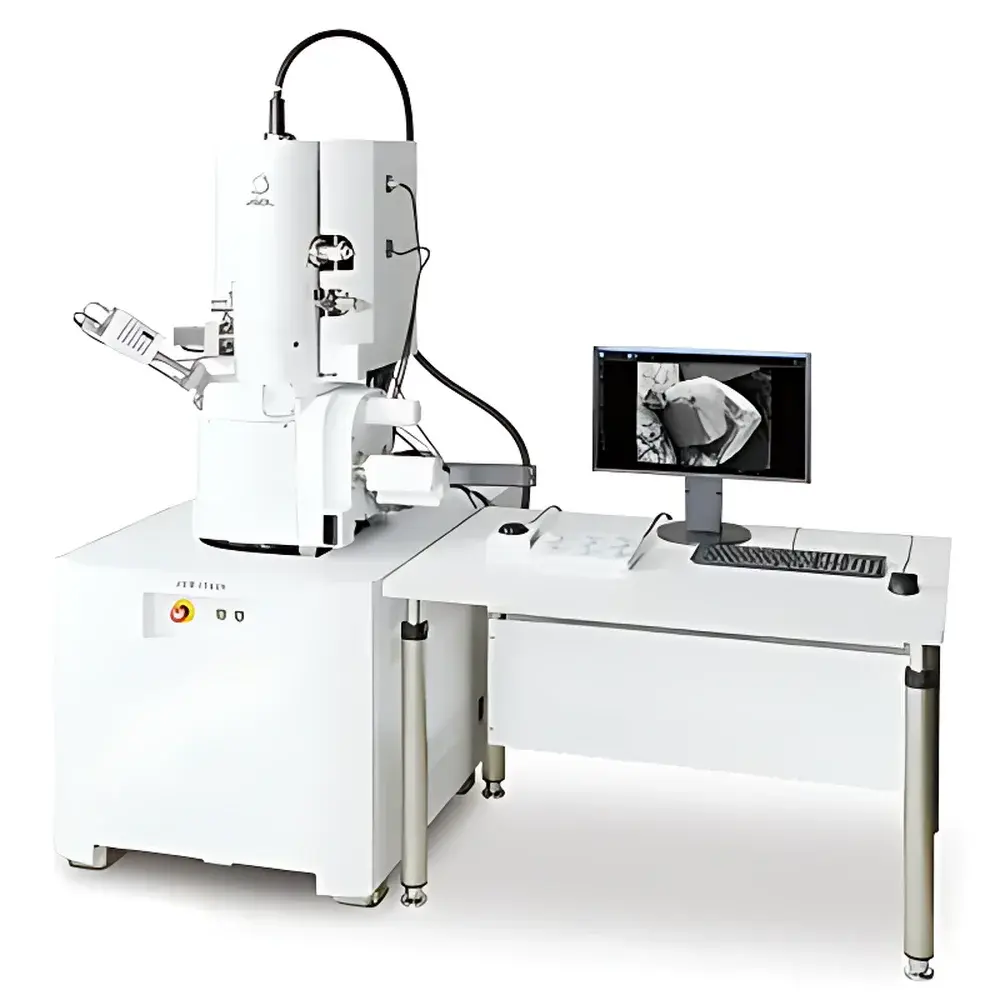
JEOL JSM-IT800 Ultra-High-Resolution Thermal Field-Emission Scanning Electron Microscope
| Brand | JEOL |
|---|---|
| Origin | Japan |
| Model | JSM-IT800 |
| Instrument Type | Floor-Standing SEM |
| Electron Source | Thermal Field-Emission Gun (TFEG) |
| Secondary Electron Resolution | 0.6 nm @ 15 kV, 0.7 nm @ 1 kV |
| Backscattered Electron Resolution | 1.5 nm |
| Accelerating Voltage Range | 0.01–30 kV |
| Maximum Magnification | 2,000,000× (real) |
| Specimen Diameter Capacity | 150 mm |
| Stage Type | 5-Axis Motorized Precision Stage |
| Detector Configuration | In-lens SE detector, upper-stage BSE detector, optional EDS/WDS integration |
| Beam Current | ≥300 nA @ 15 kV |
| Objective Lens Design | Super Hybrid Objective Lens (Magnetic-Field-Free) |
Overview
The JEOL JSM-IT800 is a floor-standing, ultra-high-resolution thermal field-emission scanning electron microscope engineered for nanoscale imaging and microanalysis in demanding research and industrial laboratories. Utilizing a high-brightness thermal field-emission electron gun (TFEG), the system delivers exceptional beam stability, long-term emission consistency, and reduced energy spread—critical for high signal-to-noise imaging at low accelerating voltages and high spatial resolution. Its proprietary Super Hybrid Objective Lens eliminates magnetic field leakage around the specimen, enabling artifact-free observation of magnetic materials without deflection or domain distortion. This design also supports simultaneous multi-detector acquisition (SE, BSE, STEM-in-SEM) with minimal aberration across the full magnification range—from 25× to 2,000,000×—making it suitable for both routine quality control and advanced materials characterization.
Key Features
- Thermal field-emission electron source offering superior brightness and beam current stability (>300 nA at 15 kV), enabling high-speed mapping and quantitative EDS analysis without compromising resolution.
- Sub-nanometer secondary electron resolution: 0.6 nm at 15 kV and 0.7 nm at 1 kV—validated per ISO 16700:2016 methodology—ensuring reliable imaging of beam-sensitive polymers, biological coatings, and insulating ceramics.
- Magnetic-field-free imaging environment achieved via the Super Hybrid Objective Lens, permitting direct examination of ferromagnetic thin films, permanent magnets, and spintronic devices without sample demagnetization or image distortion.
- 5-axis motorized precision stage with ±90° tilt, 360° rotation, and sub-micron repeatability—fully programmable for automated multi-site acquisition and tilt-series tomography workflows.
- Modular chamber architecture featuring multiple standardized ports (e.g., Gatan, Oxford, EDAX compatible) for seamless integration of EDS, WDS, EBSD, CL, and in-situ heating/cooling stages.
- Optimized vacuum system with differential pumping stages maintains <2×10⁻⁷ Pa in the gun chamber and <5×10⁻⁴ Pa in the sample chamber during operation—ensuring extended TFEG lifetime and minimal contamination.
Sample Compatibility & Compliance
The JSM-IT800 accommodates specimens up to 150 mm in diameter and 50 mm in height, supporting standard SEM stubs, wafer carriers, and custom holders. Its low-voltage capability (down to 10 V) and beam deceleration mode enable charge-free imaging of non-conductive samples—including oxides, glasses, and biological tissues—without metal coating. The instrument complies with IEC 61000-6-3 (EMC emissions) and IEC 61000-6-2 (immunity), and its software architecture supports audit trails, user access levels, and electronic signatures required under FDA 21 CFR Part 11 and ISO/IEC 17025-accredited laboratory environments. Optional environmental SEM (ESEM) mode allows partial pressure operation for hydrated or outgassing specimens.
Software & Data Management
Acquisition and analysis are managed through JEOL’s SmartSEM™ platform—a Windows-based application supporting real-time image stitching, particle analysis (ISO 13322-2 compliant), grain size distribution (ASTM E112), and automated feature recognition. All raw data are stored in TIFF/DM3 formats with embedded metadata (accelerating voltage, working distance, dwell time, detector settings). The system logs every operational parameter and user action in an encrypted, tamper-evident audit trail, meeting GLP/GMP documentation requirements. Remote monitoring and diagnostic capabilities allow service engineers to perform predictive maintenance via secure TLS-encrypted connections.
Applications
- Advanced semiconductor metrology: trench depth profiling, gate oxide integrity assessment, and defect localization on 5 nm node wafers.
- Materials science: crystallographic contrast analysis of Ni-based superalloys, interfacial segregation mapping in solid-state battery cathodes, and nanoparticle dispersion quantification in polymer composites.
- Geosciences: clay mineral identification via BSE Z-contrast imaging combined with integrated WDS, and pore-network reconstruction from FIB-SEM serial sections.
- Life sciences: correlative light-electron microscopy (CLEM) workflows using fiducial marker alignment, and cryo-SEM of vitrified tissue sections with controlled sublimation.
- Failure analysis labs: cross-sectional imaging of solder joint intermetallics, delamination detection in multilayer PCBs, and contamination source tracing via EDS spectral deconvolution.
FAQ
What vacuum level is maintained in the electron gun chamber during operation?
The thermal field-emission gun operates under ultra-high vacuum conditions, typically ≤2×10⁻⁷ Pa, sustained by a combination of ion pumps and non-evaporable getter (NEG) elements.
Can the JSM-IT800 be configured for automated batch analysis of production samples?
Yes—the SmartSEM™ software supports script-driven acquisition sequences, stage positioning macros, and pass/fail threshold logic for fully unattended inspection of wafers, filters, or catalyst pellets.
Is the system compatible with third-party EDS detectors and spectrum processing packages?
All JEOL SEMs conform to the EDAX/AMETEK and Oxford Instruments hardware interface standards; spectral data export adheres to the ISO 14971-compliant .eds and .raw formats for interoperability with DTSA-II, AZtec, and HyperMap.
How does the Super Hybrid Objective Lens improve imaging of magnetic materials?
By eliminating stray magnetic fields at the specimen position, it prevents Lorentz deflection of low-energy secondary electrons and preserves intrinsic magnetic domain contrast—enabling direct observation of domain wall dynamics without external field compensation.
What is the typical service interval for the thermal field-emission gun?
Under normal operating conditions (≤8 h/day, clean vacuum environment), the TFEG requires no filament replacement for ≥18 months; JEOL recommends quarterly performance verification using certified reference standards (e.g., NIST SRM 2090).




