
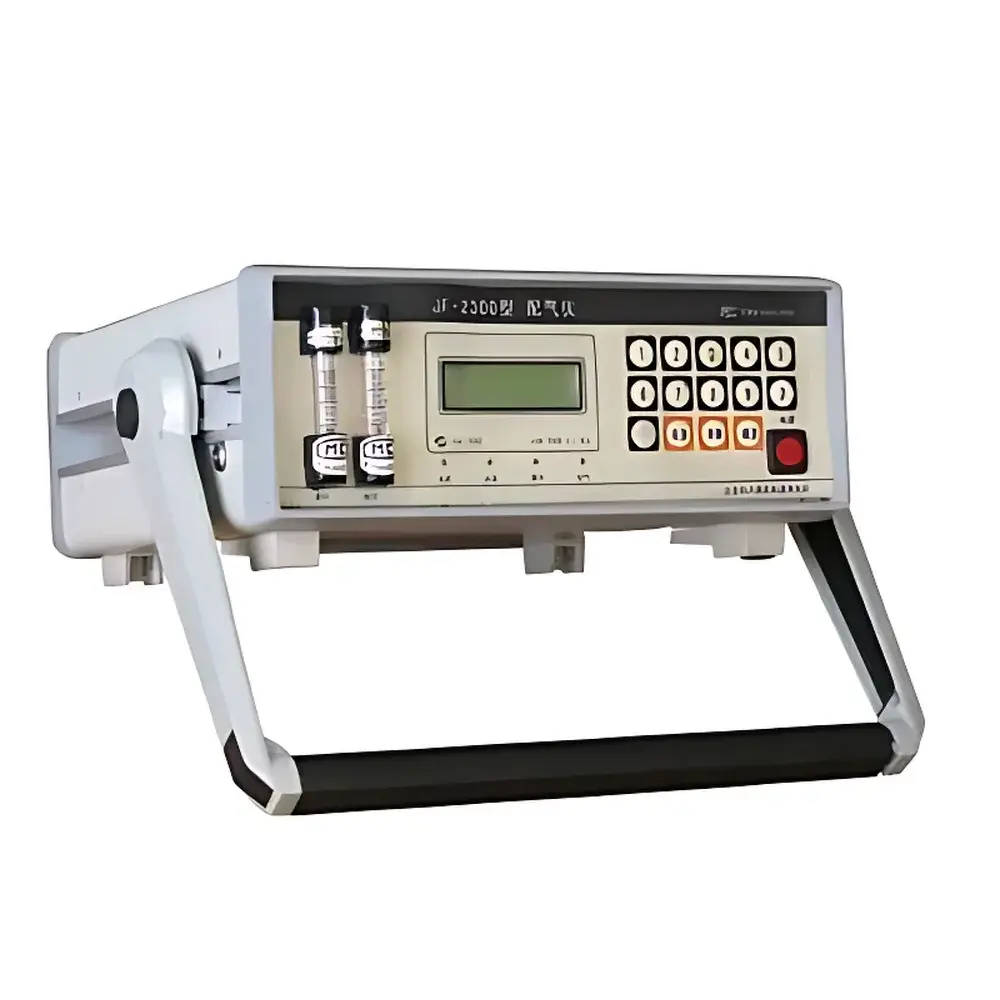
JF-2300 Portable Gas Dilution Pump by Junfang Physical Chemistry
| Brand | Junfang Physical Chemistry |
|---|---|
| Origin | Beijing, China |
| Model | JF-2300 |
| Operating Temperature | 0–50 °C |
| Relative Humidity | 40–90 % RH |
| Power Supply | AC 220 V ±10 %, 50 Hz |
| Gas Mixing Accuracy | ±1 % of set value |
| Concentration Range | 0–100 % (adjustable continuously) |
| Repeatability | ≤0.5 % |
| Stability | ≤±1 % F.S. |
| Linearity Error | ≤±1 % of set value |
| Response Time | ≤5 s |
| Flow Rate | 0.5–1.0 L/min |
Overview
The JF-2300 Portable Gas Dilution Pump is a microprocessor-controlled, digitally regulated gas mixing system engineered for high-fidelity calibration gas generation in laboratory, industrial, and field-deployable environments. Based on the principle of precision mass flow control and dynamic proportional blending, the instrument delivers traceable, stable, and repeatable gas mixtures by diluting a primary standard gas (e.g., CO, NO, SO₂, CH₄, or O₂ in balance air/N₂) with a zero-grade carrier gas. Unlike fixed-ratio gas generators or manual syringe-based dilution methods, the JF-2300 employs dual thermal mass flow controllers (MFCs) with real-time feedback compensation to maintain stoichiometric consistency across its full 0–100 % concentration range. Its compact, battery-compatible chassis enables mobile deployment for on-site analyzer verification—critical for environmental monitoring stations, emissions testing labs, and process safety audits where portability and metrological integrity must coexist.
Key Features
- Microprocessor-driven dual-MFC architecture ensures continuous, stepless concentration adjustment from 0.1 % to 100 % of input standard gas
- Real-time digital display with intuitive membrane keypad interface for rapid parameter entry and operational status monitoring
- Integrated pressure regulation and back-pressure compensation to minimize flow-induced concentration drift
- Response time ≤5 seconds for 90 % step-change recovery, enabling efficient multi-point calibration sequences
- Repeatability ≤0.5 % and accuracy ±1 % of set value—validated per ISO 6145-7 (gas mixture preparation by dynamic volumetric method)
- Rugged aluminum alloy housing rated IP54 for dust and splash resistance; designed for benchtop, cart-mounted, or handheld use
- Compliant with electromagnetic compatibility requirements per IEC 61326-1 for laboratory instrumentation
Sample Compatibility & Compliance
The JF-2300 supports inert and reactive gases compatible with stainless-steel wetted parts (316L SS), including but not limited to CO, CO₂, NO, NO₂, SO₂, NH₃, H₂S, CH₄, O₂, and hydrocarbon standards in air or nitrogen matrices. It is unsuitable for corrosive gases (e.g., Cl₂, HF, HCl above 10 ppm), condensable vapors, or particulate-laden streams without upstream filtration. The system meets functional requirements outlined in EPA Method 205 (calibration gas preparation), ASTM D6866 (biogenic carbon analysis support), and ISO 17025-accredited calibration workflows. While not certified as a Class I, Div. 1 hazardous area device, it may be operated in non-classified zones under ambient laboratory conditions (0–50 °C, 40–90 % RH).
Software & Data Management
The pump operates autonomously via front-panel controls but also features an RS-232 serial interface for optional computer integration using ASCII command protocol. Third-party software (e.g., LabVIEW, Python pySerial, or custom SCADA modules) can initiate sequence runs, log timestamped concentration/flow data, and generate audit-ready CSV reports. All configuration parameters—including setpoints, flow profiles, and calibration coefficients—are stored in non-volatile memory with write-protection logic to prevent accidental overwrites. While the JF-2300 does not implement FDA 21 CFR Part 11 electronic signature functionality natively, its deterministic behavior and traceable output enable integration into GLP/GMP-compliant validation protocols when paired with external data acquisition systems that provide audit trail, user access control, and electronic record retention.
Applications
- Multi-point linearity and span verification of electrochemical, NDIR, PID, and chemiluminescence gas analyzers
- Field calibration of portable emission measurement systems (PEMS) and ambient air quality monitors (AQMs)
- Preparation of intermediate calibration standards for GC-FID, GC-TCD, and FTIR spectroscopy
- Performance testing of gas detection tubes, fixed toxic gas sensors, and leak detection equipment
- Method development and uncertainty budgeting per ISO/IEC 17025 Clause 7.7 for accredited calibration laboratories
- Training and proficiency testing for environmental technicians and QA/QC personnel
FAQ
What gases are compatible with the JF-2300?
The pump is validated for use with common calibration gases such as CO, NO, SO₂, CH₄, O₂, CO₂, and NH₃ diluted in air or nitrogen. Corrosive, oxidizing, or condensable gases require prior consultation with technical support.
Can the JF-2300 be used in explosion-hazardous areas?
No—it is not intrinsically safe or ATEX-certified. Operation is restricted to non-hazardous, well-ventilated laboratory or outdoor environments.
Does the instrument require annual recalibration?
Yes. To maintain stated accuracy and traceability, biannual verification against NIST-traceable reference standards is recommended, with full recalibration every 12 months per ISO/IEC 17025 guidelines.
Is remote control via USB or Ethernet supported?
Only RS-232 serial communication is provided. USB-to-serial adapters or Ethernet-to-serial gateways may be used externally, but native USB/Ethernet interfaces are not integrated.
How is flow stability maintained during pressure fluctuations in the supply lines?
Internal pressure transducers and closed-loop MFC firmware dynamically adjust valve actuation to compensate for inlet pressure variations up to ±15 % of nominal supply pressure (typically 0.1–0.3 MPa).



