
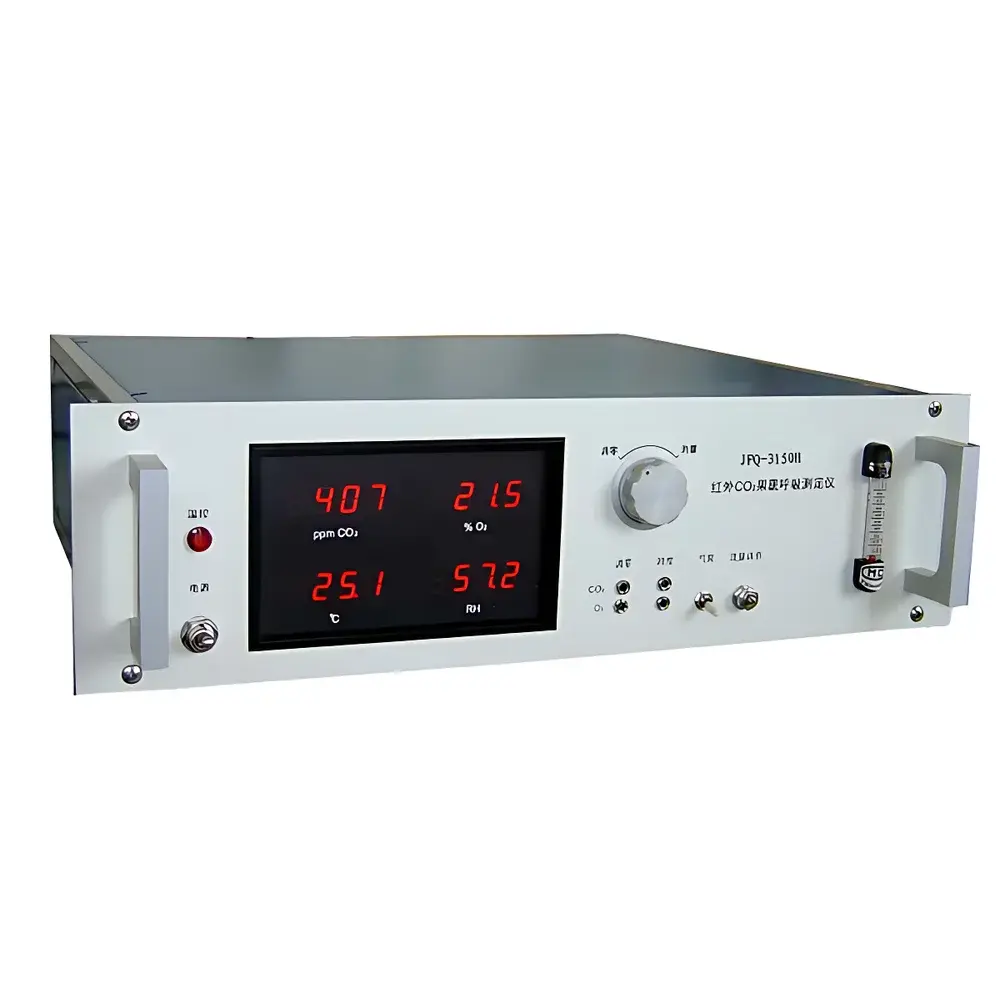
JFQ-3150H Fruit and Vegetable Respiration Rate Analyzer by Junfang Physical & Chemical
| Brand | Junfang Physical & Chemical |
|---|---|
| Origin | Beijing, China |
| Model | JFQ-3150H |
| Respiratory Chamber Options | Φ100×140 mm and Φ150×250 mm |
| Simultaneous Measurement | CO₂ concentration, O₂ concentration, temperature, relative humidity |
| Dual Respiration Calculation Modes | CO₂ evolution rate and O₂ consumption rate |
| Application Environment | Ambient storage, cold storage, controlled atmosphere (CA) storage, retail refrigerated display units |
Overview
The JFQ-3150H Fruit and Vegetable Respiration Rate Analyzer is an engineered solution for quantitative assessment of postharvest physiological activity in horticultural commodities. It operates on the principle of closed-system gas exchange analysis, measuring real-time changes in CO₂ accumulation and O₂ depletion within a sealed, temperature- and humidity-controlled respiration chamber. This dual-gas differential method enables calculation of respiration rate—expressed either as µmol CO₂·kg⁻¹·h⁻¹ or µmol O₂·kg⁻¹·h⁻¹—providing physiologically relevant metrics aligned with internationally accepted protocols (e.g., ISO 22030:2020, ASTM F2716-21). Designed for use across diverse storage environments—including ambient warehouses, refrigerated chambers (0–15 °C), controlled atmosphere facilities (O₂: 1–5%, CO₂: 1–10%), and commercial retail chillers—the instrument supports non-destructive, repeated measurements on intact produce without tissue disruption.
Key Features
- Modular respiration chamber system with two standard configurations: Φ100 mm × 140 mm (1.1 L) and Φ150 mm × 250 mm (4.4 L), enabling optimization of chamber-to-sample volume ratio for improved gas equilibrium time and measurement reproducibility
- Simultaneous, synchronized detection of CO₂ (NDIR sensor, range 0–5% v/v, resolution 0.01% v/v), O₂ (electrochemical cell, range 0–25% v/v, resolution 0.01% v/v), temperature (PT100, ±0.2 °C), and relative humidity (capacitive sensor, 10–95% RH, ±2% RH)
- Dual-respiration mode calculation: automatic derivation of respiration rate from either CO₂ production kinetics or O₂ consumption kinetics, with user-selectable normalization per unit fresh mass (g or kg) or surface area (m²)
- Integrated environmental stabilization: active chamber temperature control (±0.5 °C) and passive humidity equilibration to minimize condensation and metabolic artifact during extended assays (up to 72 h)
- Robust industrial-grade architecture: aluminum alloy chassis, IP54-rated enclosure, and EMI-shielded electronics suitable for laboratory, cold room, and field-deployable settings
Sample Compatibility & Compliance
The JFQ-3150H accommodates whole fruits (e.g., apples, pears, tomatoes, citrus), leafy vegetables (e.g., spinach, lettuce), root crops (e.g., carrots, potatoes), and cut produce (e.g., sliced melon, pre-cut salad blends), provided sample dimensions fit within chamber volume constraints. Chamber sealing integrity is verified via automated leak-check routine prior to each assay. Data acquisition and reporting comply with GLP-aligned documentation practices: timestamped raw sensor outputs, operator ID logging, chamber ID tracking, and audit-ready CSV export. While not certified under FDA 21 CFR Part 11, the system supports manual signature logs and version-controlled protocol templates compatible with internal QA/QC workflows in food safety laboratories and academic research units adhering to ISO/IEC 17025 requirements.
Software & Data Management
The analyzer connects via USB 2.0 to Windows-based acquisition software (v3.2+), providing real-time graphical overlay of all four parameters, customizable alarm thresholds (e.g., CO₂ > 3.5% triggers auto-termination), and automated respiration rate fitting using first-order exponential decay models. Export formats include .csv (for Excel, R, or Python analysis), .pdf summary reports (with chamber ID, sample weight, ambient conditions, and calculated rates), and .xlsx templates pre-formatted for submission to USDA Postharvest Technology Research databases. Software includes built-in calibration wizards for CO₂ and O₂ sensors, traceable to NIST-traceable reference gases (certified 2.00% CO₂/N₂ and 20.9% O₂/N₂ standards).
Applications
- Evaluation of harvest maturity indices and optimal picking windows based on respiratory climacteric profiling
- Validation of modified atmosphere packaging (MAP) film permeability and headspace gas stability over shelf life
- Comparative assessment of precooling methods (hydrocooling vs. forced-air cooling) on metabolic suppression efficacy
- Screening of postharvest treatments (1-MCP, ethanol vapor, chitosan coatings) for respiration inhibition potency
- Curriculum-integrated teaching modules in postharvest physiology, food engineering, and supply chain management courses
- Supporting HACCP plan development through quantification of spoilage-associated metabolic acceleration under abuse conditions (e.g., temperature fluctuation in cold chain)
FAQ
What sample mass is recommended for reliable respiration rate calculation?
For fruits ≥50 g and vegetables ≥100 g, minimum chamber headspace-to-sample volume ratio of 2:1 is advised to ensure adequate gas mixing and signal-to-noise ratio. Smaller samples require the Φ100 mm chamber.
Can the instrument operate inside a walk-in cold room at 2 °C?
Yes—the electronics are rated for 0–35 °C ambient operation, and the chamber’s thermal mass ensures stable internal conditions even during brief door openings. Optional external dew-point controller recommended for high-humidity CA rooms.
Is third-party calibration service available?
Junfang Physical & Chemical provides annual recalibration services traceable to CNAS-accredited labs; users may also perform in-house verification using certified gas standards.
How is respiration rate normalized when sample weight changes due to water loss?
Software allows input of initial and final fresh weights; rate calculations default to initial mass unless user selects dynamic normalization, which applies linear interpolation between weighings.
Does the system support remote monitoring via Ethernet or Wi-Fi?
No—USB-only connectivity is implemented to maintain signal integrity and eliminate network-induced latency in time-critical gas kinetic measurements.




